
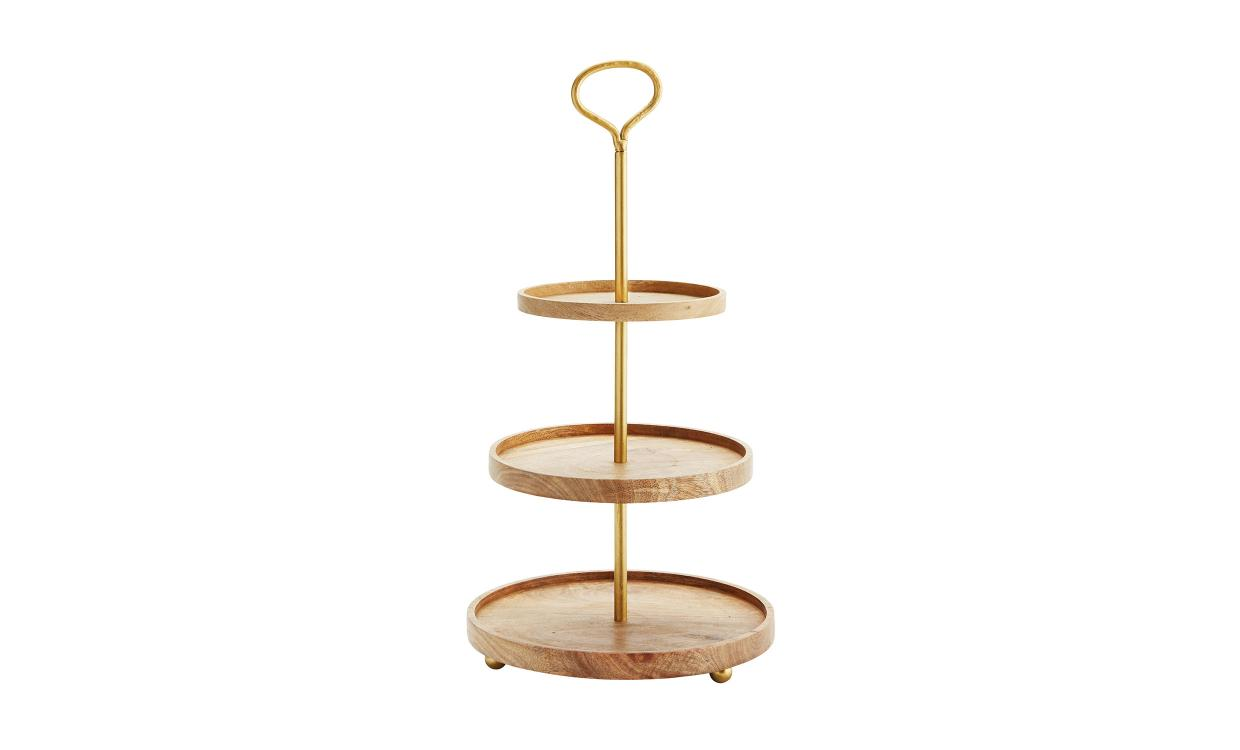
A three-tier stand may look like a simple product, but its intended use can change the entire wholesale specification.
A decorative stand displaying candles and small accessories is not necessarily suitable for serving cakes or other unwrapped food. Even when two products share the same shape, their material, finish, cleaning, structural, and regulatory requirements may differ.
For buyers researching three tier serving stand wholesale, the first question should therefore be: What exactly will customers place on the trays?
Answering that question before requesting samples can prevent costly product-development mistakes.
One Product Shape, Two Different Retail Promises
Imagine a European home décor buyer discovering an attractive three-tier wooden stand with a gold-tone center post.
The stand could fit two retail departments.
In the home accessories section, it might display candles, small decorative objects, or packaged gifts.
In the dining section, customers might expect to use it for pastries, fruit, or afternoon tea.
The appearance is nearly identical. The customer’s expectations are not.
If the retailer markets the product as suitable for direct food contact, the supplier needs to provide appropriate material and compliance information.
If it is intended only for decorative use, the product description should communicate that limitation clearly.
This is an illustrative buying scenario, not a reported customer project.
Decorative Display Stand vs. Food Serving Stand
The commercial differences extend beyond the product’s name.
| Buying Requirement | Decorative Display Stand | Food Serving Stand |
|---|---|---|
| Primary use | Displaying home accessories | Presenting food and dining items |
| Surface priority | Appearance and finish durability | Suitability for intended food contact and cleaning |
| Material review | Strength, appearance, surface quality | Relevant food-contact requirements in addition to performance |
| Structural review | Stability under decorative loads | Stability under specified serving loads and foreseeable handling |
| Cleaning | Appropriate surface-care instructions | Cleaning method suited to intended food use |
| Product information | Decorative-use description | Clear permitted uses, restrictions and care guidance |
A third arrangement is also possible: the stand supports separate dishes or plates rather than food placed directly on its surfaces.
That distinction can influence the product specification, but it does not automatically remove every applicable food-contact consideration.
Buyers should define foreseeable contact conditions before making a compliance decision.
Why Food-Contact Requirements Change the Sourcing Brief
Food-contact safety is not something a buyer can determine from a photograph or a polished surface.
For products entering the European Union, Regulation (EC) No 1935/2004 establishes general requirements for materials and articles intended to contact food.
The European Commission explains that food-contact materials must not transfer constituents to food at levels that endanger health or unacceptably affect its composition, taste, or smell.
Additional material-specific and national requirements may apply.
Buyers can review the European Commission’s food-contact legislation guidance when preparing EU sourcing specifications.
For the United States, the FDA’s food-contact materials guidance provides a separate regulatory reference.
The important commercial distinction is that decorative appearance and food-contact suitability are not interchangeable.
A walnut-colored wooden tray, for example, may use a stain, protective coating, adhesive, or finishing treatment that requires further evaluation before the product can be marketed for direct food service.
Likewise, a gold-tone metal component should not automatically be described as food-safe merely because the surface looks durable.
Buyers should request information relevant to the actual materials, finishing system, destination market, and intended conditions of use.
Teruier’s Three-Tier Design: Structure Matters Before Decoration
Teruier has previously discussed a three-tier serving stand concept combining walnut-toned trays with a removable champagne-gold center structure.
In its article From One Mirror to a Coordinated Home Décor Collection, Teruier describes how a fixed center structure was reconsidered in favor of a removable arrangement to improve packing efficiency.
This example illustrates an important product-development trade-off.
A fixed construction may simplify certain assembly requirements but occupy more carton space.
A removable structure can potentially reduce shipping volume, while introducing additional questions about assembly instructions, component fit, and the stability of the finished product.
Neither approach is automatically superior.
The right decision depends on the agreed construction, expected loads, manufacturing methods, and packaging requirements.
The published design discussion is not, by itself, proof that a particular serving stand has obtained food-contact approval or passed specified performance tests.
What Buyers Should Check on Physical Samples
For home décor product samples, appearance approval should be only one part of the evaluation.
Stability and Tray Spacing
The assembled stand should remain stable under its specified loading conditions.
Buyers need to review the spacing between tiers, the usable tray area, and whether the assembled structure remains level.
The proposed load should be defined rather than estimated from appearance.
Assembly and Replacement Components
For a removable center-post design, assembly should be straightforward and repeatable.
Check whether fittings align properly, connections remain secure during intended use, and small components can be identified and replaced.
If the top handle is intended for lifting a loaded stand, that use requires specific evaluation. A decorative handle should not automatically be treated as a carrying handle.
Materials, Edges, and Surface Care
Check tray edges, surface uniformity, coating condition, and any exposed connection points.
For a stand intended to hold food, the buyer should also establish the permitted cleaning method, contact conditions, and relevant supporting documentation.
Packaging
Ask for assembled and packed dimensions, component protection, carton weight, and the packing configuration.
A compact carton may reduce shipping volume, but it should not come at the expense of damaged trays or missing assembly parts.
Two RFQs for the Same Visual Design
One practical improvement in supplier evaluation is to separate the sourcing request according to the intended use.
| RFQ Detail | Decorative Version | Food-Serving Version |
|---|---|---|
| Product purpose | Home accessories display | Food presentation |
| Material specification | Decorative construction and finish | Materials suitable for defined food-contact conditions |
| Sample assessment | Appearance, assembly and stability | Appearance, assembly, stability, cleaning and relevant contact requirements |
| Documentation | Product specifications and care information | Product specifications plus applicable compliance evidence |
| Packaging | Protection of finish and components | Protection plus appropriate use and care information |
The buyer should also state the destination market, desired dimensions, anticipated order quantity, and packaging format.
These two versions may require different quotations, even if the finished products look similar.
A supplier that understands the distinction can identify technical questions before the buyer commits to production.
What Buyers Should Expect From a Sourcing Partner
A useful B2B sourcing guide should help buyers look beyond the initial sample.
For a three-tier stand, supplier discussions should cover material selection, intended use, structural design, sample inspection, manufacturing consistency, and final product information.
Teruier’s product-development approach connects international buyer requirements with design and manufacturing resources in Fuzhou–Minhou, China.
Its experience coordinating wood components, metal fittings, decorative finishes, and packaging provides a basis for discussing different product configurations.
However, the availability of any particular material specification, food-contact documentation, or approved production version must be confirmed for the selected model.
That is especially important when a decorative product is being reconsidered for a functional dining application.
FAQ
Can a decorative three-tier stand be used to serve food?
Not automatically. Buyers should confirm its intended use, materials, finishes, cleaning requirements, and applicable food-contact conditions. A decorative product should not be marketed for direct food contact without appropriate supporting evidence.
Is a removable three-tier stand better for wholesale shipping?
It may reduce packed volume, but assembly reliability, component protection, and stability must also be evaluated. The commercial benefit depends on actual carton measurements and shipping arrangements.
What information should buyers request before sample development?
Provide the intended use, target market, dimensions, materials, tray spacing, loading expectations, packaging requirements, and estimated quantity. Confirm what technical documents and testing evidence are necessary before approving the final product.
Discuss Your Three-Tier Stand Requirements With Teruier
A successful serving stand begins with a clear product definition.
Before choosing the finish, handle, or packaging style, buyers should decide whether the product is intended for decorative display, food service, or another defined application.
Teruier works with international home décor buyers on product selection, design development, sampling, and manufacturing coordination.
Contact Teruier to discuss three-tier stand concepts, available product references, material options, sample requirements, and wholesale quotation details for your target market.