
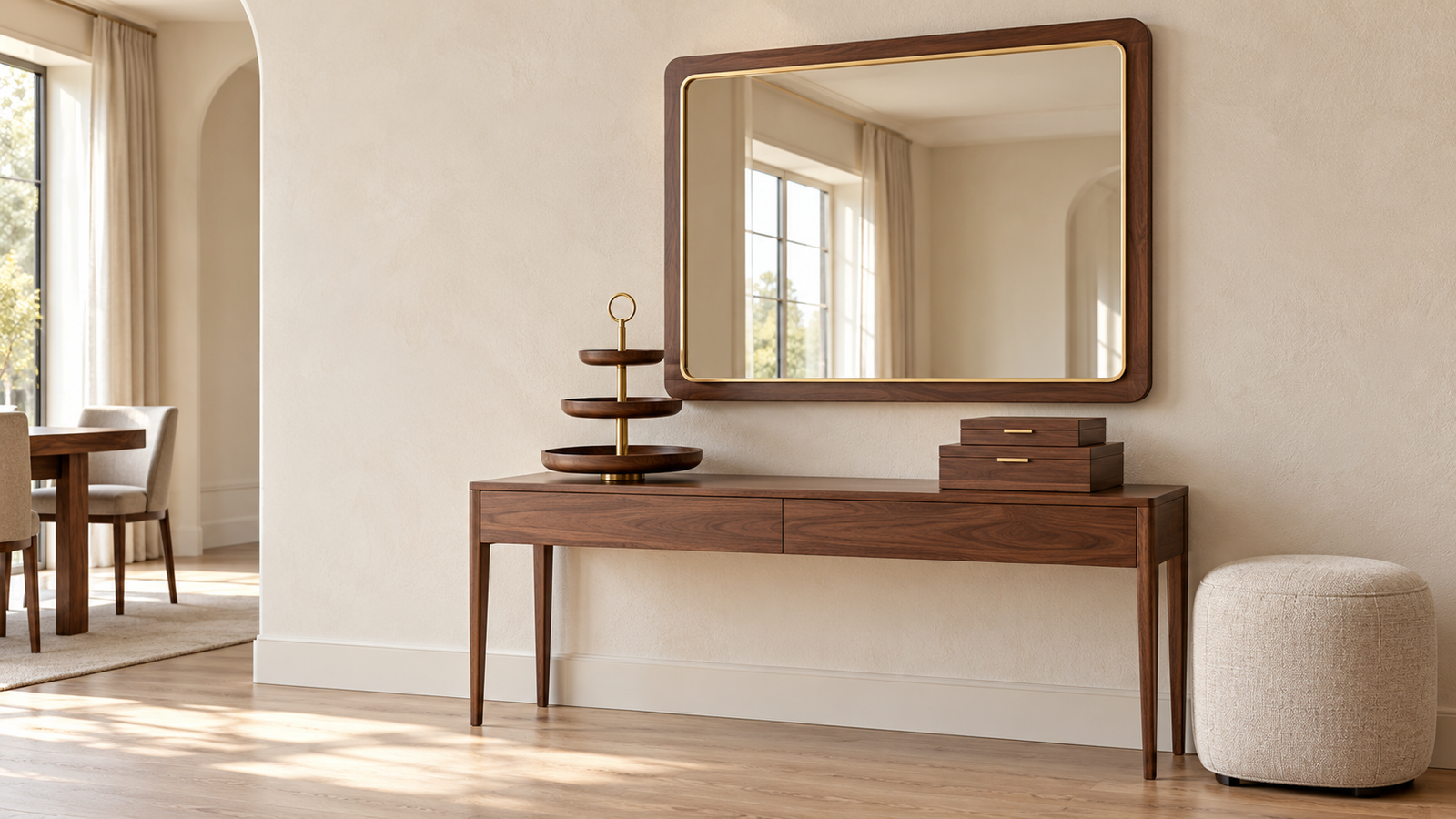
Quick Answer: A coordinated home décor collection does not require every product to look identical. Buyers should select one lead product, define a shared material and finish language, and extend it into complementary categories with different functions and price points. Mirrors can provide the visual anchor, while decorative storage, accent furniture, and tabletop serving pieces make the collection easier to merchandise across a complete room.
For importers and retailers, sourcing one attractive product is relatively straightforward. The harder task is deciding whether that product can support a wider assortment without creating inconsistent finishes, excessive SKUs, or packaging problems.
Canton Fair Signal: Buyers Can Source Across the Room
The 140th Canton Fair positions Phase 2, held October 23–27, 2026, around “Quality Home Life.” Its exhibition structure brings together Building and Furniture, Housewares, and Gifts and Decorations, including home decorations, furniture, ceramics, household items, and related categories.
For buyers, the important trend is not one color or silhouette. It is the growing opportunity to source products across adjacent categories and build a more complete retail story.
A buyer may discover a mirror in one section, a storage box in another, and a tiered server elsewhere. The commercial question is whether these products can be translated into one controlled collection rather than purchased as three unrelated items.
A Buyer Brief That Started With a Mirror
In one Teruier development review, the original brief focused on a decorative wall mirror with a warm walnut tone and satin champagne-gold metal details.
During the design review, the buyer explained that the mirror would not be sold alone. It was intended for an entryway and dining-oriented home collection, where the retailer also needed smaller giftable products and functional storage.
The design team therefore treated the mirror as the lead SKU and explored two extensions:
- A set of decorative storage boxes using the same walnut-toned surface and restrained gold trim
- A three-tier serving stand combining walnut-colored trays with a removable champagne-gold center spine
The objective was not to apply the mirror frame to every item. It was to preserve a shared material relationship—warm wood against soft gold—while allowing each product to keep its own function.
What Changed Before the Collection Was Approved
The Mirror Became the Finish Reference
The first mirror sample established the collection’s finish standard. A physical metal sample was retained because “champagne gold” can vary from pale yellow to pink or highly reflective gold between suppliers.
The revised direction used a softer satin finish that coordinated more easily with wood, textiles, and neutral interiors. That approved sample then became the reference for the storage hardware and the serving stand’s center structure.
This created a more reliable basis for developing a private-label mirror collection and its related accessories than approving each product through separate photographs.
The Serving Stand Was Redesigned for Packing
The first three-tier serving stand concept used a fixed center structure. Although visually clean, it created unnecessary carton height and exposed the upper ring to greater shipping risk.
Teruier changed it to a removable center spine with concealed support rings beneath the trays. The silhouette remained simple, but the product could be packed more efficiently and assembled after delivery.
For buyers evaluating three tier serving stand wholesale options, this structural decision affects carton volume, replacement parts, assembly instructions, and landed cost—not only appearance.
The Storage Pieces Were Simplified
The first storage-box concept used too much visible metal trim. Beside the mirror and serving stand, the collection began to look overly matched.
The designer reduced the metal to small handles and edge details, allowing the storage pieces to remain quieter supporting items. The box sizes were also reviewed as a nested set to improve packing efficiency.
This made the wholesale decorative storage range easier to position as a gift, organization, or shelf-display category without competing visually with the lead mirror.
How the Minhou Supply Chain Solved the Cross-Category Problem
The main manufacturing challenge was not producing each item separately. It was controlling the relationship between metal, wood-toned surfaces, assembly, and packaging across different product types.
Teruier coordinated the mirror-frame team, metal component supplier, wood-product workshop, sampling team, and packaging supplier around one approved finish master and one collection review.
Before bulk production, buyers should still confirm:
- Whether the same finish process is used across all visible metal components
- Which products allow natural material or grain variation
- Whether the products ship individually, nested, or consolidated
- Whether replacement hardware is shared across the collection
- Which SKU is the visual anchor and which products are supporting price points
The buyer selected the revised collection because it offered more than matching colors. It provided one lead product, two practical extensions, multiple retail price positions, and a clearer plan for display and consolidated ordering.
Single-Category Buying vs. Collection Development
| Single-category sourcing | Coordinated collection development |
|---|---|
| Products approved independently | One lead SKU establishes the design language |
| Finish names may match only on paper | Physical finish standards are reviewed across categories |
| Similar decoration applied everywhere | Each product keeps an appropriate commercial role |
| Packaging decided product by product | Cartons, nesting, assembly, and consolidation are reviewed together |
| Individual listings | A stronger room, gifting, or seasonal merchandising story |
For buyers sourcing wholesale decorative mirrors and accent furniture, the second approach requires more early coordination but can produce a clearer assortment with better cross-merchandising potential.
Buyer Summary
- Start with one commercially important lead product rather than developing every category at once.
- Coordinate materials and finishes, but avoid making every item look identical.
- Use physical finish samples when several suppliers or materials must match.
- Review structure and packaging while extending the collection.
- Give mirrors, storage, furniture, and tabletop pieces different roles and price positions.
FAQ
What makes products part of a coordinated home décor collection?
They should share a recognizable material, finish, color, or proportion language while serving different functions. Exact visual repetition is not required.
Can a Canton Fair home decor supplier develop products across several categories?
Some suppliers can coordinate multiple categories, but buyers should ask who controls sampling, finish standards, packaging, inspection, and consolidated delivery. A broad catalogue alone does not prove collection-development capability.
Should a private-label collection begin with many SKUs?
Usually not. A focused group consisting of one lead product and two or three supporting items is easier to sample, compare, price, and test before extending the range.
CTA
Teruier helps buyers translate one product direction into coordinated mirrors, decorative storage, tabletop pieces, ottomans, and accent furniture. Contact our team to review your target channel, lead SKU, finish direction, supporting categories, and sampling plan.