
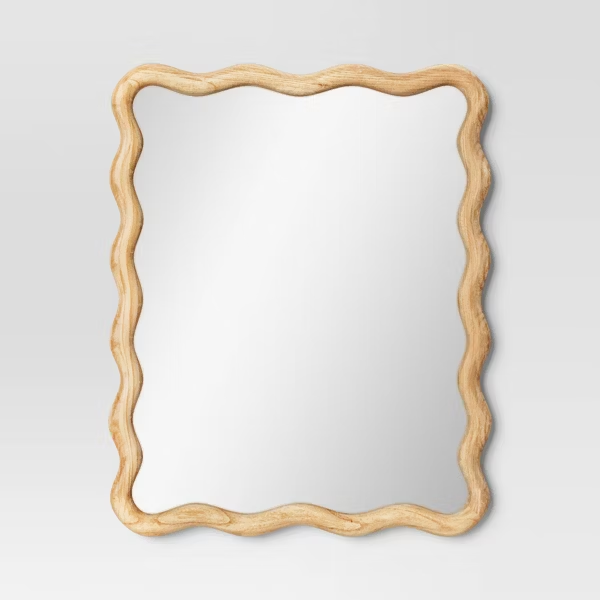
A lot of mirrors look good in a showroom.
Far fewer prove they can travel.
That is the first thing I care about as a buyer for a home décor retail chain. I am not just looking for a mirror that photographs well once. I am looking for a mirror that can hold its value across channels, across price tiers, and across customer types. That is what separates a pretty product from a commercial product.
That is also why Scalloped Wall Mirror Natural Wood is worth discussing.
What makes this item interesting is not just the shape. It is the fact that the shape keeps showing up in places that matter. When I see a style succeed in mass retail, home-specialty e-commerce, broad marketplaces, and handmade discovery channels at the same time, I stop reading it as a one-off trend. I start reading it as a sellable format.
The first commercial signal is mass-market acceptance. Target is currently carrying a Threshold™ Scalloped Wall Mirror in Natural Wood, and the product is positioned in exactly the way a buyer wants to see: easy to understand, easy to style, and broad enough to work in living rooms, bedrooms, and transitional wall décor stories. That matters because big-box assortment teams do not reward shapes that are too niche or too difficult to merchandise. If a scalloped natural-wood mirror is making it into that kind of assortment, the style has already crossed out of novelty territory.
The second signal is category depth inside home-focused e-commerce. Wayfair’s search results for “natural wood scalloped mirror” and related scalloped mirror terms show that this is not a fringe shape anymore. The platform carries multiple scalloped wood options across brands and formats, including natural rubberwood and solid-wood framed versions, with customer ratings attached and price points ranging from accessible to more design-forward. In other words, the category is not just present; it is merchandised with enough depth to suggest sustained shopper interest rather than isolated experimentation.
The third signal is price-ladder flexibility across marketplace channels. On Walmart, Home Depot, and Amazon, scalloped wood mirrors appear in several size and finish variations, with pricing that stretches from value-driven entry points into higher decorative territory. That is important because it tells me the silhouette is not locked into one narrow customer. The same visual language can survive budget retail, mid-market décor, and more presentation-led assortment builds. When a shape works across that many retail environments, it usually means the design has real commercial elasticity.
The fourth signal is taste-driven long-tail demand. Etsy currently shows a large volume of scalloped wood mirror listings, including handcrafted and more artisanal interpretations. For a buyer, that matters more than people think. Handmade and marketplace-discovery channels often reveal whether a style has emotional pull beyond standard catalog retail. If customers are still searching for, saving, and buying the silhouette in that environment, it means the product is not surviving on distribution alone. It has aesthetic traction.
This is where the sales story becomes more interesting than the styling story.
Because once a product shows up across all four channel types, the question is no longer, “Is this mirror cute?” The real question becomes, “Why is this mirror converting in so many different retail languages?”
My answer is simple: it solves two problems at once.
First, the scalloped outline gives the product enough shape to stop the eye. It feels softer than a plain rectangle, less expected than a basic round, and more decorative without becoming overly thematic. Second, the natural wood finish keeps the piece commercially grounded. It gives warmth, material honesty, and broad styling compatibility. The shape creates attention; the wood finish creates trust.
That combination is very hard to beat in home décor.
It also lines up with larger design direction. Furniture Today reported that natural elements and solid wood continue to drive demand in decorative accessories and mirrors, while ELLE Decor’s 2025 trend coverage pointed to curvy, organic forms and natural materials as elements with staying power rather than pure short-term novelty. That trend backdrop helps explain why a scalloped natural-wood mirror is performing well across channels: it sits exactly where the market currently wants to spend—soft form, grounded finish, and easy integration into real rooms.
From a buyer’s point of view, that is what I would call transferable sales performance.
Some products only work because one retailer styled them beautifully. Some only work because they are cheap enough to feel safe. Some only work because they are new. But a product like Scalloped Wall Mirror Natural Wood is showing something better: it can move through multiple retail ecosystems without losing its meaning.
In mass retail, it reads approachable.
In home e-commerce, it reads trend-right.
In marketplace environments, it reads scalable.
In handmade and discovery channels, it reads emotionally desirable.
That is not a weak signal. That is a commercial pattern.
And for suppliers, that distinction matters.
Because the best product opportunities are not always the ones that look the most dramatic in a line review. They are the ones that prove they can carry demand across channels without requiring a completely different story every time. A buyer does not want to gamble on a product that only works in one corner of the market. A buyer wants a product with evidence of range.
That is why I would take Scalloped Wall Mirror Natural Wood seriously.
Not because it is trendy.
Not because it is decorative.
But because the sales signals suggest it is portable, repeatable, and commercially legible in more than one place.
And in retail, that is usually the difference between a nice item and a smart item.
If I were building a wall décor assortment today, I would not read this mirror as a small aesthetic win. I would read it as a stronger merchandising asset: a product with enough shape to attract attention, enough warmth to broaden the audience, and enough multi-channel proof to justify real shelf space.
That is the kind of product I do not ignore.



