
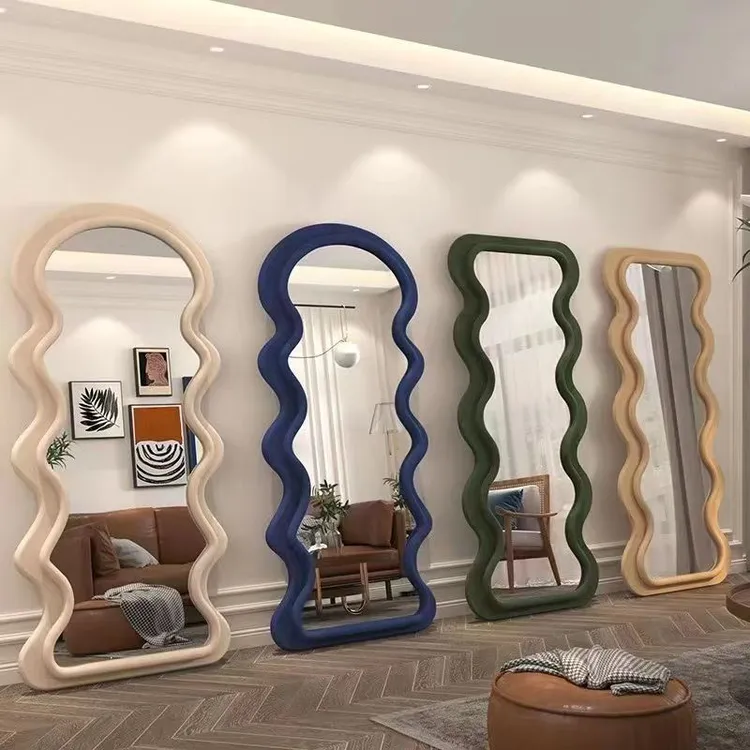
Let’s be honest: the wavy wall mirror had a very good run. It photographed well, made merchandisers feel current, and gave every showroom wall that “yes, we do know what Instagram is” energy. But if you’re a chain-store buyer, that’s not the real question. The real question is whether your next mirror supplier can give you a shape that still feels current without turning the reorder into a small emotional crisis.
That is where a wavy wall mirror alternative supplier starts to matter.
Because what most buyers need now is not “less personality.” They need a smarter shape language. Something sculptural enough to earn display space, but disciplined enough to survive freight, store lighting, margin review, and the deeply unromantic reality of replenishment.
And that timing is not random. Official North American market signals have been pointing toward curvier, more organic, more sculptural forms for a while. High Point Market’s Style Spotters explicitly called out “sinuous curves” and an “organic movement,” while ANDMORE’s Spring 2025 High Point Market winners were organized around themes like Linear Forms and Nod to Nature. Las Vegas Market’s Summer 2025 winners also highlighted Organic Minimalism as a direction buyers were rewarding. Research in architecture and neuroaesthetics points the same way: preference for curvilinear contour is robust, and design experts in particular have been shown to rate curvilinear spaces as more beautiful than rectilinear ones.
So no, this is not an anti-wave speech. It is a buyer speech.
What Teruier is really presenting here is not one mirror. It is a cleaner mirror program for buyers who still want motion and softness, but need more control.
A practical alternative assortment usually lands in three lanes:
First, the chrome wall mirror version for modern retail. This is for stores that want reflection, crispness, and a little fashion edge, but cannot afford visual inconsistency from one production batch to the next. In plain English: if your factory cannot talk clearly about chrome wall mirror finish consistency tolerance, you do not have a scalable program. You have a lucky sample.
Second, the antiqued mirror alternative distressed mirror direction. This works when your customer wants warmth, character, and a slightly collected look, but you do not want the piece to drift into fake-vintage theater. Good distressed mirror programs should read textured and intentional, not tired and confused. North American buyers are already moving toward spaces that feel warmer, more layered, and less sterile; High Point trend coverage and designer picks have leaned into sculptural silhouettes, warm brass accents, and vintage-flavored details rather than flat, cold minimalism.
Third, the smoked mirror alternative bronze tinted mirror option. This one matters more than people think. A lot of “smoked” looks go too gray, too dark, or too moody for mainstream retail. Bronze-tinted mirror is often the better commercial answer: still atmospheric, still elevated, but friendlier under store lighting and easier to pair with walnut, warm neutrals, brass, and soft contemporary upholstery.
Here’s the buyer part Teruier cares about: a mirror program should not stop at shape and finish. It should already answer the next five questions before the buyer asks them.
What sizes make sense for planograms and e-commerce?
Usually the safest starting ladder is 24″ x 36″, 30″ x 40″, and 36″ x 48″.
What materials keep the look clean without making the cost silly?
Typically: 5mm mirror, engineered back support, and metal or finished composite frame depending on target retail.
What channels fit?
Chain home décor retail, furniture stores, design-led value retail, hospitality-lite projects, and residential fit-out programs.
What spaces fit?
Entryways, powder rooms, bedroom dress walls, apartment staging, boutique hospitality, and model units.
What makes it reorderable?
Finish control, hardware consistency, stable carton engineering, and realistic delivery scheduling.
That last one matters more than most trend articles admit. A buyer does not lose sleep over curves. A buyer loses sleep over breakage, mismatched finishes, and late containers. So yes, mirror packaging for shipping belongs in the same conversation as design. If the packaging is weak, the mirror is weak. Full stop. And for larger programs, phased delivery for fit-out projects is not a “nice extra.” It is often the difference between a supplier being usable or forgotten.
A representative Teruier selection-agent case looks like this: instead of asking a U.S. retail buyer to bet on one trendy wave mirror, the program is rebuilt into a three-SKU mirror capsule. One chrome look for contemporary stores. One distressed antiqued option for transitional assortments. One bronze-tinted version for warmer interiors. The buyer reviews size ladder, finish board, outer-carton structure, and rollout timing in the same conversation. That changes the discussion from “Do we like this mirror?” to “Can this become a clean, repeatable SKU family?”
That is a much better question.
It also happens to match where North American market taste is going. The current buyer is not only chasing novelty. They are balancing sculptural form with warmth, functionality, and a more believable path to repeat business. That is exactly why the wavy mirror trend is now splitting in two directions: one path stays social-media cute, the other grows up and becomes a real assortment. Official High Point and Las Vegas Market signals both support that broader move toward organic form, functional art, and commercially usable statement pieces.
So here is the short version.
If you are looking for a wavy wall mirror alternative supplier, do not just ask for a new shape. Ask for a better retail argument.
Ask for the finish logic.
Ask for the size logic.
Ask for the freight logic.
Ask for the rollout logic.
Ask whether the mirror is merely photogenic, or actually reorder-ready.
That is where Teruier is trying to be useful: not as a factory that says yes to everything, but as a partner that translates trend into margin, packaging into survival, and design into a mirror program a serious buyer can actually buy again.



