
The Vase Looks “Easy” Until the First Shipment Breaks Your Margin
If you’ve ever sold vases at scale, you already know the dirty secret:
A ceramic vase can be a top-performing décor add-on… and the fastest way to rack up damages, returns, and “not as pictured” complaints.
I’m a U.S. home décor mall buyer. I’ve watched the same vase go two completely different directions depending on one decision:
Did we pick a ceramic vase wholesale supplier who can repeat the product—not just sample it?
Because the sample is where everyone looks good. The warehouse is where the truth shows up.
Why Vases Keep Winning (Even When Buyers Complain)
Vases are a merchandising cheat code:
They refresh a room story without changing furniture.
They sell in clusters (a hero vase + two supporting shapes).
They cross-sell with stems, candles, trays, and books.
And right now, “statement vessels” are having a very public moment again—Architectural Digest recently highlighted a revival of tulipières (tiered Dutch vases) across fairs and contemporary ceramic work, which is exactly the kind of “heritage-meets-sculpture” signal buyers watch.
Even mainstream styling content is pushing vases as the perfect vehicle for shifting finishes (like the renewed push toward silver accents in 2026), because a vase is an easy way for shoppers to try a “new look” without repainting a room.
But the bigger context matters: the home décor market is enormous and still growing, which means more SKUs, faster resets, and less patience for operational drift.
So yes—vases sell.
The question is whether your supplier can protect the business after the vase sells.
The Buyer Reality: Returns and Breakage Are Not “Small Problems”
When your ceramic vases show up chipped, scratched, or inconsistent, the cost doesn’t stay in the warehouse. It becomes:
returns and replacements
markdowns and damaged-out inventory
negative reviews that kill reorder velocity
NRF projects total U.S. retail returns at $849.9B in 2025, and estimates 19.3% of online sales will be returned. That’s not a rounding error—it’s the operating environment.
So when I evaluate a ceramic vase wholesale supplier, I’m not asking “can you make vases?”
I’m asking: can you deliver vases that survive real retail conditions—consistently and repeatedly?
The “Reorder-Ready” Ceramic Vase Checklist (What I Ask Before I Say Yes)
1) Do you control glaze and color like a system?
Ceramics are beautiful because they’re nuanced. They’re returned because they’re inconsistent.
A chain-ready supplier can explain:
how they standardize glaze appearance (reference tiles, batch notes)
how they prevent lot-to-lot drift
what tolerances are acceptable (and what gets rejected)
If the answer is “handmade varies,” that’s not a plan—especially when my shelf set depends on matching pieces.
2) Can you define “acceptable variation” in writing?
Buyers don’t need perfection. We need predictability.
I want a simple QC language:
pinholes: acceptable range vs reject
warping/leaning: pass/fail limits
rim thickness and base flatness
dimensional tolerances (especially for “set stories”)
This one step alone reduces half the back-and-forth after goods land.
3) Is your packaging built for transit, not for photos?
Most “product defects” on ceramic vases are packaging failures:
rim impact
base chipping
abrasion marks on matte glazes
compression damage in mixed cartons
ISTA describes its 3-Series as “general simulation” tests designed to simulate the damage-producing forces and sequences of real transport.
Even if you’re not running lab tests on every SKU, I want to hear an ISTA mindset:
double-wall where it matters
rim and base protection
anti-rub sleeves or separators for matte finishes
consistent pack-out method (not “depends who packed it”)
4) Do you have a drop-test discipline (even a basic one)?
If you ship fragile items without any drop-risk thinking, you’re gambling with my margin.
Many packaging programs use established performance testing frameworks (e.g., distribution-cycle style testing such as ASTM D4169, which organizes sequences like drop, vibration, compression to mimic real distribution).
Again—buyers don’t require you to recite standards. We require you to act like breakage is measurable and preventable.
5) Can you support “program selling,” not just single pieces?
A ceramic vase doesn’t scale in retail as a single hero piece. It scales as:
a shape family (tall + medium + bud)
a finish family (one glaze identity across multiple SKUs)
a price ladder (good/better/best)
If you want to be a long-term ceramic vase wholesale supplier, you need to help buyers build an assortment that can be refreshed seasonally without reinventing everything.
The Three Ceramic Vase Types That Actually Work in Retail Chains
From a buyer’s perspective, the winners usually fall into three buckets:
1) The “Anchor Neutral” (the reorder machine)
matte cream, sand, stone, soft gray
simple silhouette, strong proportion
consistent glaze identity
These are the backbone—because they don’t fight the rest of the store.
2) The “Sculptural Statement” (the traffic driver)
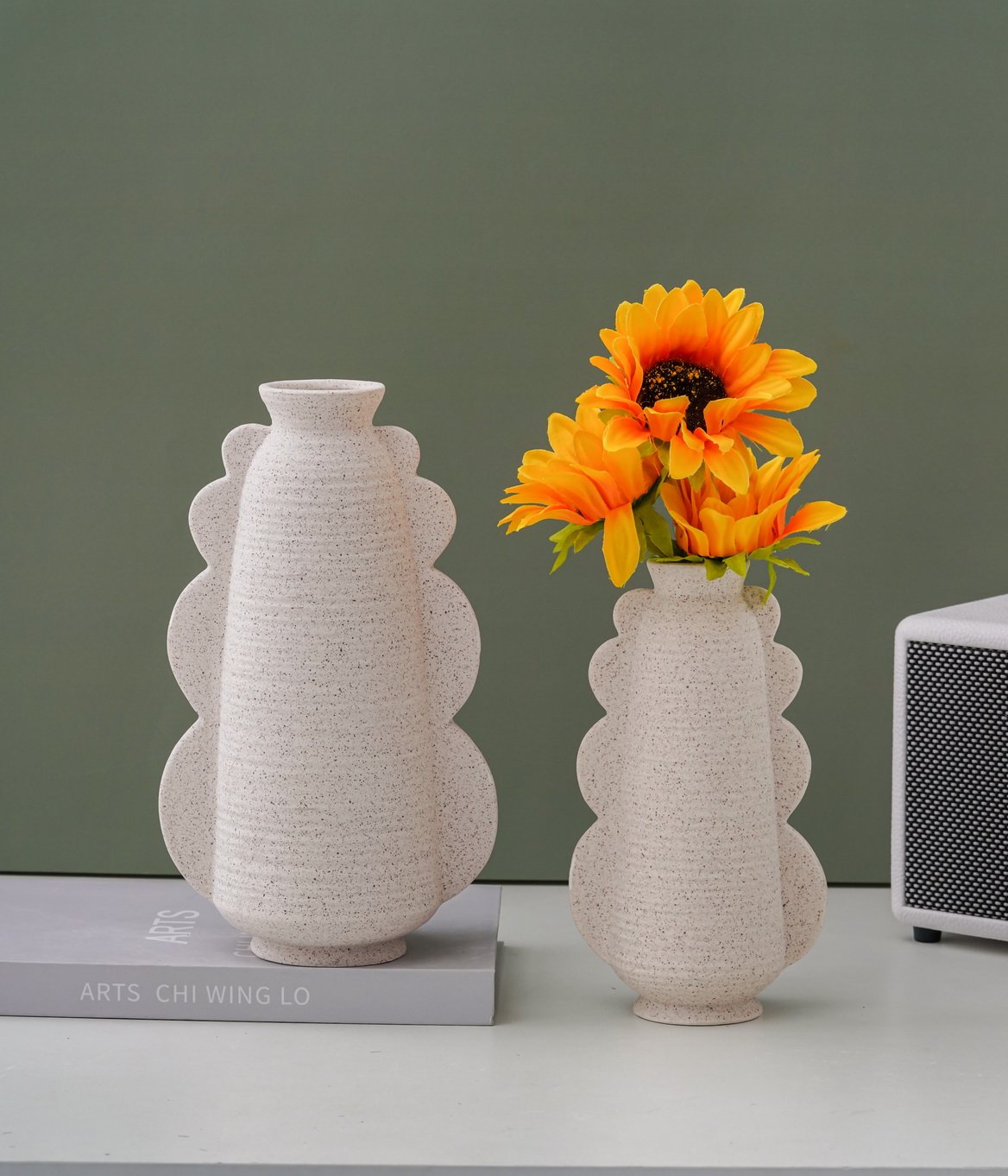
This is where trend signals like heritage forms and sculpture-led ceramics show up (think tulipière-inspired or gallery-like pieces).
These sell slower but lift the whole story and drive social sharing.
3) The “Finish Experiment” (the seasonal impulse)
Finishes swing fast—silver accents, for example, are being positioned as newly “on-trend” again in 2026 styling content, and vases are the easiest way to express that shift.
You run these as limited drops, not as your entire inventory bet.
What I Want From a Supplier Email (If You Want to Sound Chain-Ready)
If you’re pitching me, don’t start with 60 SKUs. Start with certainty:
Your top 8 best reorderables (with consistent finishes)
Packaging photos + carton spec (show rim/base protection)
QC acceptance sheet (short, clear, measurable)
Lead time range + capacity reality
How the reorder matches the first PO (golden sample rule)
Because buyers don’t buy catalogs. We buy outcomes.
Where Teruier Fits
The suppliers I keep are the ones who behave like coordination hubs—turning trend direction into stable specs, locking a reference, and engineering packaging so “fragile” doesn’t mean “risky.”
That’s the difference between “we make ceramics” and a ceramic vase wholesale supplier that buyers reorder from.
Bottom Line
A vase is not hard to sell.
A vase is hard to scale.
If you want to win U.S. retail-chain business, build your ceramic program around:
glaze consistency and written tolerances
packaging designed for real transport (ISTA mindset)
a basic performance-testing discipline
and a reorder plan that doesn’t drift after the first shipment
Because in modern retail—where returns are structurally high—reorder-ready is the real luxury.



