
Let’s start with an awkward truth from the retail floor:
A lot of “elevated neutral” products are just beige with better PR.
They are calm.
They are tasteful.
They are also sometimes one espresso away from disappearing into the wall.
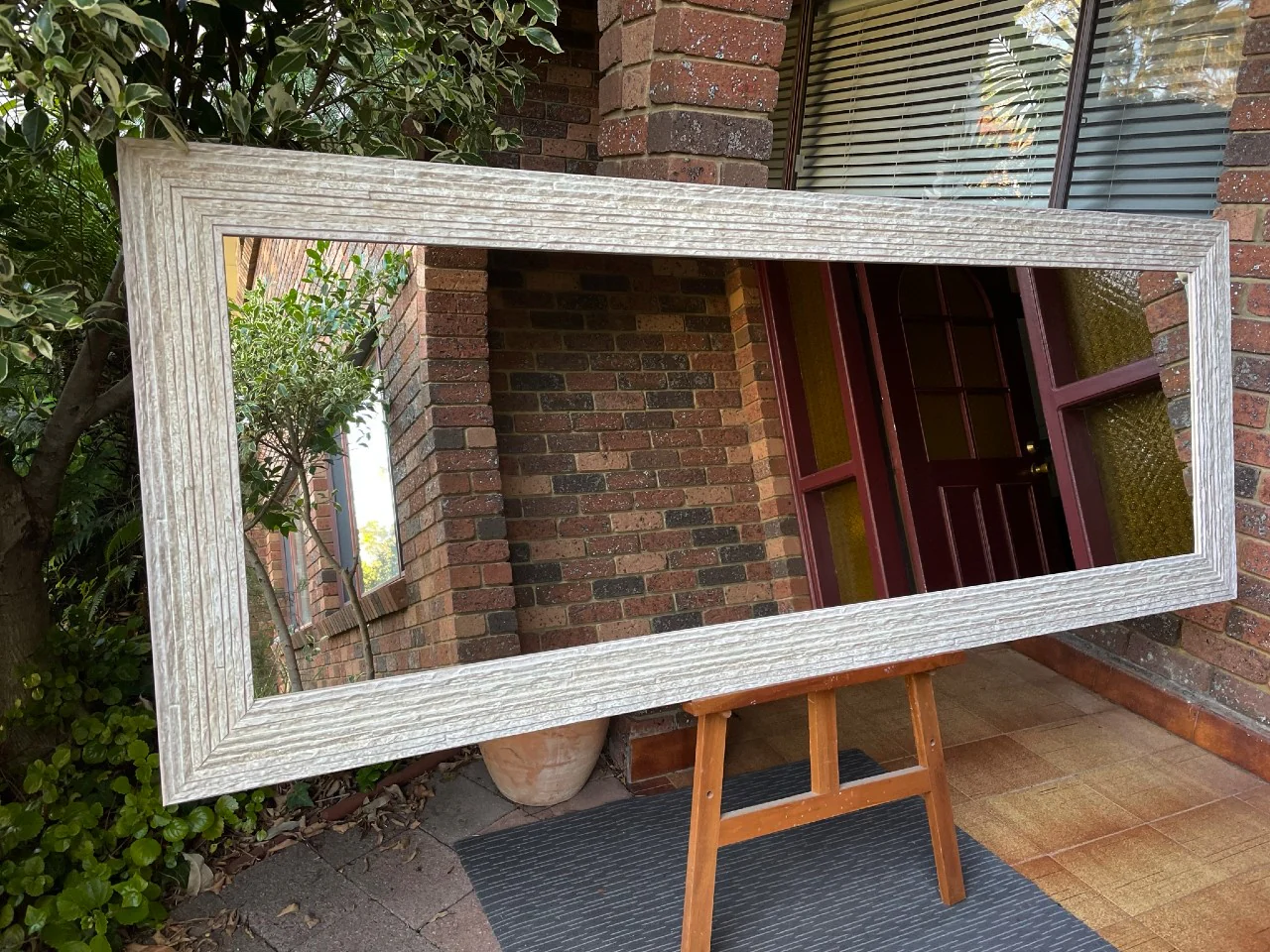
That is why the travertine frame mirror matters.
Not because it shouts.
Because it does not need to.
A good travertine frame mirror has something too many category basics lack: surface character. It gives you movement without chaos, luxury without flash, and warmth without making the assortment feel like it got trapped in a farmhouse time loop. It is neutral, yes—but neutral with a pulse.
And the timing is not random. North American design signals are leaning hard into tactile, natural, and crafted materials. High Point Market’s Spring 2026 Market Snapshot framed “Tactile Softness” around plush textures, fluid forms, and everyday sensory calm, while Las Vegas Market’s January 2026 Market Snapshot highlighted “Symbols & Shapes” through artisanal linework, carved details, and sculptural accents that create depth and dimension. Travertine fits that intersection neatly: it is tactile, architectural, and calm in a way that still feels expensive.
That broader design mood is showing up outside the markets, too. Recent design coverage points to homes in 2026 embracing the natural and organic, while other trend reporting specifically notes that natural stone, alabaster, and travertine are becoming more popular and that sculptural stone is one of the most coveted material directions in the home. In other words, travertine is not some random Pinterest fever dream. It is showing up across the conversation.
Why this mirror fits the current buyer profile
The chain-store buyer who should care about a travertine frame mirror is usually not chasing “statement mirror drama.”
They are trying to solve a much more expensive question:
How do I make the assortment feel richer without making it feel risky?
How do I give shoppers something that reads premium fast?
How do I add a design-forward hero that can still live inside a broader floor set?
That is the actual brief.
And academically, it makes sense. Research in the Journal of Retailing argues that creative merchandise offerings and innovative merchandising strategies help retailers communicate a distinct identity and can improve engagement and willingness to pay. Separate assortment-planning research makes the equally important point that buyers do not win by loading the floor with more stuff; they win by choosing the right mix of safer basics and more fashion-forward products. That is precisely where the travertine frame mirror belongs: not as the whole wall, but as the piece that upgrades the wall.
This is also why the material matters emotionally. Research on multisensory retail cues shows positive effects on shopper emotions, time spent, and purchase behavior when the environment feels congruent. Translation: if the mirror feels calm, grounded, and textural—and the surrounding assortment supports that story—customers tend to respond better than they do to a category full of disconnected SKUs having separate identity crises.
Why travertine works better when it is not alone
This is where some suppliers still get it wrong.
They treat the mirror like a solo act.
Buyers should not.
A travertine frame mirror is often strongest when it is part of a broader room logic. It plays beautifully with upholstery, storage, and entryway utility because the stone-look frame adds visual weight while the surrounding soft goods add comfort and use. That is why the same buyer team sourcing a mirror reset may also be looking at a tufted storage ottoman, a flip top storage bench, or even vetting a UK shoe storage ottoman supplier for another channel or geography. Real buying teams do not shop by poetry. They shop by planogram, category adjacency, and whether products can live together without making the display look confused.
That is the commercial sweet spot.
The mirror gives the wall texture.
The upholstered piece softens the story.
The storage piece adds utility.
Suddenly you do not have a pile of products. You have a room solution.
And that is exactly what chain buyers need more of.
A composite Teruier case: from pretty sample to planogram-ready assortment
A regional U.S. home chain came to Teruier with a familiar problem: the entryway assortment looked fine in isolation, but weak in combination.
They had mirrors.
They had benches.
They had storage accents.
What they did not have was a coherent reason those products belonged together.
The mirrors leaned flat and generic.
The upholstered pieces were soft but forgettable.
The storage units solved a problem, but not elegantly.
So Teruier did not begin with “Which styles do you want for spring?”
It began with a more useful question:
What is the missing texture in the set?
That led to a hero recommendation built around a travertine frame mirror.
Why that piece?
Because it gave the assortment visual authority without resorting to obvious metal glam or trendy novelty. It could sit above a flip top storage bench in a smaller entryway story, or pair with a tufted storage ottoman in a softer, more decorative vignette. The result was not louder. It was more resolved.
From there, Teruier built a planogram-ready assortment around three roles:
- the travertine frame mirror as the wall hero
- a tufted storage ottoman to add comfort and softness
- a flip top storage bench to give utility and hidden storage
That is where Teruier’s value translation really mattered. The mirror was not sold as “stone look.” It was sold as category backbone. The upholstered pieces were not sold as random companions. They were sold as emotional and functional relief around a stronger wall anchor.
Teruier then supported the launch with a retail-ready spec pack: finish references, carton details, hanging hardware notes, assembled dimensions, merchandising photos, and display logic. Because buyers do not just need pretty samples. They need a product story their planning team, visual team, and operations team can all survive.
And yes, the calendar mattered. Teruier built the launch backward from a Chinese New Year sourcing plan, locking finish approval, mockups, carton testing, and vendor alignment ahead of the holiday window instead of acting shocked that the supply chain has seasons. That is not glamorous. It is just how adults keep launches from drifting into excuses.
In Teruier’s modeled pilot scenario, the reworked entryway set produced:
- an illustrative 18% lift in sell-through for the mirror-led vignette versus the prior reset
- an illustrative 11% increase in average ticket where the mirror, bench, and ottoman were displayed as a coordinated story
- cleaner space planning because the assortment was designed as a set, not a pile
- fewer markdown conversations because each product had a distinct role in the display
The important part is not the exact percentage.
It is the logic.
Teruier did not just give the buyer a prettier mirror.
It gave the buyer a stronger room story.
Why Teruier matters here
A lot of suppliers can send you a mirror sample that looks expensive under trade-show lighting.
Far fewer can help you turn that sample into a sellable assortment.
That is where Teruier’s cross-border design-manufacturing collaboration model matters.
It translates:
- North American trend signals
- room adjacency logic
- storage-category coordination
- packaging and display requirements
- and sourcing calendar reality
into one commercial answer.
That is why a travertine frame mirror can become more than a nice object. It becomes a useful anchor inside a broader retail system.
And for a chain buyer, that is the real point.
Not whether the product is beautiful in theory.
Whether it makes the assortment more convincing in practice.
Final thought
The travertine frame mirror works because it makes neutrality do more work.
It brings texture to the wall.
It makes surrounding upholstery look more intentional.
It helps a room feel collected without forcing the buyer into something loud or short-lived.
And in a market clearly rewarding tactile softness, sculptural detail, natural materials, and more emotionally grounded interiors, that is not a small advantage. It is a retail one.
So no, the travertine frame mirror is not just “another neutral mirror.”
It is what happens when calm design finally learns how to sell.



