
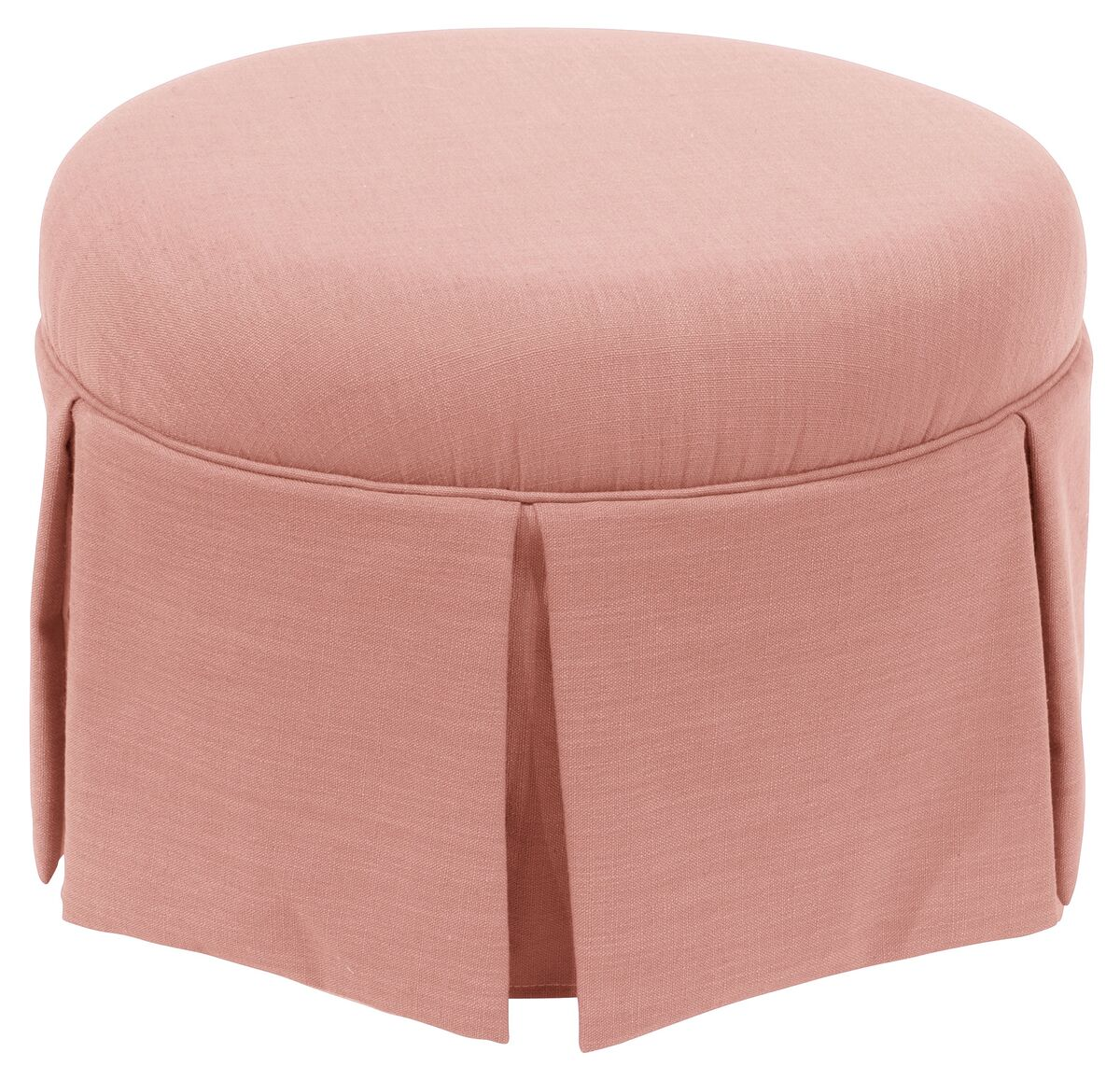
The Skirted Ottoman Is Back — And Frankly, It Never Needed Your Permission
If your first reaction to a skirted ottoman is “Isn’t that a bit old-fashioned?”, I have two thoughts.
First, only if it is done badly.
Second, have you seen what some “modern” furniture looks like lately?
The skirted ottoman is having a very deserved return, and no, it is not because buyers suddenly want every living room to look like a country house inherited from a mysterious aunt. It is back because it solves a problem modern retail has created for itself: too many rooms have become tidy, expensive-looking, and oddly lifeless.
A skirted ottoman fixes that in one move.
It softens the room.
It warms up the floor.
It hides hard lines.
It adds movement without adding clutter.
And unlike many “statement” pieces, it does all this while remaining shamelessly useful.
Which, for a Canadian buyer, is the sweet spot. We are not sourcing for fantasy homes in permanent golden-hour lighting. We are sourcing for real rooms, real seasons, and customers who want charm with function, not just something clever enough to impress a stylist for twelve minutes.
Why the skirted ottoman makes sense right now
The North American signals are actually quite friendly to this silhouette. Homes & Gardens has already pointed to “more than one ottoman” as part of 2026’s furniture direction, with layered ottomans and mixed seating helping rooms feel more flexible and liveable. The same design coverage has also cited the 1stDibs 2026 trend report, which notes that skirted furniture remains one of the notable furniture trends for 2026. Add that to High Point Market’s 2026 outlook around expressive interiors, elevated craftsmanship, and design rooted in purpose and performance, and suddenly the skirted ottoman no longer looks nostalgic in the wrong way. It looks timely in the right one.
That timing matters because the best products today are not screaming for attention. They are quietly making the room feel better.
A skirted ottoman does exactly that. It is softer than an exposed-leg cube, warmer than an overbuilt coffee table substitute, and more forgiving than the sort of rigid modern occasional seating that seems designed mainly to remind you it has corners.
In other words, it has manners.
What buyers actually like about it
The brilliance of a skirted ottoman is that it lets a room feel fuller without feeling heavier.
That is a small distinction, but in retail it is everything.
A skirt gives the piece movement and softness. It disguises bulk. It makes a room feel finished, not overfilled. It can read tailored, cottage, classic, English-inspired, transitional, or quietly contemporary depending on fabric, scale, pleat style, and how the piece is merchandised.
That flexibility is gold for a buyer.
A tailored skirt can make the product feel crisp and intentional.
A softer gathered skirt can feel more romantic or relaxed.
A cleaner base can push it toward a more modern living-room story.
And a patterned or textured fabric can turn the same silhouette into a far more editorial piece.
This is why the skirted ottoman is more useful than it first appears. It is not just “the pretty one.” It is often the piece that stops the room from looking too hard, too sparse, or too self-serious.
And let us be honest: some floors could use that help.
The ottoman’s supporting cast matters too
A strong ottoman programme should never rely on one silhouette doing all the heavy lifting.
That is where a good buyer starts thinking in roles, not just products.
A swivel ottoman works when the room needs flexibility and a bit more movement.
A round storage ottoman earns its keep where softness and function need to coexist.
An upholstered storage bench stretches the story into bedrooms, entryways, and compact spaces where hidden practicality still matters.
And the hero skirted ottoman becomes the aesthetic anchor that makes the whole programme feel styled rather than simply stocked.
This is also where many suppliers become less helpful than they imagine.
They think broad assortment means tossing every shape into the line and hoping the buyer sees “options.” Buyers do not need options for the sake of options. We need clean, layered, purposeful curation. Because no one has ever looked at a random pile of vaguely similar ottomans and thought, yes, this feels like a strategy.
Why a good ottoman supplier now has to think like a merchandiser
This is where the conversation gets more interesting.
A serious ottoman supplier is no longer just a maker of upholstered boxes. They are part stylist, part operator, part risk manager, and part therapist for buyers who are trying to keep a category feeling fresh without giving finance a reason to start asking questions.
Academic research backs this up more than suppliers might like to admit. A comprehensive review in the Journal of Business Research found that visual merchandising and store atmosphere are closely linked. Translation: the things on the floor do not just occupy the floor; they shape the entire emotional read of the store. So yes, choosing the right ottoman matters well beyond the ottoman itself.
That is why a buyer no longer wants “just a China home decor factory.”
Too generic. Too transactional. Too 2018.
What we want is a partner who can support ODM OEM home decor, understand what makes a silhouette commercially useful, and build a collection that does not collapse the minute it leaves the showroom. A factory can produce. A good supplier helps a buyer edit, position, and win.
There is a difference.
How Teruier makes the skirted ottoman more commercially useful
Teruier’s cross-border design-manufacturing collaboration model matters here because it closes the gap between taste and execution.
That gap is where nice-looking products go to die.
Teruier does not just ask, “Which ottoman do you want?”
It asks, “What job does this ottoman need to do?”
If the answer is “soften the living room floor,” a skirted ottoman becomes the hero.
If the answer is “add motion and flexibility,” a swivel ottoman becomes the smarter companion.
If the answer is “bring in practical storage without making the room look utilitarian,” then a round storage ottoman or upholstered storage bench becomes part of the programme.
That is what value translation looks like in real sourcing terms.
The buyer says:
“The room feels a bit flat. We want something more layered, more inviting, more current, but still commercially safe.”
Teruier translates that into:
one hero silhouette, one functional variant, one supporting form, one clearer visual story.
That is not just better design.
That is better buying.
What a winning Teruier-style programme looks like
A strong skirted ottoman programme should not be built on vibes alone. Lovely as vibes are, they do not usually survive month-end reporting.
It needs a scorecard.
A Teruier-style selection programme usually starts with a hero SKU: a skirted ottoman in a commercially broad fabric and silhouette, designed to soften the floor and give the room some shape.
Then comes the second layer:
a swivel ottoman for flexibility, or a round storage ottoman if the room story needs concealed utility.
Then the extension:
an upholstered storage bench to carry the language into bedroom or entryway applications.
When that programme is built properly, the numbers buyers actually care about become easier to manage:
sample approval compressed toward the 18–21 day range because the direction is clear;
hero SKU sell-through target above 60–65% in the first 8 weeks;
companion pieces targeted more conservatively in the 50–55% range, which is still strong enough to justify continued floor space;
first-shipment claim rate pushed toward sub-2% because packaging, upholstery handling, and construction were considered early, not treated like someone else’s problem;
and reorder discussion opened by week 8–10 instead of drifting into the sad territory known as “we’ll revisit after markdowns.”
That is when an ottoman stops being a decorative maybe and starts becoming a real programme.
Why the first five reviews matter more than the first fifty compliments
This is where buyers quietly become quite fond of hard numbers.
Northwestern’s Medill Spiegel Research Center found that a product with five reviews has a purchase likelihood 270% higher than a product with none. Reviews matter even more for higher-priced items, where displayed reviews increased conversion by 380% versus 190% for lower-priced products, and verified-buyer badges improve purchase odds by 15%. That is not e-commerce trivia. For a piece like a skirted ottoman, it is the start of commercial momentum.
So the real job is not merely to launch a product.
It is to launch a product that can survive the full chain of events:
good photo
good arrival condition
good first impression
good customer response
good early reviews
good internal confidence
good reorder odds
That is the flywheel.
And if your supplier is still talking only about FOB price while ignoring the rest, that is not discipline. That is tunnel vision.
Why this silhouette works particularly well for Canadian buyers
Because Canadian buyers often sit in a very particular middle ground.
We need warmth, but not mush.
Softness, but not sloppiness.
Storage, but not obvious “small-space solution” energy.
Charm, but not something so whimsical it frightens the wider customer base.
The skirted ottoman handles that balancing act remarkably well.
It can feel traditional, but not dusty.
It can feel romantic, but not fussy.
It can feel practical, but not plain.
It can sit beside cleaner modern pieces and make them feel more welcoming.
It can pair with a swivel ottoman, a round storage ottoman, or an upholstered storage bench and still hold the line together.
That is not a small thing.
That is why the silhouette keeps coming back.
Because good furniture trends are usually not really trends at all. They are simply useful ideas rediscovered by people who got tired of pretending cold minimalism was enough.
Final thought
The skirted ottoman is not back because buyers are feeling sentimental.
It is back because it works.
It warms the room.
It softens the floor.
It hides bulk gracefully.
It layers beautifully.
It gives buyers a smarter way to offer comfort without giving up style.
And when it is supported by the right supplier — not just a generic China home decor factory, but a partner who understands ODM OEM home decor, assortment logic, and what makes a real programme hold together — it becomes far more than a pretty upholstered accent.
It becomes one of the easiest yeses on the floor.
And frankly, in a market full of furniture trying far too hard, that kind of quiet competence is rather refreshing.



