How AI-generated interiors are changing home décor inspiration — and creating a new problem for consumers and retailers.
Scroll through Pinterest or Instagram and you will find thousands of beautiful interiors.
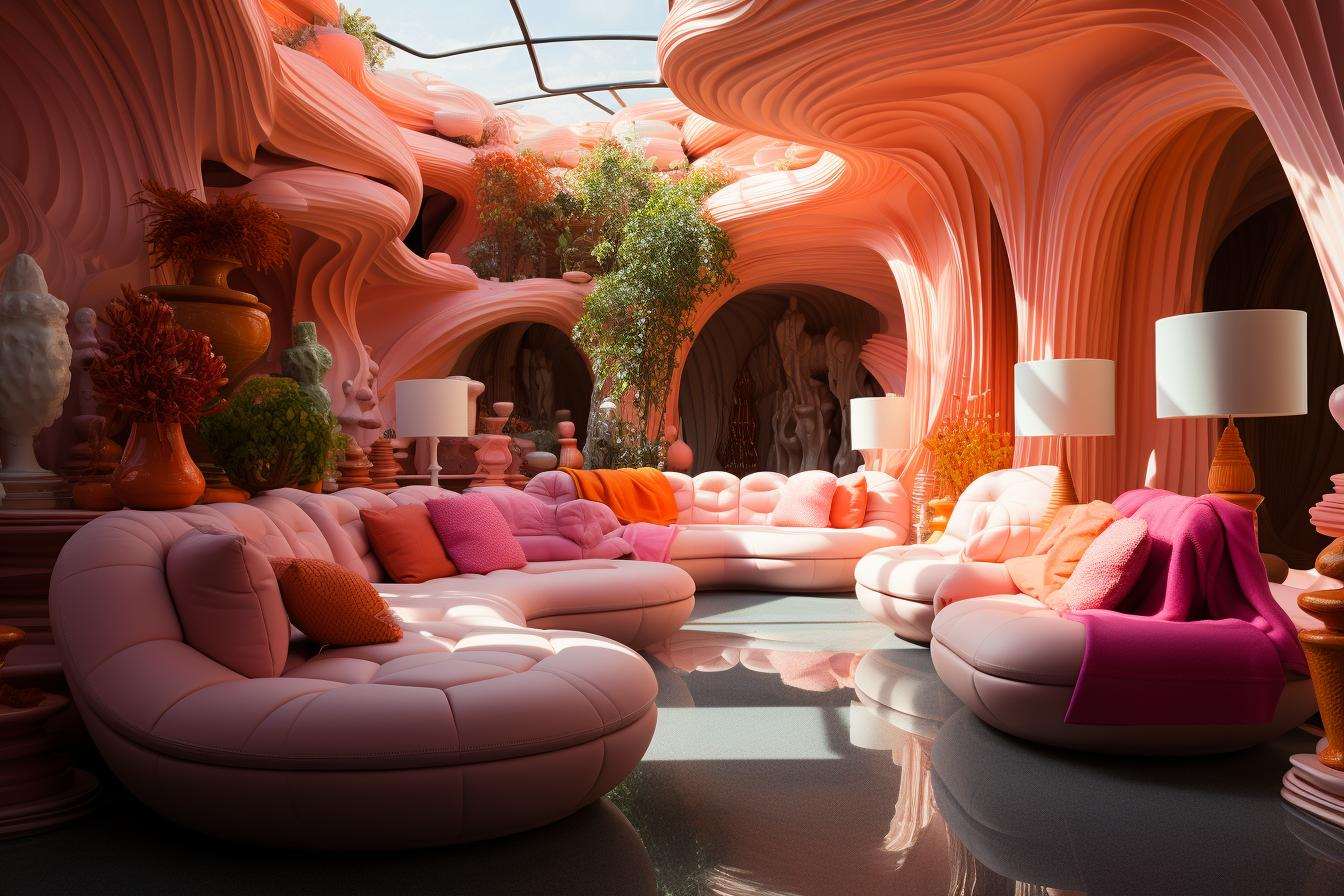
A curved sofa sits beneath a sculptural staircase. A marble coffee table appears to grow naturally out of the floor. An unusual mirror reflects a perfectly arranged room. Every cushion, vase and decorative object seems to be in exactly the right place.
There is just one problem.
Some of those products do not exist.
Others may exist only as AI-generated interpretations of real furniture, with no identifiable manufacturer, specification or commercially available version.
Welcome to a new problem in home décor: the difference between an interior that looks beautiful online and one that can actually be created.
AI can generate a dream home in seconds. But who is responsible for making that dream real?
1. The Most Beautiful Room on Your Feed May Be Impossible to Build
AI image generators have changed the way people discover interior design.
A homeowner can describe a dream living room, upload a reference image and request a dozen variations.
Want a larger marble island? Done.
A sofa with an unusual organic shape? Done.
A mirror with an architectural frame and a floating stone base? Done.
The results can look remarkably convincing.
But a convincing image does not guarantee a workable product.
An AI-generated coffee table might have a base that cannot support its top. A decorative shelf might appear to float without any visible fixing structure. A chair may have beautiful proportions but no realistic way to manufacture its joints.
Even materials can be misleading.
A surface that looks like natural marble may have no relationship to the appearance, weight or physical properties of actual stone.
In November 2026, Architectural Digest examined this growing problem in an article about AI design visualizers and the unrealistic expectations they can create.
Design professionals described clients arriving with highly specific AI-generated images that could be difficult, expensive or physically impractical to reproduce.
The problem is not that the images are unattractive.
It is that they can look finished before the design has been properly resolved.
2. Have We Started Confusing Inspiration With Evidence?
This is perhaps the most important question for consumers.
There are three very different types of interior images.
Type 1: Inspiration
An image communicates a mood, colour palette or general design direction.
It does not need to represent a real product.
Type 2: Design Visualization
A designer uses a rendering to explore a proposed space, product arrangement or material combination.
The image is a development tool, not necessarily a final representation.
Type 3: Verified Product Photography
A photograph shows an identifiable product that has actually been made.
Its materials, proportions, dimensions and finishes can be checked against the physical item.
These three categories should not be treated as interchangeable.
An AI-generated living room may be an excellent source of inspiration. But if a retailer presents it as a photograph of products available for purchase, the customer deserves a much clearer explanation.
The distinction matters even more when consumers are spending hundreds or thousands of dollars on furniture and home accessories.
3. The Hidden Cost of Falling in Love With an AI Image
Imagine a customer who sees a beautiful living room online.
They want the mirror, the console table and the decorative objects.
They contact a retailer or designer and ask for the same arrangement.
Only then do the questions begin.
Where can the mirror be purchased?
Is the frame made from metal, resin or natural stone?
Can the console support the required weight?
Does the colour shown in the image actually exist?
Can the furniture fit through the customer’s doorway?
What will the finished room cost?
The original image may have answered none of these questions.
This creates a gap between visual expectation and commercial reality.
For homeowners, it can mean disappointment or unexpected costs.
For interior designers, it can create additional explanation and specification work.
For retailers, it can lead to customers searching for products that cannot be supplied.
And for manufacturers, it creates a new challenge: turning an attractive visual idea into a product that can actually be made, priced, packaged and delivered.
4. Why AI Can Make Every Home Look the Same
There is another problem that is less obvious.
AI does not automatically create originality.
Most image-generation systems learn from existing visual material. Their outputs are influenced by patterns, styles and references already present in their training data.
This can make it easy to produce interiors that look fashionable.
It can also make it easy to produce interiors that look remarkably similar.
The same curved sofa.
The same beige palette.
The same marble surfaces.
The same sculptural accessories.
The same carefully positioned decorative objects.
The result is a strange contradiction.
We use AI to create more design options, but many of those options end up repeating the same visual language.
Architectural Digest’s November 2026 discussion also raised this issue, noting how algorithm-driven visual culture can flatten individual taste.
For homeowners, the lesson is simple:
Do not let an attractive image decide what your home should look like.
Use it to discover what you like, then make the design your own.
5. Natural Materials Are Where the Difference Becomes Obvious
AI can generate an image of marble in almost any colour, pattern or shape.
Real marble is not so convenient.
Every slab has its own variation. Veining, colour, mineral inclusions and surface characteristics are part of its natural identity.
Wood behaves similarly.
Grain patterns differ. Knots appear in unexpected places. Finishes interact with the underlying material.
Ceramics introduce another set of variables, including glaze behaviour, firing results and surface texture.
These are not defects that can simply be corrected with a better prompt.
They are physical characteristics that need to be understood during product development.
For buyers, this distinction is commercially important.
A product specification should identify what the material actually is, rather than relying on a visual description such as marble-look, natural wood appearance or handcrafted finish.
A good supplier should also explain which variations are acceptable and which would require correction.
The objective is not to make every product perfectly identical.
It is to understand and control the characteristics that define the product.
6. Can AI Still Help the Home Décor Industry? Absolutely.
It would be a mistake to treat AI as the enemy of design.
Used properly, it can be extremely useful.
For example, AI can help:
- Explore different colour combinations.
- Test decorative arrangements.
- Visualize a mirror in several interior styles.
- Compare alternative furniture silhouettes.
- Develop early-stage product concepts.
- Communicate a design direction between buyers and suppliers.
A buyer may start with a reference image and ask a designer to explore three different frame treatments for a wall mirror.
An AI-generated visualization can help communicate the intended mood.
The next step, however, requires real design decisions.
The frame material must be selected. The dimensions must be established. The structure must be reviewed. The finish must be achievable. A physical sample must be made and evaluated.
AI is useful when it shortens the distance between an idea and a decision.
It becomes dangerous when it makes people believe the work has already been completed.
7. A Real Example: From a Visual Idea to a Defined Product
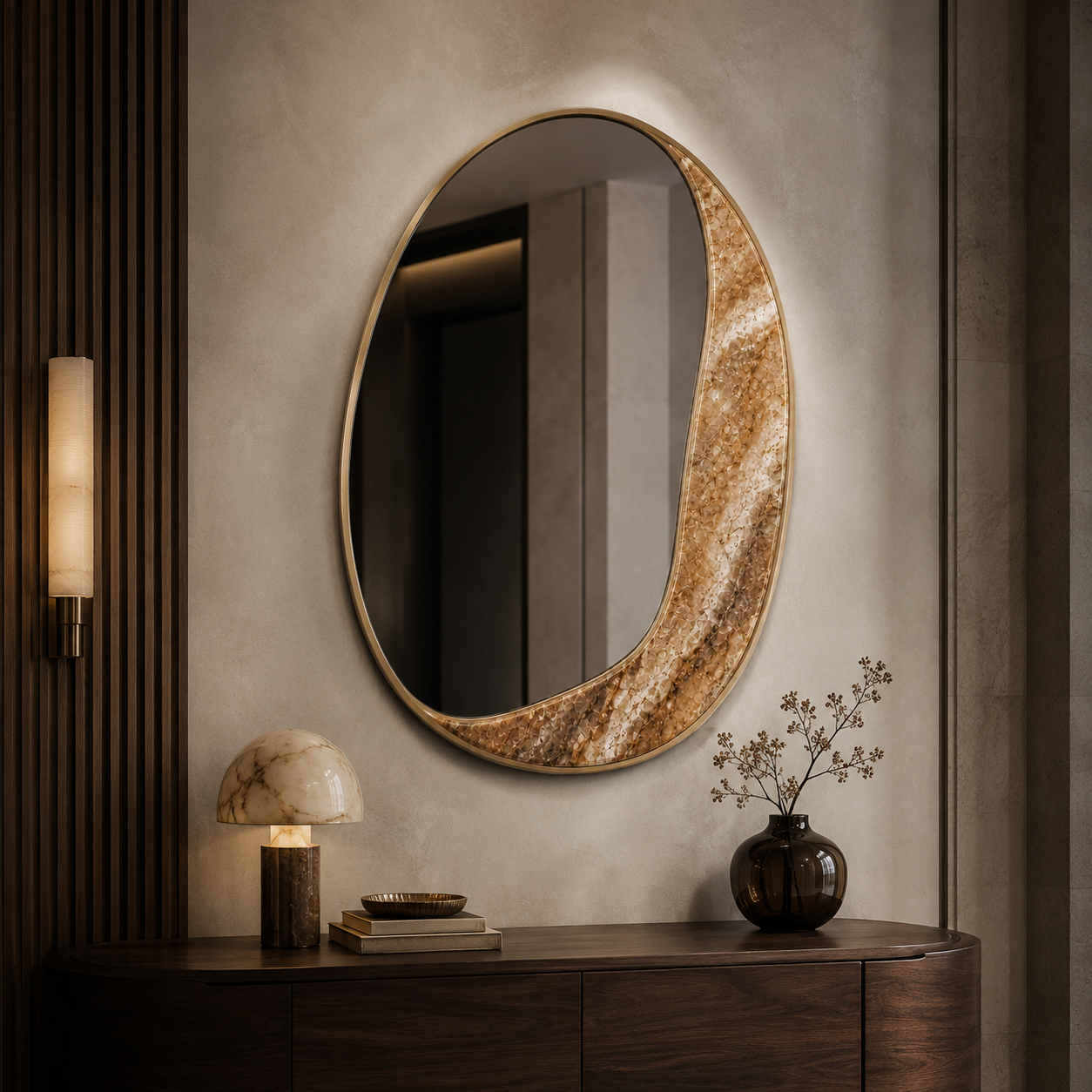
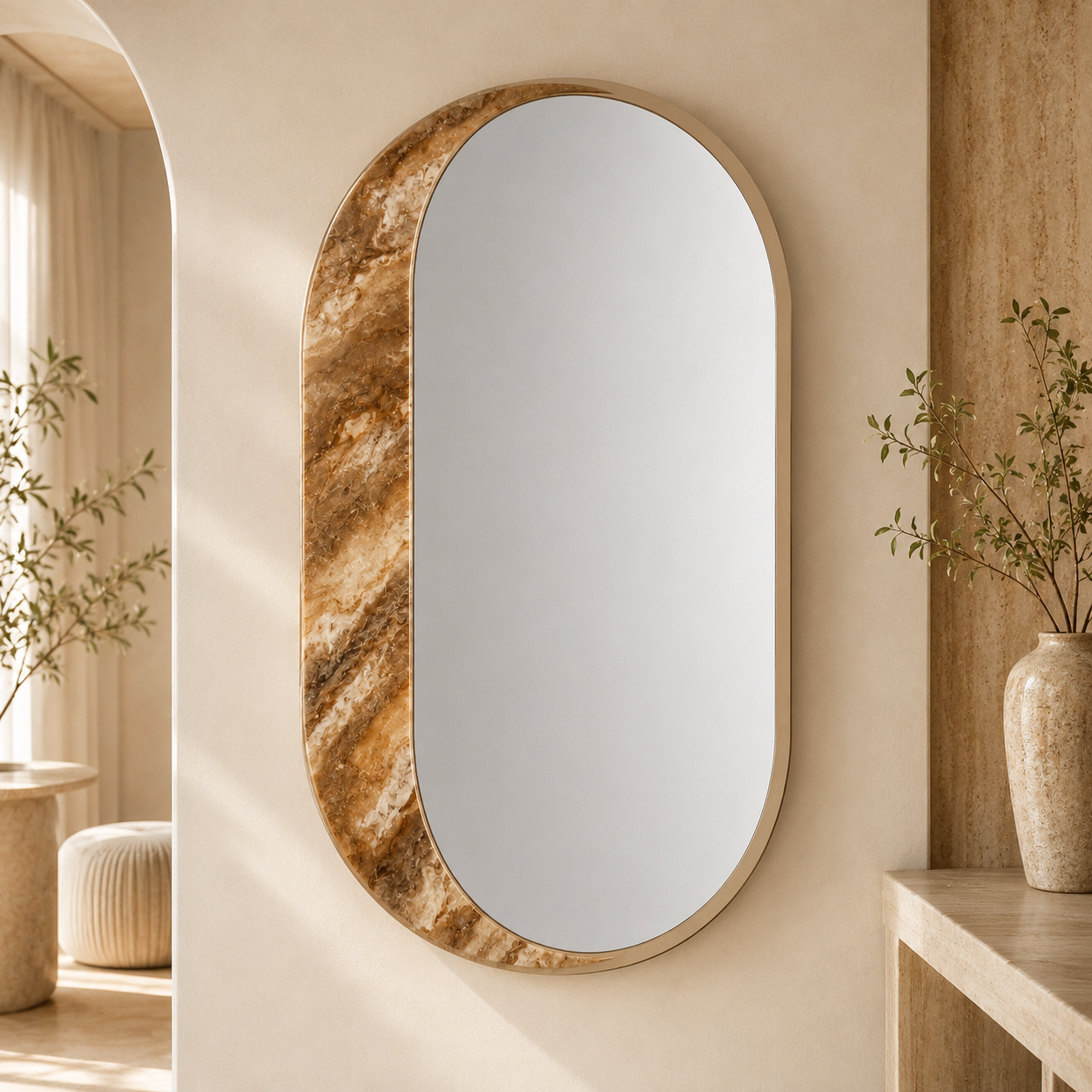
Consider Teruier’s Aurelia Natural Marble Mirror Collection.
The Aurelia Horizon Natural Marble Console Mirror and Aurelia Plinth Natural Marble Wall Mirror use natural marble as an identifiable design element.
The stone is not simply a pattern printed onto a frame.
Its position, proportions and relationship with the mirror structure are part of the product definition.
This is an important difference between generating an attractive image and developing a commercially defined product.
A visualization can suggest that marble and a mirror would look beautiful together.
Product development must answer different questions:
- What type of stone is suitable?
- How should the stone component be integrated?
- What are the actual dimensions?
- How will the mirror be supported?
- How will the product be protected during transportation?
- Can the appearance be maintained across production batches?
These questions cannot be answered by visual appearance alone.
For Teruier, AI-assisted visualization can be useful during early creative exploration, but the final product must be grounded in actual materials, specifications and manufacturing feasibility.
8. A Better Way for Retailers and Brands to Use AI
The answer is not to stop using AI-generated images.
It is to introduce a clearer workflow.
Step 1 — Explore
Use AI to explore styles, colours, room arrangements and product concepts.
Step 2 — Identify
Determine which elements are real products, which are design references and which are still conceptual.
Step 3 — Define
Translate the selected direction into product drawings, dimensions, materials, finishes and functional requirements.
Step 4 — Validate
Review the design for structural feasibility, manufacturing methods, cost and packaging.
Step 5 — Sample
Produce and evaluate a physical sample before presenting the product as a finished commercial item.
Step 6 — Photograph
Use real product photography to show customers what they are actually purchasing.
This approach does not reduce creativity.
It gives creativity a way to become commercially useful.
Frequently Asked Questions
Can AI-generated interior images be used to sell furniture?
They can be used for inspiration and concept visualization, but retailers should clearly distinguish conceptual images from actual product photography. Product availability, specifications and appearance should be represented accurately.
Why do AI-generated furniture designs sometimes look unrealistic?
Image generators prioritize visual patterns rather than automatically validating structural engineering, material properties, assembly methods or manufacturing costs.
Can AI replace interior designers?
AI can assist with visualization, research and early-stage concept development. However, professional design still involves understanding the client, selecting real materials, coordinating suppliers, resolving technical constraints and managing execution.
Is AI useful for home décor product development?
Yes. It can help explore silhouettes, colour directions, material combinations and product presentations. Physical samples and manufacturing validation remain necessary.
How should buyers evaluate an AI-generated product concept?
They should identify the actual product requirements, confirm materials and dimensions, review structural feasibility, obtain a physical sample and establish realistic pricing and packaging.
Final Thought: Beautiful Images Are Easy. Real Products Are Hard.
We are entering a period when almost anyone can generate a beautiful interior.
That is exciting.
But when every person can create a perfect-looking room, the value of a genuinely well-designed product may become even greater.
A real marble surface has physical character.
A well-made mirror has actual proportions and structure.
A thoughtfully developed decorative object has a material, a purpose and a manufacturing process behind it.
These qualities cannot be established by a beautiful image alone.
The future of home décor will not belong to whoever generates the most beautiful room. It will belong to those who can turn a beautiful idea into something people can actually live with.
At Teruier, we believe good product development begins with imagination but must be completed through design, materials, physical samples and manufacturing expertise.
Explore our collections or contact Teruier to discuss product development and wholesale sourcing opportunities.