
The Ottoman Should Be an “Easy Yes.” Here’s Why It Usually Isn’t.
Ottomans are supposed to be the low-drama SKU: small footprint, high add-on rate, easy to style, easy to refresh.
Design media even calls them “true multitaskers”—footrest, extra seating, flexible for almost any space.
And yet… when I’m sourcing for retail chains, ottomans are one of the fastest ways to accidentally buy myself a quarter of headaches: damaged corners, fabric pilling, inconsistent firmness, and the classic “the reorder doesn’t match the first shipment.”
So when a vendor pitches me as an ottoman supplier for retail chains, I don’t start by asking about colorways.
I start by asking whether they’re built for the only thing chains actually reward:
boring reorders.
Why Chains Keep Buying Ottomans (Even in a Returns-Heavy World)
Ottomans sell because they’re a fast visual upgrade and a functional add-on—especially when you can ladder them (pouf → storage ottoman → bench ottoman). But the operational downside is amplified by modern returns behavior.
NRF projects total retail returns to reach $849.9B in 2025, and estimates 19.3% of online sales will be returned.
That makes “minor issues” expensive issues—especially for a high-touch upholstered piece shoppers sit on, drag around, and scrutinize in store lighting.
What “Ottoman Supplier for Retail Chains” Means in Buyer Language
A chain-ready supplier isn’t the one who can make a nice sample once.
A real ottoman supplier for retail chains can do four things on repeat:
Deliver on time and in full (OTIF)
Hit durability expectations buyers can benchmark
Meet U.S. labeling/compliance realities without scrambling
Package for real transit—not showroom photos
Let’s break those down the way buyers actually evaluate them.
1) OTIF: The KPI That Quietly Decides Who Gets Reorders
OTIF (On Time In Full) measures whether shipments arrive when promised and in the quantities ordered.
McKinsey also points out a practical truth: there isn’t one universal OTIF definition—retailers and suppliers often define it differently—so the best vendors clarify it upfront and operate to milestones, not vibes.
What I want to hear from a chain-ready ottoman supplier:
“Here’s our milestone calendar (materials, cut/sew, upholstery, pack-out, booking).”
“Here’s how we flag exceptions early (and what options we offer).”
“Here’s how we handle partials without wrecking your floor set.”
2) Fabric Durability: Speak in ACT Benchmarks, Not “High Quality”
If your ottomans are for retail chains, your fabrics need a defensible durability story.
ACT’s voluntary abrasion guideline gives a clean reference:
15,000 Wyzenbeek / 20,000 Martindale: commercial low traffic / private spaces
30,000 Wyzenbeek / 40,000 Martindale: commercial high traffic / public spaces
No, not every chain ottoman must be “contract grade.”
But if you can’t tell me what your fabrics are designed to withstand, I assume the product is built for photos, not shoppers.
3) U.S. Flammability Labeling: Don’t Let This Delay a Launch
Here’s the part many suppliers underestimate: chains hate compliance surprises late in the process.
CPSC’s guidance says that under 16 C.F.R. part 1640, the labeling requirement is providing a permanent label with the certification statement:
“Complies with U.S. CPSC requirements for upholstered furniture flammability.”
If you want to be a serious ottoman supplier for retail chains, you should be able to explain:
how you handle the label statement,
what records you keep as best practice,
and how you avoid last-minute relabeling chaos.
4) Packaging: The Hidden Margin Protector
Most chain buyers aren’t obsessed with packaging because we like cardboard.
We’re obsessed because packaging failure becomes:
damage allowances
chargebacks
returns
bad reviews
and a dead reorder cycle
ISTA’s 3-Series are described as General Simulation Performance Tests designed to simulate the damage-producing motions, forces, conditions, and sequences of transport.
Even if you’re not running formal ISTA testing on every SKU, your packaging design should reflect that reality:
corner & edge protection (ottomans get dropped)
abrasion barriers (bouclé/shearling-style textures scuff and snag)
internal blocking so legs don’t punch through cartons
compression resistance for stacked freight
The “Chain Program” Test: 10 Questions I Ask Before I Approve a Vendor
If you want to win chain business, prepare answers to these—clearly, in writing:
What’s your golden sample control process for reorders?
What are your tolerances (height, firmness, leg alignment, wobble limits)?
What ACT abrasion tier are you targeting (15k vs 30k and why)?
How do you prevent pilling/matting on high-touch textures?
What’s your OTIF definition and milestone reporting cadence?
What is your 16 CFR 1640 labeling workflow?
What packaging hazards are you engineering against (drop/compression/abrasion)?
How do you reduce damage without exploding cube/landed cost?
What happens when product is out of spec—rework/replace/credit rules?
If it hits, how fast can you replenish without changing the product?
If your answers sound like a system, you’re in my “reorder” bucket.
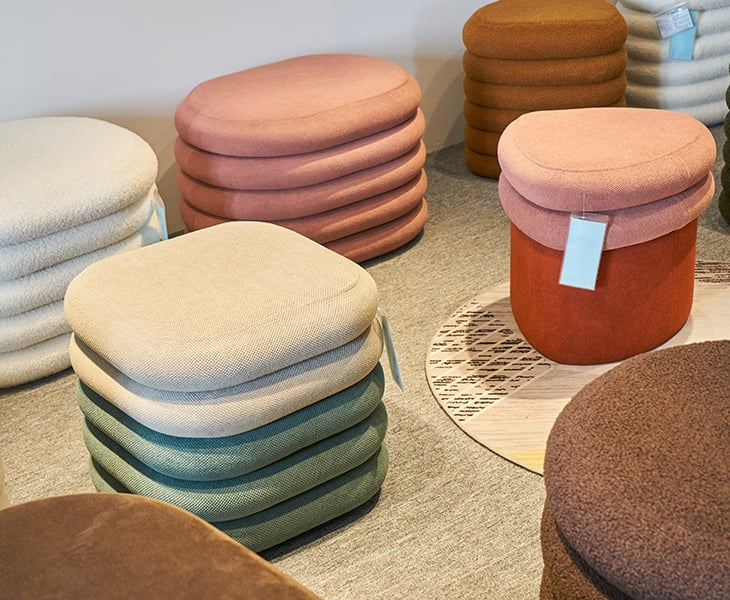
What Buyers Actually Want
We don’t need 60 new ottoman designs.
We need 8 reorderable winners:
2 anchor neutrals (always-on)
1–2 texture stories (seasonal)
1 storage option (functional driver)
consistent carton footprints (logistics sanity)
and a supplier who can repeat the same product without drama
Because in a returns-heavy environment, the winning ottoman isn’t the most creative one—it’s the one that lands clean, holds up, and reorders safely.



