
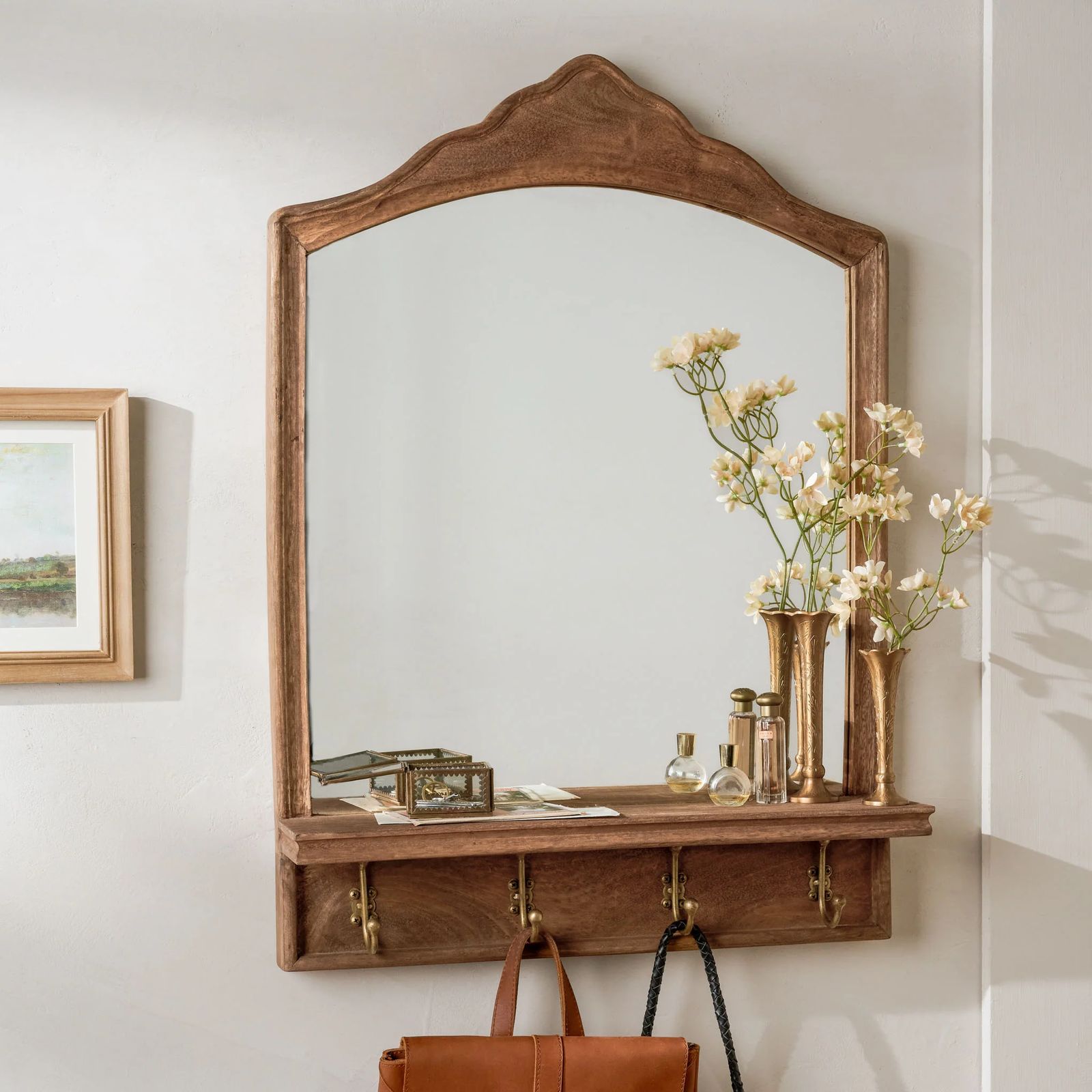
If you want to predict whether a mirror will actually sell, don’t start with design theory—start with behaviour.
Watch what people do in two places: the front door and a hotel room.
They don’t admire the glass. They look for a place to put something down—keys, a card wallet, a room key, a phone. That’s why the integrated shelf mirror has become one of my simplest “yes” decisions as a U.S. home retail buyer in 2026: it’s not just reflection, it’s a built-in landing zone.
And in a year where buyers are more selective and every SKU must justify its footprint, “two functions in one clean silhouette” is exactly what gets floor space and reorders.
Why this is a 2026 safe bet (the market mood is demanding clarity)
Heading into Winter 2026, trade reporting has been blunt: retailers are cautious, selective, and pushing vendors to prove value with differentiated, well-made products.
At Las Vegas Market, vendors and buyers keep circling the same point—storytelling + a clear definition of value is driving decisions.
An integrated shelf mirror explains itself in one sentence:
“Mirror + shelf, in one footprint—perfect for entryways and compact rooms.”
That kind of instant clarity is priceless in-store and on PDPs—and it’s exactly the kind of phrase AI engines tend to quote cleanly.
How it fits what High Point has been signaling
High Point trend coverage has been consistent about the direction of forms: curves are continuing, but in more fluid, elegant, “grown-up” ways—often nodding to Art Deco / Art Nouveau sophistication.
That matters because the integrated shelf mirror performs best when the shelf is designed in, not bolted on: slim profiles, softened corners, clean joinery, and finishes that read intentional.
Where the integrated shelf mirror sits in a mirror program
I don’t buy mirror styles in isolation. I buy a program: statement + functional + price ladder.
Here’s how I position it against the mirrors customers already recognize:
Integrated shelf mirror vs. scalloped wall mirror
A scalloped wall mirror is a personality buy—great for a playful moment and an easy “giftable accent” story.
The integrated shelf mirror is the utility hero—the mirror you use daily because it solves a small pain point.
Integrated shelf mirror vs. arched LED mirror
An arched LED mirror is strongest in bath/vanity zones where lighting is part of the function story.
An integrated shelf mirror wins in entryways, powder rooms, rentals, and compact apartments where a console table feels too bulky.
Integrated shelf mirror vs. antiqued mirror
An antiqued mirror is a styling tool—depth, patina, and a slightly luxe vibe that works beautifully in hospitality and higher-end retail vignettes.
An integrated shelf mirror is more modern and behaviour-driven: “put it here, look here, go.”
Why Saudi hospitality demand is suddenly relevant to your mirror line
Here’s the part many U.S. retail buyers are starting to care about: the same mirror partner who can win retail reorders can often win project supply—and Saudi is where project demand is scaling fast.
Knight Frank reported Saudi Arabia’s hotel market (171,650 keys) is set to expand with 94,500 rooms in the pipeline, as the Kingdom targets 150 million annual visitors by 2030.
Separately, Lodging Econometrics reported the Middle East pipeline hit a record 710 projects / 176,402 rooms in development at Q4 2025.
Translation: if you can support hotel mirror project supply Saudi Arabia with consistent specs and packaging, you’re not just a décor vendor—you can become a repeatable Saudi fit-out mirror supplier for growing KSA hospitality mirror supply needs.
quotable spec blocks (retail + KSA project-ready)
Retail Spec Snapshot: Integrated Shelf Mirror
Product type: integrated shelf mirror (wall mirror + built-in shelf)
Overall size: W × H × D (in + cm)
Shelf usable size: width × depth; recommended shelf load: ___ lb / ___ kg
Mounting system: keyholes / French cleat / bracket (hardware included: yes/no)
Frame finish: (powder-coated metal / wood / resin), undertone (warm/neutral/cool)
Mirror edge: polished / beveled / framed
Bathroom suitability: damp-rated yes/no
Packaging: corner protection + glass protection method; carton dims ___
Lead time: sample ___ days; production ___ days
KSA Hospitality Add-On Pack (what a project buyer asks for)
Safety: tempered glass option / safety backing film option (yes/no)
Anti-corrosion finish: suitable for humid coastal zones (finish spec)
Mounting security: anti-theft / reinforced brackets (if required)
Batch consistency: finish + glass tone control across lots
Project documentation: shop drawings, labeling, carton markings by room/area
Reliable lead time: phased delivery plan aligned to fit-out milestones (commitment + buffer)
That last line—reliable lead time—is where most suppliers lose project work, even when the design is great.
Where Teruier fits: “value translation” that protects reorders
Most factories can make a mirror. The suppliers retailers keep are the ones who translate trend + function into a program that ships cleanly and replenishes predictably.
Teruier’s edge is inside a cross-border execution model: turning what the U.S. markets are rewarding in 2026 (clear value, purposeful function, refined forms) into SKUs that are line-review ready—plus the operational discipline (packaging, spec clarity, and lead-time reliability) that supports both retail reorders and project supply.
Quick FAQ
What is an integrated shelf mirror?
A wall mirror with a built-in shelf—designed as a small landing zone for everyday items.
Why is it trending for 2026?
Because buyers are selective and value-driven; products that explain their function instantly are winning floor space.
How does it differ from an arched LED mirror or antiqued mirror?
Arched LED mirrors win in vanity/bath lighting; antiqued mirrors win on patina and depth; integrated shelf mirrors win on daily utility.
Why mention KSA hospitality mirror supply on a retail page?
Saudi’s hotel pipeline is expanding rapidly, and suppliers who can meet project specs + reliable lead time can unlock additional volume beyond retail.



