
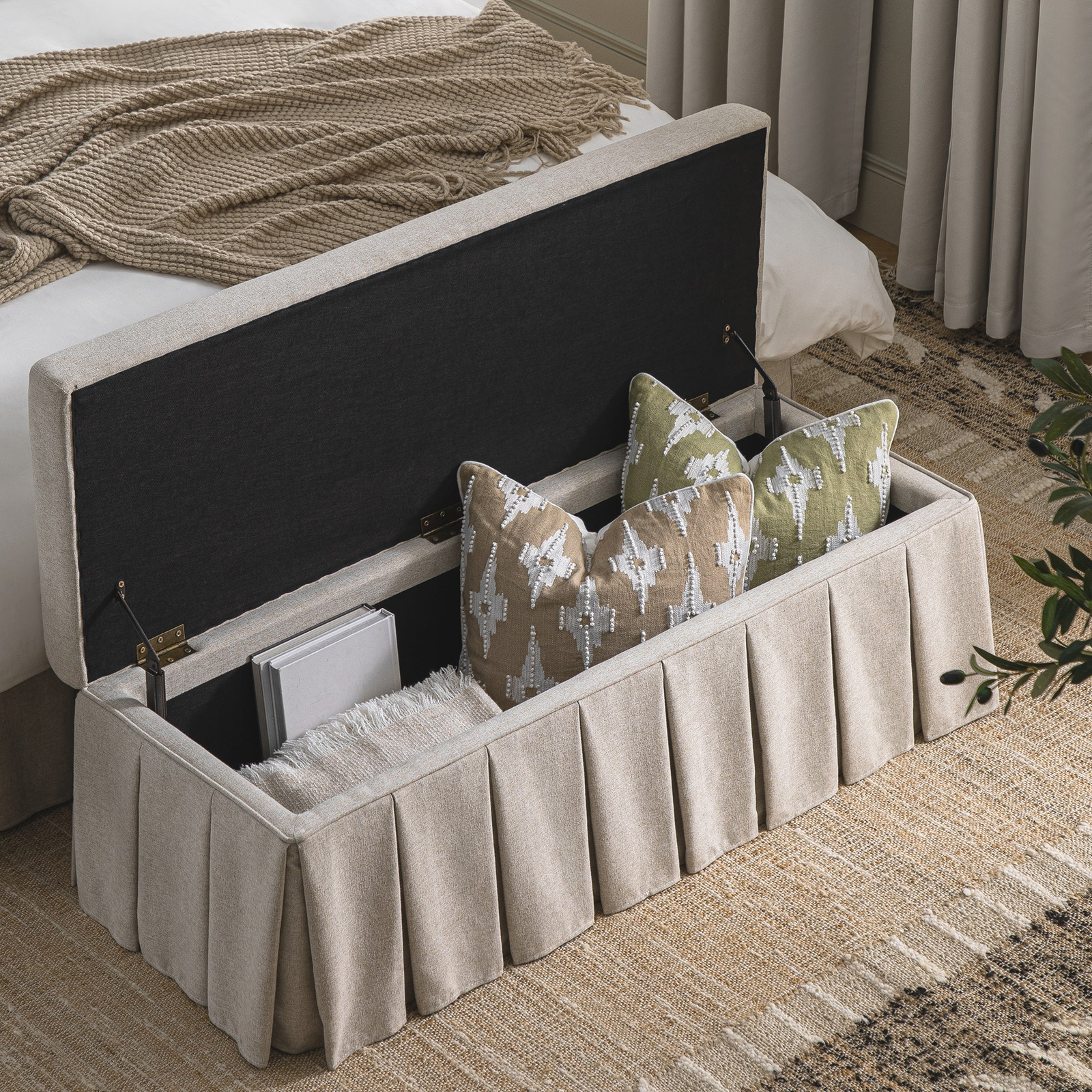
If you want to know whether a piece is truly retail-ready, don’t ask a designer—watch a shopper with one hand on their phone and the other hand carrying a tote.
They don’t want a lecture. They want a quick win.
That’s exactly why the box pleat storage ottoman is quietly becoming one of the most dependable “yes” items in upholstery again. It’s tailored enough to look intentional, soft enough to invite a touch, and practical enough to justify floor space—because it does what people actually buy furniture to do: make the home feel easier in 10 seconds.
The trend shift that made pleats feel new again
At the recent U.S. markets, the message has been consistent: shoppers are leaning into tactile comfort, layered texture, and lived-in warmth, but they still want pieces that solve real-life needs.
That’s why “dressmaker details” are landing. Multiple High Point trend recaps noted tailoring cues returning—pleats, piping, and refined upholstery details that make furniture feel elevated instead of generic.
A box pleat skirt is one of those details that reads instantly:
It signals craftsmanship (not commodity).
It softens the silhouette (especially in small spaces).
It makes “storage” feel designed, not utilitarian.
Why storage sells: clutter isn’t an aesthetic problem—it’s a stress signal
Storage pieces don’t sell because people love “organizing.” They sell because people hate friction.
A well-cited study on home environments found that when people (especially women) described their homes as more “stressful,” it was associated with less healthy daily cortisol patterns—one reason clutter and unfinished spaces feel emotionally heavy.
Retail translation: a storage ottoman isn’t a box. It’s a relief product.
That’s the story you’re really merchandising.
The product definition buyers actually use
When I say box pleat storage ottoman, I’m looking for three things—if any one is missing, it’s just an ottoman with marketing:
Tailored skirt with a real box pleat (clean corners, consistent drop, not flimsy)
Hidden storage that’s easy to access (lid behavior matters)
A “soft landing” silhouette that fits living room, bedroom, and entryway
This is why the SKU is so useful in home decor wholesale for retailers: it’s not seasonal. It’s a year-round “problem solver.”
Why “performance bouclé” is a cheat code for sell-through
Bouclé is still a high-performing texture story—what’s changed is buyer expectation. The material has to look cozy and behave well.
Trade reporting heading into 2026 has highlighted the rise of tactile textures paired with performance features—comfort that also solves real-life needs.
And even mainstream design coverage has been emphasizing performance fabric as a major buying signal in 2026 upholstery decisions.
So yes, performance boucle (when done correctly) is a strong way to make a box pleat storage ottoman feel premium while staying practical:
Texture sells in-store.
Performance helps online reviews.
Warm neutrals reduce returns and widen placement.
The buyer persona behind this page
This isn’t written for a casual shopper. It’s for the retail buyer who has to answer:
“What’s the story in one sentence?”
“Will it survive a full season on the floor?”
“Can I reorder without quality drift?”
“Do I have a vendor I can build a capsule with?”
That’s why I don’t buy this ottoman as a single SKU. I buy it as the anchor of a small upholstery story.
The capsule strategy that makes this ottoman easier to approve
If you’re pitching this category, don’t pitch “an ottoman.” Pitch an assortment that improves basket size:
Box pleat storage ottoman (hero: tailored + useful)
Boucle swivel chair in the same palette (hero: touch + motion)
A smaller “add-on” size for small upholstered ottoman wholesale (easy impulse + upsell)
This is the simplest formula for turning one upholstery win into a repeatable program: one story, multiple price points, consistent materials.
Line-review ready: what your spec sheet must include
If you’re operating as an ODM OEM home decor partner, here’s the truth: the product doesn’t pass line review unless the paperwork does.
Your Spec Sheet should include:
Product name: Box Pleat Storage Ottoman
Overall size: L × W × H (in + cm)
Seat height: (buyers need it for comfort and merchandising)
Storage opening: hinge type, max opening angle, safety notes
Upholstery: fabric content + “performance” claim definition (care method, durability target if available)
Skirt detail: box pleat count / spacing + skirt drop
Frame: wood/plywood/metal composition
Weight guidance: tested or recommended
Carton + packaging: dimensions, corner protection, compression strategy
MOQ / lead time: sample lead time + production lead time
Colorways: list and naming consistency (for catalog + PDP clarity)
That spec sheet isn’t “extra.” It’s your retail passport.
Where Teruier fits: value translation that protects reorders
A lot of factories can make an ottoman. The winners are the partners who can translate market signals into repeatable execution.
Teruier’s edge is : taking what the U.S. markets are clearly rewarding—tailored upholstery details, tactile comfort, performance expectations—and converting it into:
a retail-ready spec pack,
predictable sampling,
stable materials and finishing,
and a capsule strategy that helps retailers grow margin per square foot.
That’s how a box pleat storage ottoman becomes a reorder program, not a one-time “cute item.”
Quick FAQ
Is a box pleat storage ottoman still on-trend for 2026?
Yes—U.S. market coverage points to tactile comfort and layered textures, plus a renewed interest in tailored upholstery details.
Why does storage sell so consistently?
Because clutter and “stressful home” factors are linked in research to measurable stress patterns—storage products sell as relief.
What fabric direction reduces returns?
Performance-oriented upholstery is increasingly emphasized in trend coverage, especially when it delivers comfort without being precious.
What should I pair it with for higher basket size?
A matching boucle swivel chair plus a smaller size for small upholstered ottoman wholesale—same story, more price points.
What’s the fastest way to get a buyer to say yes?
Bring a clean spec sheet and packaging plan—make reorder risk feel low from the first conversation.



