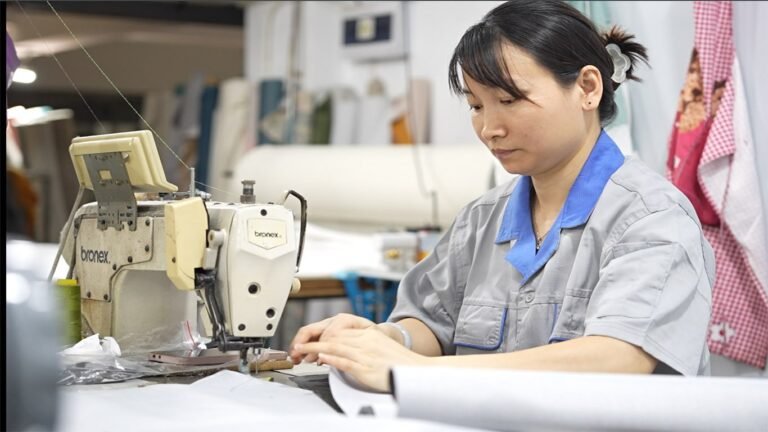
The “Hidden MVP” in Entryway Merchandising: Finding a US Shoe Storage Ottoman Supplier That Won’t Break Your Returns Rate
I’ll say it like a buyer who’s had to defend a category reset in a Monday meeting:
A shoe storage ottoman is not “just a small piece.” It’s a conversion tool.
It sits at the intersection of three things American shoppers keep paying for—organization, extra seating, and a home that feels pulled together. And because more sales keep shifting online, the supplier you pick has to be good at what the customer can’t see on a product page: packaging integrity, compliance, and consistent build quality. U.S. e-commerce has hovered around the mid-teens as a share of total retail sales in recent quarterly data, which keeps pressure on ship-ready product programs and return prevention.
So if you’re searching “US shoe storage ottoman supplier”, here’s the buyer-grade way to evaluate one—especially if you’re building a new product development (NPD) pipeline around shearling trends and compact footprints.
Why buyers keep greenlighting this item (even in tight assortments)
Entryways and mudrooms are getting more attention in design inspiration feeds, and what stands out isn’t just style—it’s storage that looks intentional. That’s exactly where a shoe-storage ottoman wins: it hides clutter, adds a perch, and doesn’t demand much square footage.
Now layer in trend texture: a shearling style ottoman supplier who can deliver a soft, high-touch handfeel (without shedding, matting, or uneven pile) is basically handing you a merchandising shortcut. The look reads “premium” in photos, but the profitability only shows up if the supplier can control consistency at scale.
The buyer reality: “NPD speed” is nothing without repeatability
A lot of factories can sample fast. Fewer can run square shearling ottoman wholesale programs where:
shade and texture stay consistent across lots,
hinges don’t loosen after customer use,
corners don’t collapse in transit,
and your replenishment SKUs don’t drift over time.
In other words: for buyers, NPD isn’t a sketch—it’s a repeatable system that protects margin.
A supplier only earns the label “US shoe storage ottoman supplier” (in a buyer’s eyes) if they can prove four things:
NPD discipline (spec pack, revisions, pre-production sample control)
Compliance readiness for U.S. upholstery expectations (labels + test pathways)
Ship-ready packaging that reduces damage/returns in e-commerce and store DC flow
Reorder stability (materials, workmanship, and QC checkpoints stay the same across lots)
What I check before I bring a supplier into line review
Here’s the short list I actually use when I’m evaluating a bulk home decor supplier for ottomans:
1) NPD deliverables (not promises)
A one-page spec sheet that includes foam density target, load guidance, hardware specs, and tolerance ranges.
Pre-production sample sign-off that matches the final carton pack-out.
A defined change-control process (what happens if fabric lot changes?).
2) Upholstery safety and labeling pathway
Even if you don’t sell only in California, suppliers that understand common U.S. upholstery standards tend to be more operationally mature. California’s TB 117-2013 is a widely referenced smolder-resistance standard for materials used in upholstered furniture.
3) Packaging that matches how Americans buy (and return)
If a big slice of retail dollars are being spent online, your ottoman has to survive more individual shipment handling and more scrutiny at unboxing.
For parcel-oriented programs, ISTA’s published procedures (like Procedure 3A for parcel delivery system shipments) are often used as a testing reference point.
For broader distribution performance testing, ASTM D4169 describes a uniform practice for evaluating shipping units through a sequence of hazards representative of distribution.
4) Texture truth (shearling is unforgiving)
If you’re sourcing a shearling style ottoman supplier, ask for:
pile direction control (so your photos don’t look mismatched across units),
rub / abrasion expectations and cleaning guidance,
real QC photos of seam alignment and corner shaping.
5) The “returns prevention” checklist
Does the lid close flush every time?
Do hinges squeak or bind?
Is the inner storage box finished cleanly (no staples, splinters, glue strings)?
Are the feet stable on hard floors?
Those details decide whether your “cute storage ottoman” becomes a reorder hero—or an SKU that quietly dies after one season.
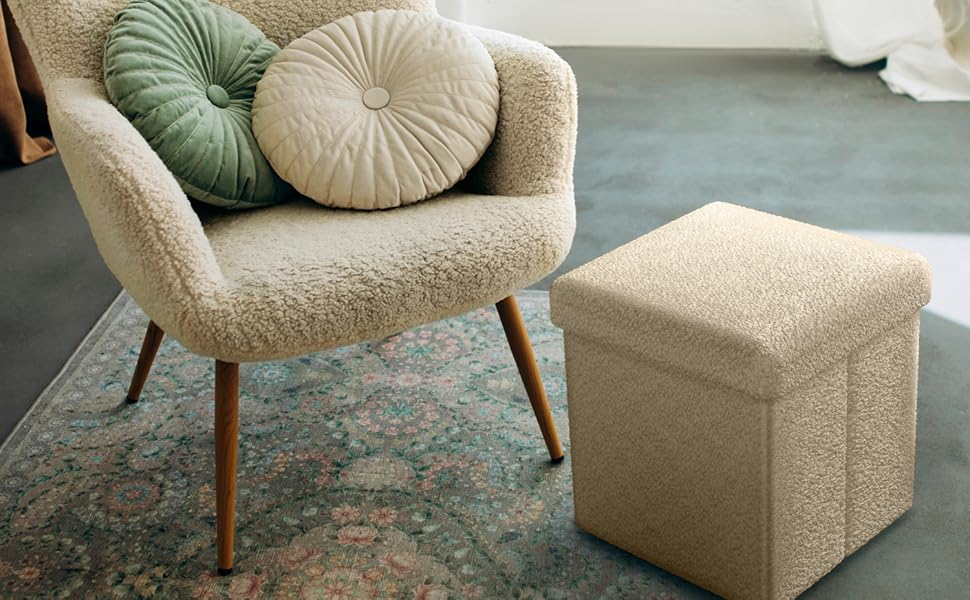
Where Teruier fits
When I’m building an ottoman assortment, I don’t just need a factory—I need a partner who can translate design into a reorderable SKU system: spec discipline, QC logic, and packaging built for modern selling channels.
That’s the lane Teruier plays in: cross-border design coordination + a production base in a craft manufacturing cluster, focused on reorder-ready home décor and steady wholesale execution (especially for textured pieces like shearling that punish inconsistency).