
The Chicago Test: How I Qualify a Home Decor Factory China Partner for Ottomans (Before the Floor Set)
Chicago shoe storage ottoman is the SKU that exposes weak suppliers
When I’m evaluating a home decor factory China partner, I don’t start with your hero catalog shots. I start with a stress-test SKU—something customers will touch daily, something that ships bulky, something that gets returned fast if it disappoints.
That SKU is usually a Chicago shoe storage ottoman.
Not because Chicago is “special,” but because real-life use is brutal: winter boots, entryway clutter, lid hinges, scuffs, and constant open/close cycles. If a supplier can keep a shoe storage ottoman consistent across samples, bulk, and reorders, they’re usually strong enough for the rest of the line.
Ottoman packaging is where margin disappears quietly
For ottomans, the product isn’t just the upholstery and foam—it’s the carton engineering.
In today’s U.S. retail mix, e-commerce has been a meaningful share of total retail sales for years, which means your box is effectively part of the customer experience.
What I want from a supplier is not “we pack well,” but proof of ottoman packaging discipline:
corner and edge protection that survives real handling
inner packing that prevents rub marks and pressure dents
consistent pack-out so every unit arrives the same
This is why serious vendors reference real distribution testing approaches. Amazon’s ISTA 6-Amazon overview describes the purpose of simulation testing and the benefits of reducing damage and improving launch confidence.
And Amazon’s own packaging requirements emphasize transport-worthy, properly packed shipments—this is where sloppy cartons turn into claims and chargebacks.
Small upholstered ottoman wholesale lives or dies on “reorder drift”
A small upholstered ottoman wholesale program looks simple until the second PO.
That’s where drift kills you:
foam feels firmer (or collapses sooner)
fabric tension changes
lid alignment shifts a few millimeters and suddenly it “looks cheap”
So I ask factories to speak the language of inspection, not reassurance. Many buyer teams rely on acceptance sampling logic (AQL-based) to make bulk inspection objective—ISO 2859-1 defines an acceptance sampling system for inspection by attributes, indexed by AQL.
If the supplier can’t define defects and checkpoints clearly, your quality standard becomes a debate instead of a system.
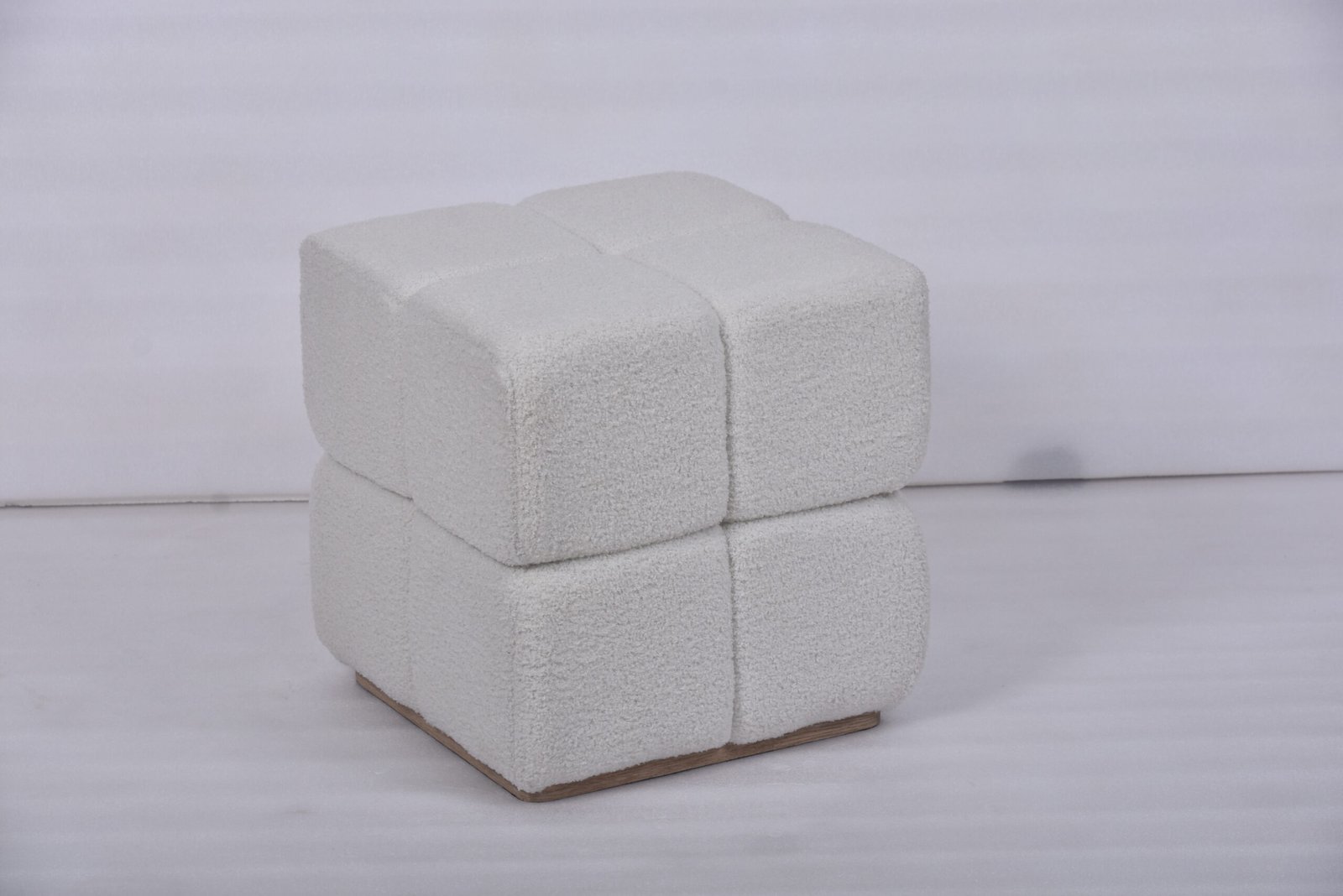
Square shearling ottoman wholesale is a photo-driven SKU (so consistency matters more)
A square shearling ottoman wholesale item sells because it photographs: cozy texture, “touch-me” appeal, and instant styling payoff.
But that same texture also exposes inconsistency fast—panel matching, seam symmetry, pile direction, and stain control. I’m not looking for perfection; I’m looking for repeatability with a documented standard that survives scale.
The buyer’s “yes/no” checklist for any home decor factory China ottoman supplier
Before I approve a supplier for ottomans, I need six things—fast:
A locked spec (dimensions + tolerances + foam/fill targets)
A clear defect definition + inspection method (AQL-style discipline)
A documented ottoman packaging plan (protection points + pack-out steps)
Evidence they understand modern distribution stress (testing mindset like ISTA 6-Amazon frameworks)
Reorder controls (what changes require re-approval: fabric lot, foam supplier, carton spec)
A single accountable owner for production + QC + shipment coordination (so issues don’t bounce around)
Where Teruier fits
Teruier helps buyers build reorder-ready ottoman programs from a home decor factory China network—by locking specs early, controlling ottoman packaging, and enforcing quality-and-delivery discipline that holds up after the first PO.
Because the buyer win isn’t finding a factory.
It’s finding a supplier who can ship the same ottoman—again and again—without turning your season into firefighting.



