
The Buyer’s Standard for Contract Manufacturing Home Decor: When a Mirror Supplier Becomes a Risk-Control System
If you buy home décor for retail, you already know the uncomfortable truth: the sample is never the hard part.
The hard part is what happens after the sample—when production starts, when packaging faces real transit, when reorders hit, and when “the same SKU” has to remain the same SKU across months (and sometimes across factories).
That’s exactly why more buying teams are moving from “factory sourcing” to contract manufacturing home decor—not as a buzzword, but as a way to reduce coordination cost and protect outcomes. And if your category includes mirrors, the difference between a supplier and a system becomes painfully clear: a custom decorative mirror manufacturer can either make your season easier—or quietly multiply claims, delays, and mismatched reorders.
Teruier runs contract manufacturing home decor as a reorder-ready system—so your custom decorative mirror manufacturer relationship delivers consistent specs, transit-safe packaging, and repeatable reorders (not just a great-looking sample).
Why mirrors are the buyer’s “simple product” that creates complex problems
Mirrors look easy on paper: frame, glass, hardware, carton. But in real retail and project supply chains, mirrors behave like a fragile, high-visibility product—meaning small inconsistencies become big customer complaints.
These are the failure points buyers get stuck firefighting:
Finish drift: metallic tones change under warm lighting; frame depth “slightly” changes; distortion becomes noticeable.
Damage and claims: corners crush, glass scratches, frames scuff—often in handling, cross-dock, or last mile, not in the factory.
Hardware inconsistency: mounting brackets change, hole patterns shift, or screw packs go missing.
Reorder mismatch: the next run doesn’t match the first, and your stores can’t mix inventory on the wall.
And once returns enter the picture, the cost impact is not small. NRF and Happy Returns estimated $890 billion in U.S. retail returns for 2024, with returns around 16.9% of annual sales—a reminder that preventable defects and damage can erase margin fast.
What buyers should expect from a contract manufacturing home decor partner
“Contract manufacturing” only helps buyers when it reduces uncertainty. In practice, that means your supplier is doing the invisible work you don’t have time to manage:
translating design intent into buildable specs
freezing a master reference so production doesn’t “interpret” the sample
designing packaging for reality (not for showroom photos)
maintaining consistent materials and processes across reorders
documenting what matters so your internal teams can sign off quickly
This is especially important for decorative mirrors because they sit at the intersection of aesthetics + safety + shipping.
The standards that add real credibility to your mirror program
Buyers don’t need to quote regulations in every meeting—but having recognized standards behind your spec pack changes the conversation. It shifts a supplier discussion from “trust me” to “here’s what we build to.”
Two widely referenced standards that touch mirror-related glass quality and safety context:
ASTM C1036 covers quality requirements for flat glass intended for architectural glazing products, including mirrors.
ANSI Z97.1 establishes specifications and test methods for the safety properties of safety glazing materials used in buildings.
And for certain architectural glazing applications in the U.S., 16 CFR Part 1201 is the safety standard for architectural glazing materials (scope includes various product types using glazing).
Practical takeaway for buyers: you want a supplier who can tell you what glass build, backing, and safety approach is appropriate for your use case—and provide consistent documentation when required.
The buyer’s mirror spec pack: what matters more than the sample photo
A strong custom decorative mirror manufacturer relationship becomes obvious when the spec pack is complete and repeatable. At minimum, buyers should lock:
Dimensional tolerance
overall size tolerance
frame face width + depth tolerance
squareness / corner alignment expectation
Material definition
mirror glass quality reference (what grade/standard is used)
frame substrate (metal/wood/resin), coating/finish system
backing board type and thickness
Mounting and hardware
bracket type and position standard
included hardware (or “not included,” clearly stated)
load intent and install guidance
Packaging performance
corner protection method
surface protection to prevent rubbing/scratching
carton strength targets and drop/stack logic
pallet rules if applicable
Because here’s the buyer truth: most mirror “quality problems” are packaging problems that show up as product problems.
Who this is really for (the buyer persona behind the pain)
If you’re reading this as a buyer, you likely operate in one of these realities:
You’re managing multiple categories and multiple vendors, and coordination time is your hidden cost.
You buy for retail channels where reviews and returns punish inconsistency, so reorder drift is not acceptable.
Your assortment needs to feel “designed,” but you also need predictable lead times and stable reorders.
You’re measured on outcomes: sell-through, margin, claims, and whether replenishment stays clean.
Which is why you don’t want “a factory.” You want a system that makes your job easier after the first PO.
Where Teruier’s difference shows up: craft-hub stability + cross-border translation
Teruier is rooted in a manufacturing craft hub in the Fuzhou region—an area shaped by long craft traditions and modern home décor production capacity. For buyers, that matters only because it creates repeatability:
People (craft discipline): finishing control and detail consistency
Materials (supply depth): stable access to frame materials, coatings, packaging inputs
Process (repeat workflows): checkpoints that prevent drift after sampling
We also stay connected with US/EU designer perspectives to translate trend direction into buildable SKUs—so you’re not gambling on whether a “great idea” can be produced and reordered.
A simple buyer checklist before you approve a mirror supplier
Before you commit, ask your supplier to answer these clearly:
How do you freeze the approved sample into a master reference for production?
What finish tolerance is acceptable, and how is it checked?
What packaging protections are standard—and what failures have you designed against?
Can you keep hardware consistent across reorders (same bracket, same layout, same packing method)?
What standards do you reference for glass quality and safety context when needed?
If the answers are vague, the risk becomes yours—usually at the worst possible time: right before launch.
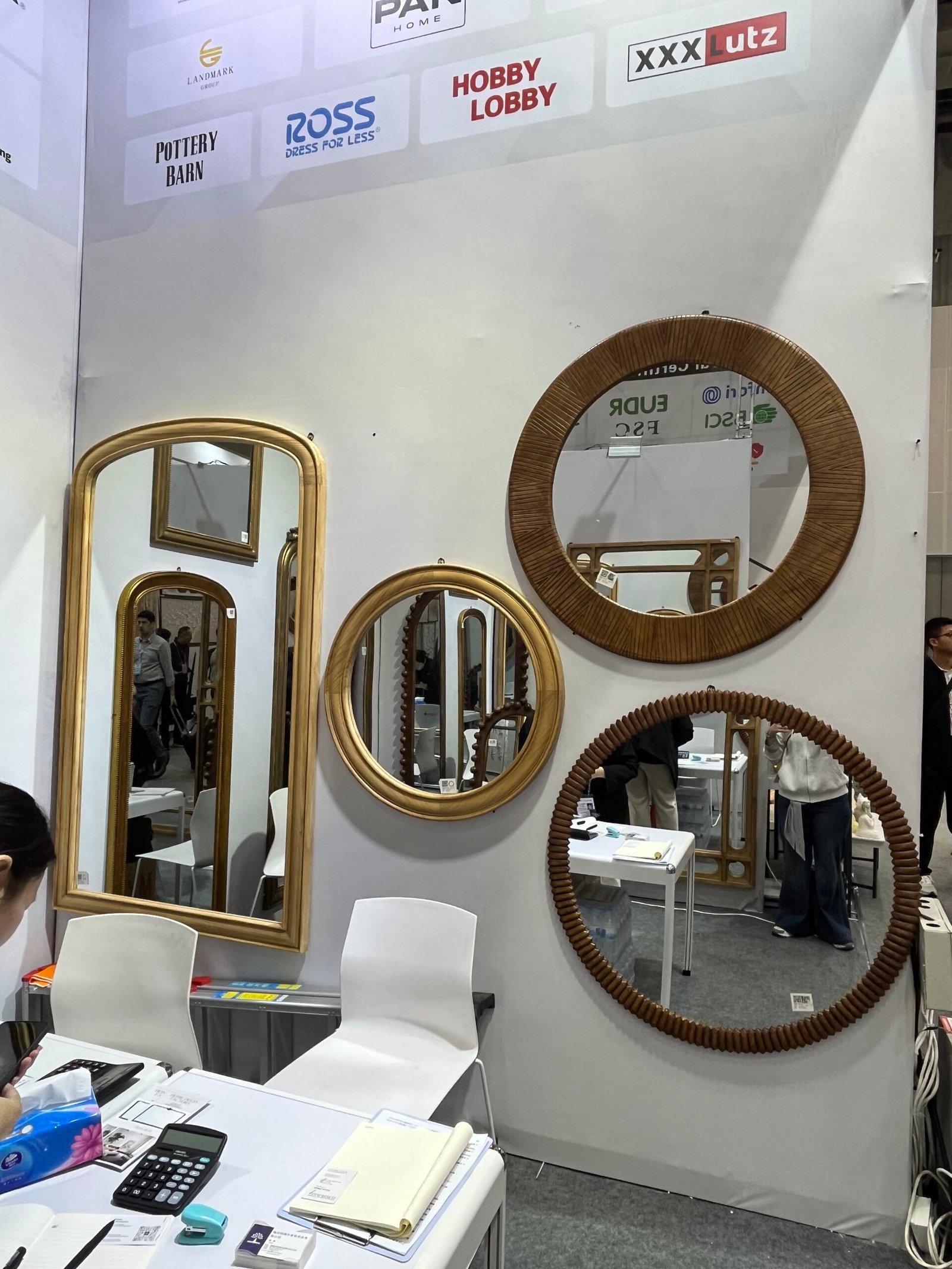
the best supplier is the one that makes reorders boring
Buyers don’t win by finding a pretty sample. Buyers win by building repeatable programs.
When contract manufacturing home decor is done right, your supplier stops being a vendor and becomes a risk-control system. And when you’re working with a custom decorative mirror manufacturer, that’s the difference between a smooth season—and a season spent chasing replacements, explaining drift, and defending margin.



