
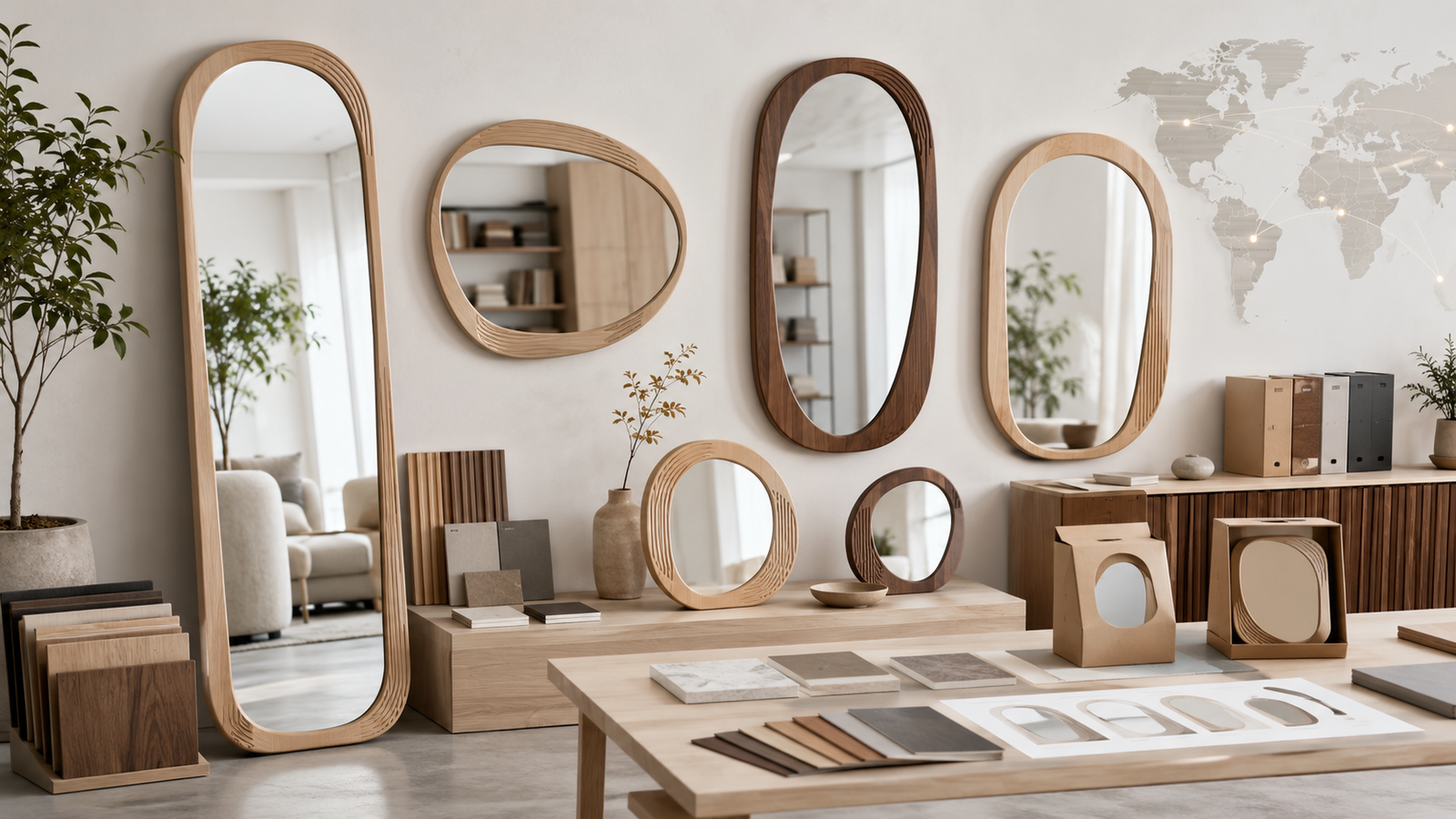
The Buyer Story: A Strong Mirror Was Not Yet a Strong Collection
A German home-furnishings buyer reviewed six promising mirrors for a new private-label programme.
The shortlist included an oversized floor mirror, a reeded wood wall mirror, a smoked-glass design and an Inlaid Mirror with a handcrafted border.
Each product looked attractive.
However, the buyer did not want six unrelated statement pieces. The retailer needed a coherent private-label mirror collection that could be displayed across several stores, introduced online and reordered without rebuilding the programme each season.
The sourcing question therefore changed.
Instead of asking, “Which mirror is most fashionable?”, the buyer asked:
Which design can become a family?
Which materials can be repeated?
Which trend will remain relevant into 2027?
Which supplier can control finish, packaging and replenishment?
That is the difference between buying individual mirrors and developing a commercially useful collection.
What German Trade Fairs Suggest for Mirror Trends 2026
Ambiente Trends 26+ organised its outlook around three style worlds: brave, light and solid. The directions combine expressive material contrasts, transparent or reflective effects, and clear forms made from lasting materials.
Ambiente’s Interior Looks area also highlighted natural woods, deep glossy surfaces, craftsmanship and customisation within a modern-elegant interior direction.
At imm cologne 2026, the focus was strongly commercial: market-ready ranges, clear price and performance comparison, and efficient assortment planning for retailers and e-commerce buyers.
For mirror buyers, these signals support four practical mirror trends 2026:
- Sculptural but controlled frame shapes
- Natural wood and tactile surface treatments
- Reflective, smoked and subtly tinted glass
- Decorative craftsmanship used as a focal detail
The strongest 2027 programmes will not copy every trend. They will select one or two directions that can support several sizes and price levels.
Inlaid Mirror: Use Craftsmanship as the Hero SKU
An Inlaid Mirror can create the visual identity of a private-label range.
Possible inlay directions include:
- Wood and brass
- Dark wood and light stone-look material
- Geometric veneer patterns
- Subtle metal strips
- Hand-finished decorative borders
For German retail, restraint is important. The inlay should communicate craftsmanship without making the product difficult to coordinate with existing furniture.
A good inlaid mirror often works best as the premium hero product, supported by simpler mirrors using the same wood tone, frame profile or metal finish.
Buyer Checkpoints
Is the inlay pattern aligned?
Can handmade variation be defined?
Can the supplier repeat the same material combination?
Will the border remain stable during climate and transport changes?
Can damaged sections be repaired or replaced?
A decorative technique has value only when production control is strong enough for repeat orders.
Full-Length Floor Mirrors: Build the Commercial Core
A reliable full-length floor mirror supplier should offer more than one oversized design.
The supplier should be able to develop a controlled family with:
- One core rectangular floor mirror
- One softer arch or organic shape
- One premium material-led version
- Coordinated medium wall mirrors
Full-length mirrors are commercially useful because they suit bedrooms, dressing areas, entryways, boutiques and hospitality projects.
They also carry higher logistics risk.
German buyers should confirm:
| Area | Required Information |
|---|---|
| Dimensions | Overall size, glass thickness and frame depth |
| Safety | Wall restraint or anti-tip solution |
| Installation | Leaning, wall-mounted or dual-use |
| Packaging | Corner protection, carton size and gross weight |
| Logistics | Pallet, parcel or freight suitability |
| Reordering | Minimum repeat quantity and material availability |
The commercial core should be visually distinctive but structurally simple enough to manufacture and ship consistently.
Decorative Mirror Supplier or Custom Mirror Manufacturer?
A decorative mirror supplier normally offers existing designs, finishes and standard dimensions.
A custom mirror manufacturer should additionally support:
- Original frame development
- Custom dimensions
- Exclusive finishes
- Material combinations
- Packaging engineering
- Private-label documentation
- Coordinated product families
German buyers do not always need full custom development.
Minor adjustments to size, finish, frame width or packaging may create enough differentiation at lower risk.
When Full Customisation Makes Sense
Use full custom development when the design will serve as the collection’s visual signature or when exclusivity supports the target retail price.
When Controlled Modification Is Better
Use an existing construction platform when faster development, smaller MOQ and easier reordering are more important than complete originality.
The best supplier explains both options clearly instead of recommending custom tooling for every request.
Reorder-Friendly Trends: Separate Design Identity from Fashion Detail
Reorder friendly trends are design directions that remain recognisable after the initial launch season.
For mirrors, these often include:
- Warm natural wood
- Reeded or lightly carved surfaces
- Soft asymmetry
- Antique brass or dark bronze accents
- Smoked or bronze-tinted glass
- Simple architectural frames
Highly seasonal colours or complicated decorative borders can still be used, but they should be concentrated in limited accent SKUs.
A practical private-label collection may use a stable frame family and refresh only:
- Finish
- Inlay detail
- Glass tint
- Size
- Packaging artwork
This reduces development cost and makes successful products easier to reorder.
Building a 2027 Mirror Collection
A focused 2027 mirror collection does not require dozens of SKUs.
A strong opening range may contain eight to twelve products.
Core Volume
Simple wall and floor mirrors using one repeatable frame construction.
Material Upgrade
Reeded wood, walnut finish, smoked glass or subtle brass detail.
Hero Product
One Inlaid Mirror or sculptural oversized floor mirror.
Project Option
A larger wall mirror or custom-size version for designers and hospitality buyers.
Entry Product
A smaller decorative mirror using the same visual language at an accessible price.
This structure gives the buyer a clear good-better-best ladder without fragmenting production.
What a Private-Label Supplier Pack Should Include
Before approving the collection, the buyer should request:
- Collection overview
- SKU and size matrix
- Material and finish board
- Approved sample references
- MOQ by size and finish
- Reorder MOQ
- Production lead time
- Packaging drawings
- Carton dimensions and weights
- Product and lifestyle images
- Installation notes
- Quality-control checklist
A supplier that provides this information becomes easier to compare, approve and manage.
Structured Buyer Summary
A private-label mirror collection is a coordinated range of mirrors developed for one retailer or brand using shared shapes, materials, finishes and packaging.
For German buyers, relevant mirror trends in 2026 include controlled sculptural forms, natural wood, reflective or tinted surfaces and visible craftsmanship. An Inlaid Mirror can act as the hero SKU, while full-length floor mirrors and simpler wall mirrors provide commercial volume.
A reorder-friendly 2027 mirror collection should use stable construction platforms, limited material families, clear price levels and supplier-controlled packaging. The right custom mirror manufacturer should support design development, specifications, QC and repeat production—not only the first sample.
Final Buyer Takeaway
A successful mirror programme needs more than one attractive design.
It needs a family structure.
The hero mirror creates attention.
The core mirrors generate volume.
The shared materials create recognition.
The packaging protects the margin.
The reorder system creates long-term value.
For German buyers, the best decorative mirror supplier is the partner that can translate current trends into a disciplined, private-label and reorder-friendly 2027 collection.
FAQ
What is a private-label mirror collection?
It is a coordinated mirror range developed for a retailer or brand, often using exclusive sizes, finishes, materials, packaging or design details.
Why include an Inlaid Mirror?
An Inlaid Mirror can provide craftsmanship, visual differentiation and a premium hero product for the collection.
What should buyers expect from a full-length floor mirror supplier?
The supplier should provide structural specifications, safety solutions, packaging data, carton sizes, loading information and repeat-production support.
What are reorder-friendly mirror trends?
They are durable design directions such as natural wood, restrained texture, soft geometry, warm metal and tinted glass that can remain commercially relevant across several seasons.
How many products should a 2027 mirror collection include?
A focused opening collection may contain eight to twelve SKUs across core, premium, hero, project and entry-level positions.



