
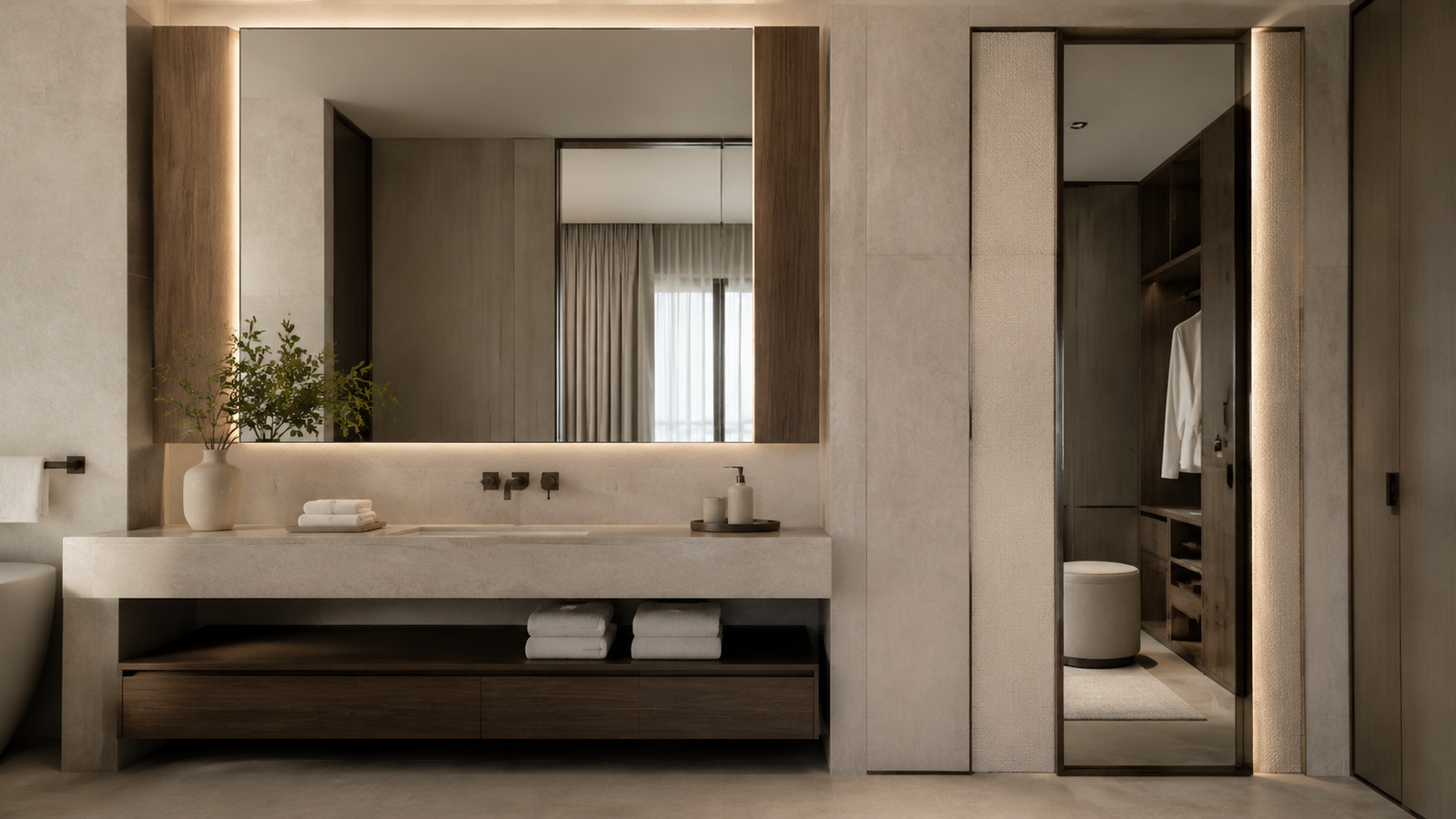
For a fit-out buyer, a mirror order is rarely just a mirror order. It may need to arrive alongside joinery, lighting, sanitaryware, or room-furniture packages—often across more than one site, floor, or installation phase.
That is why phased delivery for fit-out projects should begin during product development, not after production is complete. A workable project sourcing and delivery plan connects the approved design with dimensions, mounting, packaging, inspection points, batch allocation, and site-ready shipment timing.
Design Trends Are Raising the Delivery Standard
Recent European trade-fair presentations have reinforced a direction already familiar to hospitality and residential buyers: materials are becoming part of the architectural idea, while technology is expected to remain discreet. At Salone del Mobile.Milano 2026, materiality, durability, and integrated technology were highlighted as central directions in contemporary bathroom design.
For mirror supply, this means a buyer may specify a warm timber surround, a mineral-look panel, a slim metal return, or concealed LED lighting. Each detail changes how the product is manufactured, protected, stored, and installed. A visually strong sample is only the first proof point; a reliable delivery plan is the next.
A Development Decision That Changes the Project Outcome
In one recent hospitality mirror development program, the initial direction called for a large-format dressing mirror with a warm mineral side panel and a recessed mirror face. The visual intent was clear: the product needed to feel architectural rather than like a standard framed mirror.
The development question was more practical. A heavy solid-material structure would have increased handling risk and made phased delivery less flexible. The solution was to use a lighter structural base with a mineral-finish decorative panel, while recessing the mirror face to create the intended shadow line.
That decision gave the buyer three useful advantages:
- A more controlled product weight for handling and installation
- Better protection for the mirror edge during export packing
- A clearer visual match between the sample, room mock-up, and repeat project batches
This is the point at which design becomes delivery planning. The buyer is not simply approving an appearance; they are approving a product that can move through production and reach the site in a consistent condition.
Building a Phased Delivery Plan
Phase 1: Confirm the Room and SKU Schedule
Before production, the buyer and supplier should agree on which mirror models belong to which room types, locations, or delivery batches. This prevents a frequent project problem: the right products are made, but the wrong mix arrives first.
For phased delivery mirror supply in KSA or other multi-site fit-out markets, the release schedule should identify model, size, finish, quantity, mounting requirement, and intended delivery phase.
Phase 2: Lock the Reference Sample
A project sample should be checked beyond its front appearance. Frame joints, finish consistency, mirror clarity, mounting points, LED function where applicable, carton protection, and labeling all need to match the approved reference.
This becomes the quality benchmark for each later batch. It is much safer than allowing every production release to be judged separately.
Phase 3: Plan Production by Installation Priority
A single full shipment can look simpler on paper, but it can create storage pressure and damage risk at the project site. Phased delivery allows buyers to release products according to installation readiness.
For example, public-area mirrors may be delivered with the first fit-out phase, while guestroom, dressing-area, or replacement units can follow in later batches. The key is not to divide shipments arbitrarily; it is to divide them according to the site’s actual installation sequence.
Phase 4: Check Quality Before Each Release
Quality and delivery control should be repeated for every batch, not treated as a one-time inspection at the end of the order. Checks normally focus on dimensions, finish matching, mirror condition, backing and mounting hardware, carton protection, and batch labels.
This matters particularly when a project uses warm metallic, wood-grain, mineral, or hand-finished surfaces. These materials can look excellent individually but still require controlled comparison across batches.
Full Shipment vs. Phased Delivery
| Approach | Best for | Main Risk |
|---|---|---|
| One complete shipment | Single-site projects with finished storage and a fixed installation date | Site congestion, early handling, and damage before installation |
| Phased delivery | Hotels, apartments, villas, retail rollouts, and staged fit-outs | Requires clearer batch planning and tighter supplier coordination |
Why Buyers Use Phased Delivery
For the buyer, the value is not merely logistical. A phased approach helps protect cash flow, improves site coordination, reduces unnecessary unpacking, and makes it easier to identify issues before all units are delivered.
It also gives design and procurement teams more control. If a site condition changes, later batches can sometimes be adjusted within the confirmed specification framework rather than creating a problem after every unit has already left the factory.
FAQ
Can a mirror supplier support different quantities across several project phases?
Yes—provided that the model list, finish reference, packaging method, and batch schedule are confirmed before production. The earlier this is planned, the easier it is to maintain consistency.
Does phased delivery mean the supplier can change the approved product later?
No. The approved sample remains the reference. Any later change to material, size, mounting, or finish should be reviewed and confirmed before the relevant batch enters production.
Next Step
A successful fit-out mirror program is built around more than design approval. It depends on a clear sequence from sample review to batch production, inspection, export packing, and site delivery.
CTA:
Contact Teruier to discuss project sourcing and delivery planning, phased mirror supply, approved-sample coordination, and packaging options for your next fit-out program.



