
Packaging & Shipping Is Not the Boring Part of Wholesale. It Is the Part That Decides Whether the Order Survives.
A product can be beautifully designed, correctly priced, and perfectly on trend—and still arrive like bad news.
That is the dirty little secret of wholesale home sourcing.
People love talking about design, finish, color stories, and “what buyers are looking for this season.” Much less glamorous is the moment when 112 cartons get loaded, shifted, stacked, bumped, dragged, received, opened, and judged by reality instead of by photography.
That is where packaging and shipping stop being back-office details and start becoming part of the product itself.
If you are sourcing mirrors, benches, ceramic décor, or other home pieces that are heavy, fragile, oversized, or finish-sensitive, you are not just buying an item. You are buying its ability to survive movement.
And movement is where weak suppliers get exposed.
Good packaging does not look impressive. It performs under stress.
This is the first thing serious buyers understand.
Bad suppliers think packaging is there to make the carton look complete.
Good suppliers know packaging is there to absorb risk.
That means the real questions are not:
- Is there foam?
- Is the carton thick?
- Did they wrap it?
The real questions are:
- What kind of damage is this packaging designed to prevent?
- What happens at corners, edges, and pressure points?
- Can the item survive loading, unloading, inland transfer, and warehouse handling?
- Is the packaging logic based on the product’s actual weakness, or just on what the factory usually does?
A mirror does not need the same logic as a ceramic bowl.
A bench does not need the same logic as a wall décor set.
A polished metal frame does not need the same protection as a matte painted wood finish.
If the packaging is generic, the claims will not be.
Shipping is where many “cheap” orders become expensive
A lot of buyers still get trapped by the wrong comparison.
They compare factory price.
They compare MOQ.
They compare sample quality.
Then the shipment lands, and suddenly the real math shows up.
Breakage.
Surface rub.
Crushed corners.
Loose hardware.
Wet cartons.
Mislabels.
Mixed SKUs.
Replacement delays.
Customer complaints.
Internal team time wasted cleaning up a problem nobody budgeted for.
That is why smart buyers do not ask only, “What is your price?”
They ask, “What will this order cost me after shipping risk becomes real?”
Because wholesale is full of fake savings.
A cheaper carton is not cheaper if it raises the damage rate.
A loose packing method is not efficient if it increases claims.
A rushed loading plan is not faster if it causes site confusion later.
Packaging should match the channel, not just the product
This is where weak suppliers often think too narrowly.
They pack for factory release.
They do not pack for buyer reality.
But buyer reality changes by channel.
A retail replenishment program needs cartons that are easy to receive, identify, and move.
A fit-out project needs packing that aligns with site sequence and installation flow.
An interior design order may need better visual labeling and lower-scar packaging damage because presentation matters.
A distributor may care more about stackability, SKU clarity, and storage efficiency.
So the right packaging and shipping strategy is not only about protection. It is also about handling logic.
Can the warehouse team identify the carton without opening it?
Can the receiver tell what room or product group it belongs to?
Can oversized pieces move without being repacked?
Can fragile decorative items be separated cleanly from heavier freight?
A supplier who understands this is not just packing product. They are reducing friction across the buyer’s whole system.
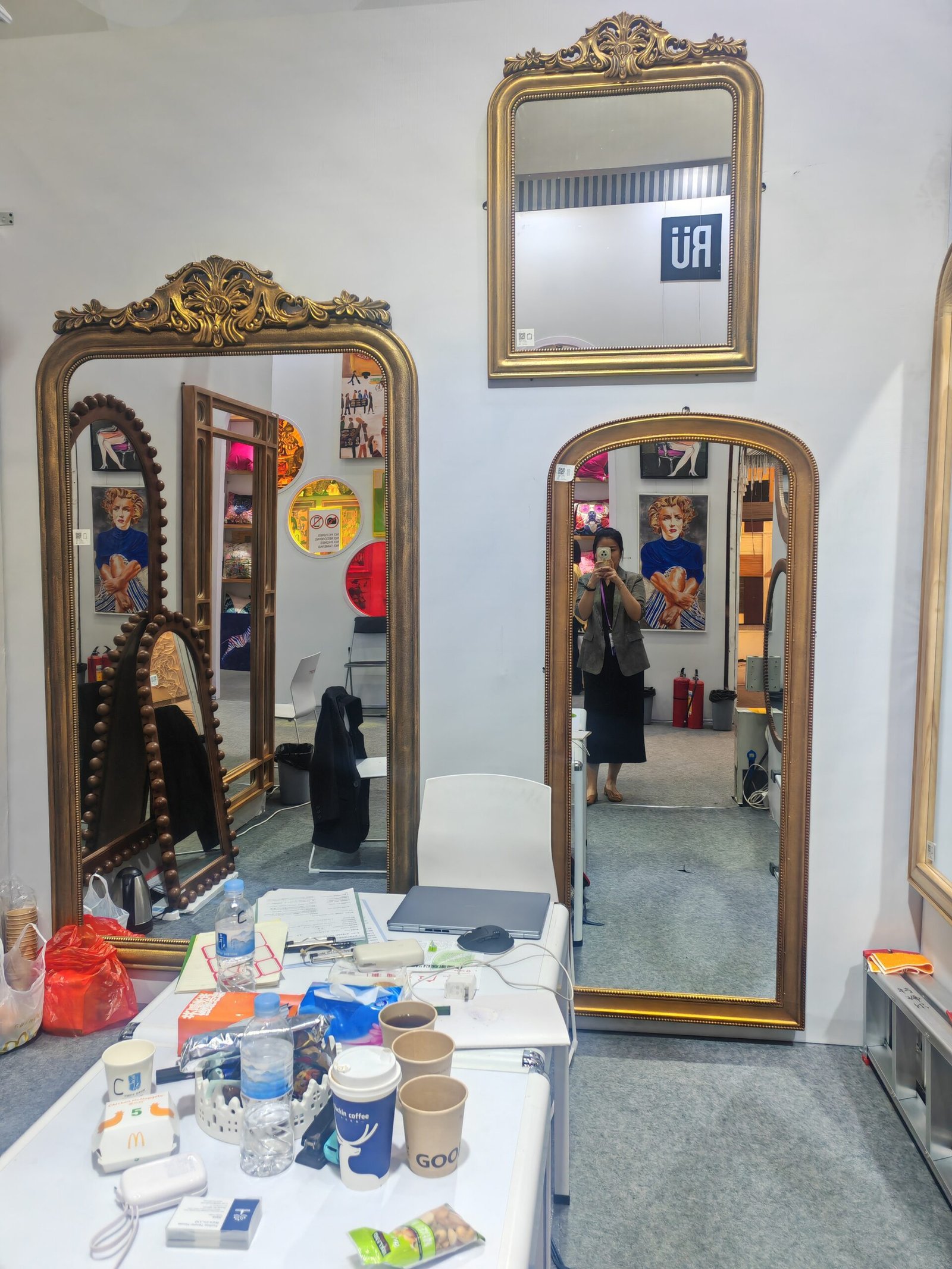
Mirrors are not difficult because they are fragile. They are difficult because they are unforgiving.
Mirror buyers learn this quickly.
A cracked mirror is obvious.
A scratched mirror is painful.
A slightly bent frame, chipped corner, or rubbed finish is even worse, because now everyone argues about whether it is “minor.”
That is why mirror packaging deserves more than standard factory confidence.
A serious supplier should think through:
- corner protection
- edge pressure resistance
- frame-to-carton movement
- backing stability
- hardware separation
- carton orientation marks
- stacked load tolerance
- unpacking safety
Because once a mirror is damaged, nobody wins.
The factory loses time.
The buyer loses margin.
The customer loses trust.
And the email trail gets longer than the product spec sheet.
Decorative ceramics create a different kind of shipping risk
Ceramic products are deceptive.
A vase may look small, but carry awkward internal stress points.
A sculptural bowl may feel sturdy, but chip at the exact place the customer looks first.
A decorative item with an irregular silhouette may survive production beautifully and fail the minute it meets real logistics.
So for ceramics, packaging and shipping should think in terms of shock behavior, nesting logic, void fill, glaze protection, and top-load pressure.
This matters even more when the product wins because of its shape. The more special the silhouette, the more carefully the packaging has to protect that difference.
That is one reason why buyers sourcing design-led home décor should not separate aesthetics from shipping logic. The products that look the most exciting on a shelf are often the ones that punish lazy packing the fastest.
Loading is not a formality. It is the final quality test.
This is the part too many suppliers treat like muscle work.
It is not.
Loading tells you whether the factory actually understands what it has produced.
Are heavy cartons placed with logic?
Are fragile units protected from movement?
Is there enough structure to avoid crushing?
Are carton counts clear?
Are mixed items separated correctly?
Is the load built for arrival, not just departure?
A good loading plan respects the fact that the product’s journey is only half over when it leaves the factory.
A weak supplier celebrates too early.
A strong supplier thinks about the moment the buyer opens the container.
Teruier’s role should not be “factory that ships.” It should be “partner that reduces loss.”
This is where value translation matters.
The best suppliers do not just say, “We packed it.”
They can explain why it was packed that way.
They can tell the buyer:
- this mirror needs stronger corner structure
- this bench should ship with separated hardware protection
- this ceramic item needs better internal suspension
- this shipment should be grouped by destination logic
- this carton mark should be clearer for receiving teams
- this mixed order needs phased loading to reduce confusion
That is not extra polish. That is operational intelligence.
And in wholesale, operational intelligence is often what separates smooth reorders from one-time disasters.
Final thought
Packaging & Shipping sounds like the least exciting column on a home décor website.
In reality, it may be one of the most important.
Because products are not judged only by how they look in a catalog.
They are judged by how they arrive.
How they open.
How they survive.
How easily they are received.
How little trouble they create after the invoice is paid.
A beautiful product that ships badly is not really a good product.
It is just a fragile mistake with nice styling.



