
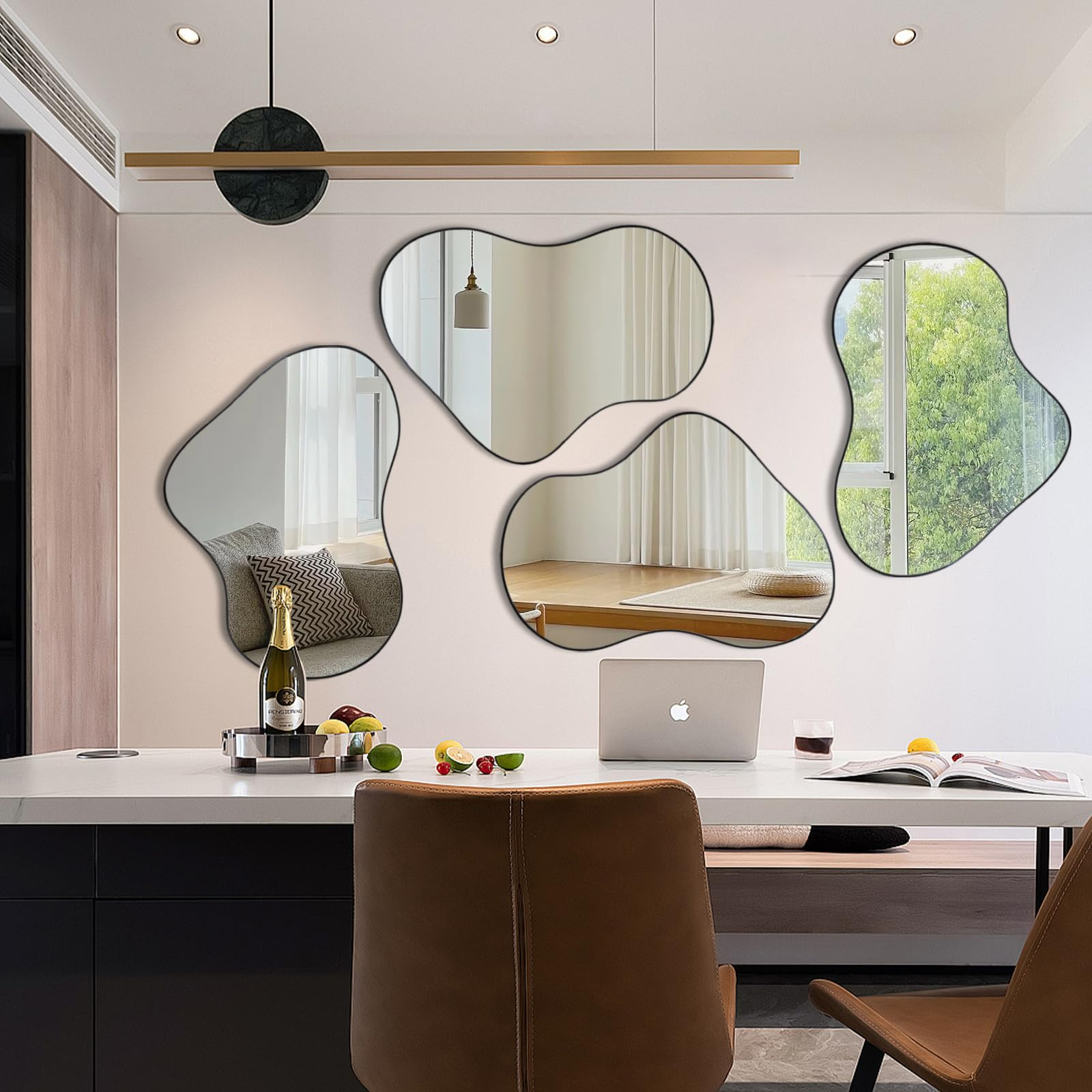
Let’s begin with the part nobody says out loud.
Most buyers do not need “another pretty organic mirror.”
They need a mirror program that feels current, survives freight, fits more than one room story, and does not become weirdly disappointing the moment the second container lands.
That is why organic wall mirror similar styles wholesale is no longer a trend search. It is a sourcing question.
And frankly, a smart one.
Because the organic wall mirror that wins in wholesale is rarely the one with the loudest shape. It is the one with the best commercial behavior: the right silhouette, the right finish discipline, the right size ladder, and just enough design personality to make a wall feel softer without making your inventory feel reckless.
That direction matches what North American market signals have been showing. High Point Market’s official Style Spotters called out sinuous curves, organic movement, sculptural silhouettes, and warm brass-accented statement pieces; ANDMORE’s Spring 2025 High Point winners grouped product stories under themes like Linear Forms and Nod to Nature; and Las Vegas Market’s Summer 2025 Snapshot highlighted Organic Minimalism as a market-facing direction. Academic work in architecture and neuroaesthetics also supports the commercial logic here: preference for curvilinear contour is robust, and design experts in particular tend to rate curvilinear spaces more positively than rectilinear ones.
So what is Teruier actually launching in this category?
Not one mirror.
A wholesale similar-styles program.
Meaning: a family of organic mirrors that share the same commercial DNA, but give buyers enough variation to build a wall story, a room story, or even a cross-channel assortment without looking repetitive or copy-pasted.
A buyer-ready assortment usually works best when it gives you three usable lanes:
The first is the clean contemporary lane: soft asymmetrical forms, lighter profiles, and a more controlled metal finish. This is where chrome wall mirror finish consistency tolerance becomes a very real buying issue. If the sample looks polished and the reorder looks slightly blue, slightly dull, or slightly “why is this somehow both shiny and tired,” that is not a mirror problem. That is a supplier problem.
The second is the warmer decorative lane: the antiqued mirror alternative distressed mirror story. Not dusty fake-vintage drama. Not “French flea market, but make it confusing.” Just enough distressing to add texture and age-value, while keeping the silhouette fresh enough for modern retail.
The third is the moodier upscale lane: the smoked mirror alternative bronze tinted mirror direction. This is often the smarter commercial choice when buyers want warmth and atmosphere without going too dark. And yes, this is where smoked mirror thickness tint level specification matters. Because “smoked” can mean elegant, or it can mean your customer sees their own face and immediately loses confidence in the product. Those are two very different mornings.
Now let’s talk about the buyer case.
A representative Teruier selection-agent project for a U.S. home chain did not begin with “find us a viral mirror.” It began with a more grown-up sentence:
“Give us similar organic styles we can spread across stores, e-commerce, and one small hospitality account without changing suppliers every six weeks.”
So the program was rebuilt into a four-SKU mirror capsule:
- 24″ x 36″ pebble-edge wall mirror for high-turn décor walls
- 30″ x 40″ asymmetrical organic mirror for furniture and accent-floor adjacency
- 36″ x 48″ antiqued mirror alternative distressed mirror for warm transitional stores
- 30″ x 40″ bronze tinted mirror version for moodier, darker assortments
Instead of approving only shape, the buyer reviewed five hard numbers before sample sign-off: size ladder, frame finish tolerance, tint level, carton structure, and hanging logic. Sample turnaround target was 10–14 days. Finish review was done against a board, not just one flattering hero sample. Packaging was engineered for direct import and retail handling, because a mirror that arrives in pieces is not “artisan.” It is just expensive trash with a freight bill.
That is the point of Teruier’s cross-border design-manufacturing model: not to make buyers choose between creativity and control, but to connect trend language, material choices, production discipline, and retail rollout in one conversation.
And here is the quiet upgrade buyers actually care about:
Older organic mirror buying was mostly aesthetic.
This version is operational.
It is built for chain home décor buyers, furniture retailers, boutique hospitality, apartment staging, design-led value retail, and selected bath-adjacent programs. It works in entryways, powder rooms, bedroom dress walls, model units, and softer commercial spaces. It also leaves room for category expansion. Because once a buyer trusts the mirror spec logic, the conversation can move naturally into adjacent items like backlit bathroom mirror spec sheet voltage wattage CCT requirements, where professional buyers want the numbers before they want the mood board.
That matters, because good suppliers do not just sell “looks.”
They sell decision clarity.
So here is the real takeaway.
If you are searching organic wall mirror similar styles wholesale, what you probably want is not a cheaper copy of an organic mirror you already saw online. You want a supplier that can help you build a shape family, control finish drift, define tint specs, and turn one good mirror into a repeatable assortment.
That is where Teruier becomes worth a longer conversation.
Not because the mirrors are trendy.
Because the program is buyable.



