
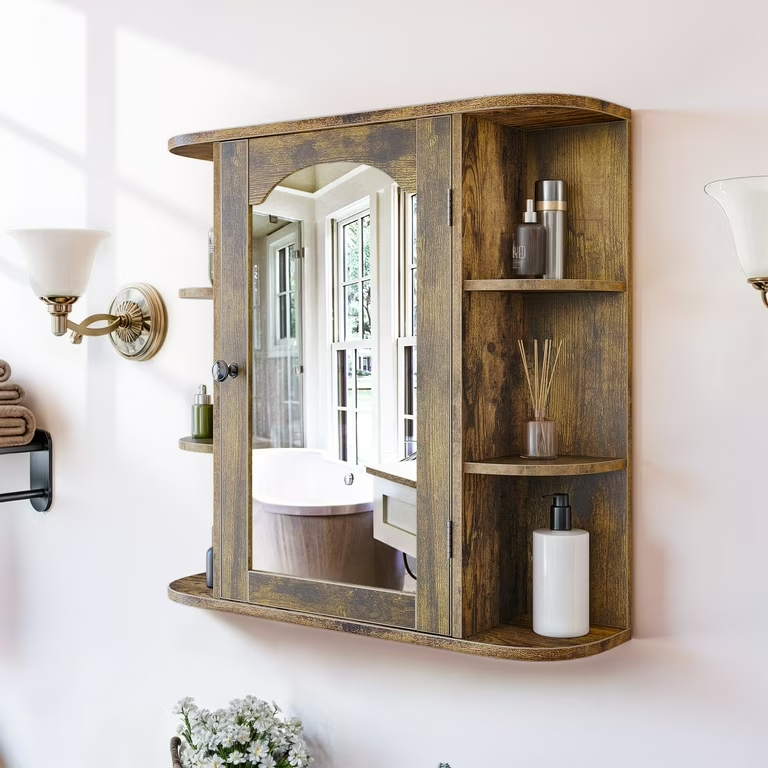
Not Just a Mirror, Not Just Storage: Why the Right Medicine Cabinet Mirror Wins the Whole Bathroom Wall
Let’s start with a small truth the bathroom category keeps trying to avoid:
Most medicine cabinet mirrors on the market are either
ugly storage pretending to be design,
or pretty mirrors pretending storage does not matter.
And buyers are tired of both.
A U.S. home retailer does not need one more cabinet with a mirror slapped on the front like an apology.
They need a product that solves real bathroom-wall problems:
- clutter
- poor task lighting
- low visual value
- awkward sizing
- generic styling
- weak assortment logic
- and that classic retail disease: “technically useful, emotionally dead”
That is why this launch is not about a single item.
It is about a medicine cabinet mirror program from Teruier—one built for North American buyers who need function, style, and margin to cooperate for once.
And yes, the timing makes sense. KBIS positions itself as North America’s premier kitchen-and-bath show, with more than 600 exhibiting brands, while NKBA’s 2025 reporting says the bathroom conversation has moved from pure utility toward wellness, smarter storage, universal design, and calmer, more durable spaces. That is exactly the environment where a smarter medicine cabinet mirror becomes more relevant, not less.
What this product really is
A medicine cabinet mirror is not just a mirror with hidden shelves.
At its best, it is a three-layer product:
a reflective surface,
a storage solution,
and a bathroom-lighting interface.
That matters because the bathroom wall is one of the most overworked zones in the house. It has to help people groom, store, organize, illuminate, and somehow still look better than a temporary rental.
So the real product is not “cabinet plus mirror.”
The real product is organized visibility.
That is the sell.
Why North American buyers are looking at this category differently now
The old medicine cabinet mirror was bought like plumbing-adjacent necessity.
The new one is bought more like a design system.
NKBA’s 2025 bath review is blunt about where the market moved: bathrooms became more wellness-oriented, more storage-aware, and more design-conscious, with smarter storage and integrated shelving rising alongside calm, organic aesthetics and easier-maintenance materials.
So if a buyer is still thinking about medicine cabinet mirrors as the boring SKU hidden in the renovation aisle, that buyer is now slightly behind the room.
Because the bathroom wall has changed.
It is no longer just where the mirror goes.
It is where the daily routine gets judged.
The old buyer problem this solves
Here is the usual pain:
The buyer wants storage.
But not a boxy wall tumor.
The buyer wants a mirror.
But not something that wastes usable vertical space.
The buyer wants lighting.
But not a cold, cheap, face-flattening glow that makes everyone look like they lost an argument with the ceiling.
The buyer wants a clean assortment.
But most suppliers send either overbuilt project cabinets or underdesigned retail mirrors.
So the shelf ends up full of compromise:
- plain mirrored cabinets that feel builder-grade
- decorative mirrors with no utility
- trendy mirrors that solve no storage problem
- storage cabinets that damage the whole bathroom display story
This is why a medicine cabinet mirror should not be sourced as an isolated SKU.
It should be sourced as part of a mirror collection strategy.
What Teruier is launching here
Teruier should not be read here as just a wall mirror supplier.
That is too small.
This is closer to a custom home accessories supplier with a mirror-first product logic: a team that understands how one functional wall product needs to fit retail aesthetics, daily use, lighting quality, storage behavior, and assortment architecture at the same time.
So the Teruier program is built around three commercial layers:
1. The practical core
This is the volume mover.
Think:
- clean rectangular format
- recessed or surface-mount flexibility
- mirrored front
- adjustable internal shelving
- simple finish language
- left/right door logic
- easy spec sheet, easy reorder
This is for mainstream bath retail, project-friendly programs, and renovation buyers who want smart utility without drama.
2. The upgraded light-and-storage layer
This is where the category stops feeling tired.
Think:
- backlit bathroom mirror integration
- anti-fog option
- better edge illumination
- cleaner frame reveal
- soft-close hinges
- higher perceived value with almost no explanation needed
This is the version that makes the buyer say, “Okay, now this wall is doing something.”
3. The design-led companion layer
This is where the program becomes a collection, not just a cabinet.
Think:
- decorative companion SKUs like a fluted frame mirror
- matching open-wall mirror profiles
- coordinated finish palette
- same visual language across utility and decorative pieces
That matters because buyers do not really want random product.
They want one story told in several price points.
Why lighting quality matters more than most mirror programs admit
A mirror with bad light is like a nice hotel with terrible coffee.
Technically open, spiritually closed.
Lighting research is useful here. UC Davis’ California Lighting Technology Center notes that 90+ CRI provides excellent color rendering, meaning colors and skin tones are rendered more accurately. It also notes that consistent lighting properties matter for how adjoining materials appear. That is highly relevant to bath mirrors, especially in spaces where grooming, make-up, shaving, and finish perception matter.
And lighting is not only about appearance. A systematic review on lighting in the home found that lighting affects visual performance, safety, and physiological functions. Another recent review on design for older adults highlights lighting, spatial layout, and barrier-free design as key principles affecting health and comfort. That matters because a good medicine cabinet mirror is not just “nice-looking storage”; it is part of how safely and comfortably people use the bathroom every day.
This is also why backlighting should not be treated like a cheap gimmick.
Done properly, it supports the routine.
Done badly, it supports returns.
The launch specification logic buyers actually care about
Now we stop talking like lifestyle copywriters and start talking like buyers.
A buyer-ready medicine cabinet mirror program should be presented through a clear spec architecture.
Recommended size ladder
For U.S. retail and project flexibility, the assortment can be structured like this:
- 20″ x 26″
compact powder rooms, smaller apartments, secondary baths - 24″ x 30″
the safest mainstream retail size - 30″ x 36″
stronger value perception for primary baths and renovation projects - 48″ dual-door formats
double-vanity and premium storage applications
Mounting logic
- recessed mount for cleaner built-in look
- surface mount for easier retrofit installation
- convertible mount options where commercially viable
Construction logic
- aluminum or moisture-resistant metal cabinet body
- mirrored door with safety backing
- adjustable glass or powder-coated shelving
- soft-close hinges
- optional integrated outlet / organizer insert depending on target channel
- anti-fog available on upgraded lighted versions
Lighting logic
- front or perimeter backlight depending model
- 3000K / 4000K / 5000K range options where program allows
- CRI target aligned with grooming-friendly performance
- no overly blue “showroom operating room” effect, please
Visual language
- frameless clean line for core SKUs
- fine-profile edge frame for upgraded retail
- fluted or decorative companion mirrors for style-led collection building
That is how a buyer decides whether this is worth continuing.
Not by hearing “premium quality,” but by seeing whether the product logic is coherent.
What problem this solves better than a regular mirror
A regular wall mirror solves one problem:
reflection.
A medicine cabinet mirror solves several:
- reflection
- storage
- organization
- lighting opportunity
- cleaner countertop story
- better use of wall depth
- stronger renovation value proposition
And that storage piece is not minor. NKBA’s 2025 trend review specifically calls out smarter storage as part of the new bathroom expectation. In aging-in-place research, bathroom adaptations and improved lighting are associated with increased safety, comfort, and ease of use, with one systematic review noting meaningful reductions in bathroom-related difficulties after home modifications.
So no, this is not “just a mirrored cabinet.”
It is a product that helps the whole bathroom behave better.
Where this product fits best
This program works especially well for:
Home improvement and bath retail buyers
because it combines utility and visual upgrade in one wall position
Lifestyle home chains
because upgraded and decorative companions allow the line to sit inside a broader mirror collection
Project and multifamily distributors
because recessed/surface-mount flexibility supports different installation conditions
Aging-in-place and universal-design assortments
because storage, lighting, and easier daily use matter more over time
Renovation-focused channels
because buyers love products that improve both function and resale logic without moving the whole wall
That fit aligns with where KBIS and NKBA have been pushing the category: smarter, more seamless, more human-centered, and less purely utilitarian. (kbis.com)
A Teruier buyer success scenario
Here is the kind of Teruier-assisted success case that makes sense for a U.S. chain buyer.
This is a modeled buyer scenario, not a named public case.
A regional home retailer wants to update the bathroom wall category in 22 stores.
The old assortment is split badly:
- plain builder-grade medicine cabinets
- decorative mirrors with no storage
- lighted mirrors with style but no organization value
The result:
too many SKUs, weak storytelling, and poor cross-sell between mirror, vanity, and lighting.
So Teruier’s selection-intelligence logic proposes a tighter program:
Proposed test assortment
- 2 core medicine cabinet mirror SKUs
- 1 upgraded backlit bathroom mirror cabinet SKU
- 1 decorative companion fluted frame mirror
- 1 standard decorative wall mirror for entry price
Test logic
Stores are grouped into:
- value-led renovation stores
- style-led suburban stores
- mixed-format stores
Modeled retail outcomes
In the scenario:
- the standard cabinet remains the unit-volume anchor
- the backlit cabinet lifts perceived value and average ticket
- the fluted companion mirror helps the whole wall read like a collection, not spare parts
- the simplified 5-SKU structure improves buyer clarity versus the old “too many lookalikes” wall
Commercial lesson
The winning move is not replacing all mirrors with cabinets.
It is building a mirror collection where utility and decorative style work together.
That is what Teruier helps buyers see.
Why this is better than old-school medicine cabinets
Old model:
- mirrored box
- white wall
- survive somehow
New model:
- bathroom wellness logic
- smarter storage
- cleaner visual calm
- better task-light potential
- universal-design awareness
- decorative companion story
- better cross-merchandising with vanity and bath accessories
That is a better product.
But more importantly, it is a better shelf strategy.
What serious buyers should verify next
Before taking the conversation further, a buyer should ask for:
- size matrix
- rough opening requirements for recessed models
- surface-mount depth
- shelf material and adjustability
- hinge specification
- anti-fog configuration
- LED CCT / CRI details on lighted models
- door swing options
- moisture-resistance details
- packaging dimensions and drop protection
- MOQ by size and finish
- whether companion decorative mirrors can be merchandised as one mirror collection
That is how you tell whether you are speaking to a real supplier or just a catalog distributor with better email signatures.
Final word
A strong medicine cabinet mirror should do five things well:
hide clutter,
improve the routine,
clean up the countertop story,
support better light,
and still make the bathroom wall look worth looking at.
That is the standard now.
So if the product only stores things, it is behind.
If it only looks pretty, it is incomplete.
And if the supplier cannot explain how it fits into a broader mirror collection, then the buyer still has work to do.
Teruier’s advantage is that it does not treat this as a lonely box on a wall.
It treats it as a design-led bathroom solution with retail logic.
And that is why this product deserves another conversation.



