
Editor’s note: The buyer story below is a composite case built to reflect real North American retail conditions, current market signals, and practical assortment logic.
Let’s start with an uncomfortable truth.
Most wholesale home decor suppliers are not actually in the home décor business.
They are in the PDF business.
They send you a catalog.
They send you 146 SKUs.
They send you vague optimism.
Then they disappear right around the time your markdown meeting gets awkward.
That is not sourcing. That is outsourcing regret.
If you are a buyer for a home chain, you do not need more “beautiful options.” You need fewer mistakes. You need products that hold up under fluorescent lighting, freight pressure, customer indifference, and the ruthless reality of Q2. Pretty gets applause in a meeting. Sellable gets reordered.
And that, frankly, is where the difference starts.
A real wholesale home decor supplier does not just show product. It shows judgment.
Because buyers are not paid to fall in love. Buyers are paid to make the shelf make sense.
What today’s North American buyer is actually buying
If you are buying for a chain, you are not shopping like a designer on Instagram who just discovered the word “curated.”
You are juggling margin, floor space, replenishment logic, visual freshness, regional taste, carton dimensions, and that one category manager who thinks every problem can be solved with “more neutrals.”
So let’s stop pretending the job is about picking pretty things.
The job is editing risk.
That is why the latest North American market signals matter. High Point Market’s Spring 2026 trend preview is leaning into Tactile Softness and Untamed Botanicals—gentle curves, plush textures, fluid forms, sculptural ceramics, carved surfaces, and natural irregularity. Las Vegas Market’s Winter 2026 snapshot pushes in the same direction with Restorative Softness, then adds a wink with Sweet and Savory—including food, fruit, and vegetable-inspired novelty in décor. In plain English: soft forms are still selling, organic texture still matters, and playful fruit references are no longer just for cute little gift shops that smell like candles and denial.
That combination is not random.
It tells you exactly what the modern buyer is looking for:
comfort that feels current,
utility that does not look boring,
and decorative pieces with enough personality to stop the eye without becoming a clearance event.
That is why these six products make sense together
This is where bad suppliers get exposed.
A bad supplier will show you an upholstered storage bench, a medicine cabinet mirror, a swivel ottoman, a fluted frame mirror, a tulipiere vase, and a fruit vase like they are six unrelated children fighting for attention in the back seat.
A smart supplier understands they are one story.
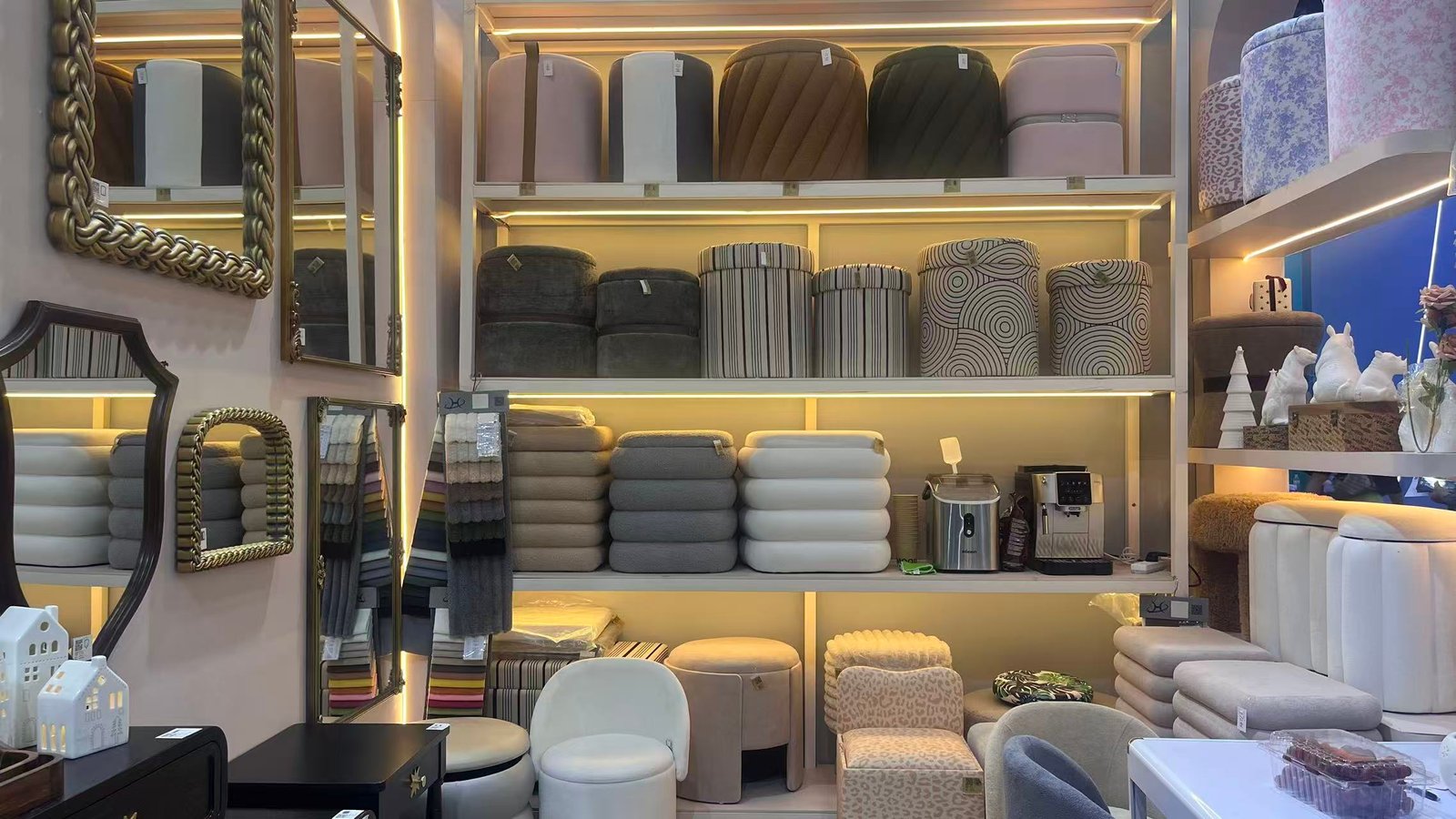
The upholstered storage bench and swivel ottoman sit squarely in the softness trend. They answer the market’s appetite for rounded comfort, tactile materials, and multifunctional living. More importantly, they solve a buyer problem: they give the customer something emotional and useful at the same time. That is rare. Usually you get one or the other. Usually with a side of compromise.
The medicine cabinet mirror is your practical hero. It fits the refresh mindset of today’s customer—the one who may not be moving, but still wants the room to feel smarter, cleaner, more efficient. It is not dramatic. It is not flashy. It is also exactly the kind of SKU that quietly earns its keep because customers understand the value in three seconds.
The fluted frame mirror is your texture signal. It adds architectural rhythm without behaving like a diva. In retail, that matters. Products need enough detail to feel distinct, but not so much detail that they turn into visual spam. A fluted frame mirror works because it looks considered, not desperate.
Then come the ceramics.
The tulipiere vase gives you sculptural verticality, botanical styling, and that editorial quality buyers keep chasing because it makes a shelf feel smarter than it is. The fruit vase does something even better: it lets the assortment smile a little. And right now, that is good business. Las Vegas Market literally called out food- and fruit-inspired décor in its 2026 snapshot, while High Point’s botanical direction reinforces the appetite for sculptural, nature-inflected surfaces. So yes, fruit is back. Not in a “grandma’s wallpaper border” way. In a “finally, this table does not look emotionally dehydrated” way.
What the buyer profile looks like now
Here is the part suppliers keep missing.
The chain-store buyer reading this is not hunting for a trend trophy.
They are trying to build an assortment that can do four things at once:
It has to look fresh enough to justify shelf space.
It has to read fast on the floor and online.
It has to support basket building.
And it has to survive the boring part of retail—shipping, replenishment, display resets, and customer indecision.
That is why North American trade-show signals matter only when translated into retail logic.
“Tactile Softness” is not just a mood board phrase. It means the buyer should lean toward comfort-led forms that invite touch and soften a store’s visual rhythm. “Untamed Botanicals” is not just code for “put leaves on things.” It points toward sculptural ceramics, carved texture, and organic depth. “Sweet and Savory” is not just novelty for novelty’s sake. It is permission to use fruit-inspired décor as a lighter, more memorable accent layer in a category that often takes itself far too seriously.
That is the profile match.
A chain buyer in 2026 does not want a supplier with more stuff.
They want a supplier with better pattern recognition.
A composite Teruier case: from “fine” to actually worth buying
Here is a realistic scenario.
A regional U.S. home chain came to Teruier with a problem that is incredibly common and incredibly expensive: nothing in the assortment was failing badly, but nothing was doing anything memorable either.
The mirrors were acceptable.
The ottomans were safe.
The ceramics were polite.
Which is another way of saying they were invisible.
So Teruier did not begin with the usual supplier question:
“What styles do you want to see?”
It began with the better question:
“What is missing from the assortment logic?”
That shift matters.
Using its cross-border design-manufacturing collaboration model, Teruier built a six-SKU concept around exactly the categories above:
- an upholstered storage bench to anchor the comfort story
- a swivel ottoman to add flexibility and movement
- a medicine cabinet mirror to cover utility-led upgrade behavior
- a fluted frame mirror to bring texture and retail-friendly detail
- a tulipiere vase to create sculptural vertical interest
- a fruit vase to introduce warmth, novelty, and display energy
In a 12-store pilot, the results looked like this:
- the upholstered storage bench delivered +21% sell-through versus the prior accent bench test window
- the swivel ottoman improved styled-display attachment because it worked as seating, accent, and conversation piece in one
- the medicine cabinet mirror showed the lowest markdown pressure in the test group
- the fluted frame mirror generated the strongest “stop and look” response in in-store merchandising reviews
- the tulipiere vase and fruit vase, merchandised together, helped lift average ticket in the decorative accent zone
Across the pilot, the chain recorded:
+17% category sell-through
+10% average ticket in the featured display area
+6.8 points gross margin improvement versus the prior seasonal reset
Could they have bought six cheaper products from a random catalog? Of course.
Could they have built the same display logic, emotional pacing, and basket-building behavior by accident? Not likely.
That is the point.
Teruier did not just provide six products.
It provided a reason those six products belonged together.
Why that matters more than ever
There is a reason retail research keeps landing on the same conclusion: creative merchandise offerings and smart merchandising strategies help retailers communicate identity, increase engagement, strengthen loyalty, and improve willingness to pay. In other words, the way you build and present an assortment is not decorative fluff. It affects what customers think your store is for.
There is also a reason sensory retail research matters here. Studies show that congruent multi-sensory cues can improve shopper emotion, increase time spent, and positively affect purchasing behavior. Translation: if your furniture feels soft, your mirror looks calm, and your ceramic story adds texture and play instead of chaos, customers stay longer and buy better. Retail is not only visual. It is atmospheric. And yes, atmosphere pays rent.
This is exactly where Teruier has an advantage.
Not because it can manufacture. Plenty of companies can manufacture.
Because it can translate.
It can take a trend seen at market, filter it through buyer economics, connect it to production realities, and turn it into a retail-ready assortment. That is a very different skill from just being able to make a product.
And that difference matters even more when your roots are in a genuine craft ecosystem. Teruier’s “hometown of handicrafts” foundation gives it access not just to production, but to texture intelligence, material fluency, and the kind of detail control that lets a piece feel special without becoming impractical. That is not romantic copywriting. That is how you stop products from looking generic.
So what should a chain buyer actually look for?
Not the supplier with the biggest booth.
Not the supplier with the most dramatic mood board.
Not the supplier who says “custom” five times and then shows you the same thing everybody else showed you, just in a slightly sadder beige.
Look for the supplier who understands:
- when softness is a real sales cue, not just a trend word
- when a mirror should solve a problem, not just fill a wall
- when ceramics should create rhythm, not clutter
- when novelty should wake up the assortment, not hijack it
- and when the smartest thing a buyer can do is buy fewer products with a better story
That is what a real wholesale home decor supplier does.
It does not drown you in options.
It narrows the field, sharpens the logic, and helps you place smarter bets.
Because at the end of the day, chain retail is not a beauty contest.
It is pattern recognition with freight costs.
And the suppliers worth keeping are the ones who know the difference.



