
KSA LED Bathroom Mirrors That Reorder: The QC + Packaging Playbook I Use Before I Scale
I buy mirrors the way a retail buyer has to: for the second shipment, not the first sample.
Because in Saudi programs—especially KSA LED bathroom mirrors wholesale—the margin doesn’t disappear in your quotation. It disappears later: at customs (paperwork), at installation (spec mismatch), and in returns (packaging + QC drift).
The opportunity is real. Saudi’s hotel pipeline and fit-out activity is large enough that serious suppliers are investing in better documentation and controls—not just prettier designs.
Why KSA mirror demand keeps scaling (and why buyers get stricter)
If you supply hospitality bathrooms, showrooms, or multi-door retail in Saudi, you’re not shipping “a few pieces.” You’re supporting projects and rollouts.
Knight Frank reports Saudi hotel stock at 167,500 keys (end of Q1 2025) with ~99,500 more keys in the pipeline through 2030—most of it in higher-end categories.
And ResearchAndMarkets summaries put Saudi’s interior fit-out market at $3.13B (2024), projected to $5.14B by 2030.
Buyer translation: more projects + tighter timelines = less patience for supplier surprises.
What I require from a bathroom mirror supplier in Saudi Arabia before we talk price
When a supplier pitches me as a bathroom mirror supplier Saudi Arabia, I’m not looking for a catalog. I’m looking for program discipline:
submittal-ready spec sheets (LED driver, CCT, CRI, IP rating, anti-fog details, mounting method)
a parts-and-replacement plan (drivers, sensors, brackets)
consistent build rules (glass thickness, edge polish standard, mirror backing, wiring routes)
packaging designed for long-haul + site handling
This is the baseline if you want to be taken seriously as an LED mirror OEM Saudi Arabia partner.
Compliance is part of lead time for LED bathroom mirrors in Saudi Arabia
LED mirrors aren’t “just decor” at the border.
Saudi’s SASO compliance framework includes certificates of conformity (e.g., model approval / batch approval).
Saudi also has an IEC/IECEE certificate pathway via Saudi national certification bodies (relevant to regulated electrical product categories).
And the U.S. International Trade Administration notes that products going through the SABER system must comply with SASO technical regulations (it’s not optional paperwork).
Buyer translation: if your compliance workflow is weak, your “good price” becomes delays, storage fees, and angry site teams.
The QC checkpoints mirror supply Saudi programs need (my real checklist)
This is the line item most suppliers underbuild. “Final inspection” is not enough for LED mirrors.
Here’s the QC checkpoints mirror supply Saudi structure I expect:
1) Incoming materials (before production starts)
glass thickness + flatness check
edge chip tolerance definition
LED driver verification (model, wattage, heat rating, stability)
anti-fog pad/sensor spec confirmation (if included)
2) In-process (where drift actually happens)
edge polishing and backing adhesion checks
LED strip placement + heat dissipation review
wiring routing + strain relief check (no pinch points)
functional test: dimming, touch sensor, defog, memory function (if claimed)
3) Pre-pack / pre-shipment (where returns are decided)
100% lighting/function test on finished units
mounting hardware count + jig-fit check (install reality)
cosmetic check under strong light (micro-scratches show up later)
carton drop-risk review + shake/vibration sanity check
If you can’t describe these checkpoints clearly, I assume your batch consistency will drift under volume.
Mirror packaging: the unglamorous margin protector
In mirrors, packaging isn’t “extra cost.” It’s the cheapest insurance you’ll ever buy.
ISTA publishes packaged-product test procedures built around distribution hazards, including random vibration procedures for different weight ranges.
What I want to see in your packaging plan for LED mirrors:
corner protection that doesn’t shift under vibration
glass surface protection that prevents rub marks
carton strength designed for stacking/compression
clean unboxing (less mess = less store labor)
This matters even more when you’re also scaling a standing mirrors bulk supplier Saudi Arabia program—large mirrors punish weak cartons.
Features that sell: why LED bathroom mirrors are becoming the default upgrade
If you’re building LED bathroom mirror Saudi Arabia lines, don’t guess features—follow what homeowners are choosing.
Houzz’s 2025 U.S. Bathroom Trends Study reports 34% of renovating homeowners choose mirrors with specialty features, including LED lighting (24%) and anti-fog systems (22%).
Even though that’s U.S. data, the buyer logic transfers globally: shoppers increasingly treat bathroom mirrors as lighting + comfort + premium signal, not just glass.
The OEM question: what I actually mean by “LED mirror OEM Saudi Arabia”
OEM isn’t “put my logo on it.”
A real LED mirror OEM Saudi Arabia setup means you can lock:
electrical configuration options (CCT range, driver spec, plug/connection method)
consistent component sourcing (so batch #2 doesn’t look/behave different)
documentation packs for approvals (spec sheets, conformity pathway awareness)
serviceability (access to driver/sensor without destroying the unit)
That’s what makes an OEM relationship reorderable.
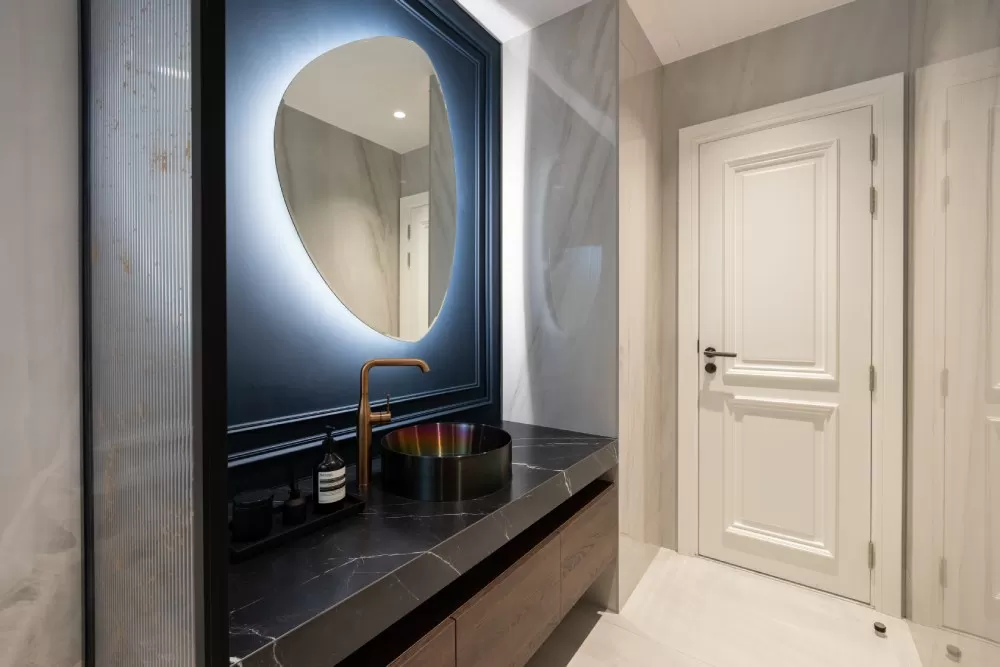
My buyer close: how you win the second PO
If you want to win KSA LED bathroom mirrors wholesale programs, lead with operational proof:
show your compliance readiness (SASO/SABER awareness and cert workflow)
show your QC checkpoints across incoming → in-process → pre-ship
show packaging engineered for vibration/compression reality (ISTA-style thinking)
show feature logic aligned with what buyers actually select (LED + anti-fog)
That’s when you stop being “a supplier” and become the mirror partner buyers can scale—across bathrooms, showrooms, and bulk standing mirror rollouts.



