
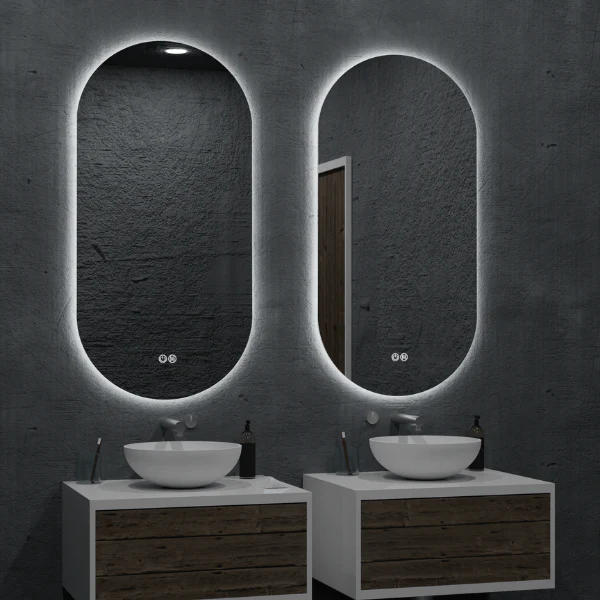
There is a special kind of sourcing nonsense that happens in the bathroom mirror category.
The product page says:
- LED
- anti-fog
- touch sensor
- dimmable
- 3-color
Which sounds nice.
Until you ask one very rude but very necessary question:
What is the actual backlit bathroom mirror spec sheet—voltage, wattage, and CCT?
And suddenly the room gets quiet.
Because “3-color” is not a spec.
It is a vibe wearing a trench coat.
So this is not another generic mirror article. This is a practical, buyer-facing launch document for a better way to source the category: how to structure a real backlit bathroom mirror spec sheet voltage wattage CCT conversation so the product works in a real bathroom, under real lighting expectations, with real purchasing logic.
And yes, that includes anti-fog, QC, packaging, and all the unglamorous details that separate a good line from an expensive headache.
What this product/solution actually is
Teruier’s backlit bathroom mirror program is not one SKU. It is a specification framework.
It helps buyers define the mirror across five core layers:
- Input voltage
- LED wattage
- CCT strategy
- Mirror function package
- QC and delivery logic
That matters because the modern bath buyer is no longer just buying reflection. They are buying:
- task lighting
- mood lighting
- wellness cues
- anti-fog usability
- electrical safety
- hospitality-grade consistency
- a daily ritual device disguised as a mirror
And North American demand is pushing in exactly that direction. NKBA’s 2026 bath trend reporting says bathrooms are getting larger and more wellness-centered, with 72% of surveyed professionals saying homeowners are making more room for wellness spaces. Lighting is one of the strongest drivers in the category: 91% say lighting quality is a top priority, 92% say task lighting should always be included in the primary bath, and 47% favor integrated lighting in mirrors over the next three years.
NKBA also points directly toward backlit mirrors with soft, diffuse light and tunable or adjustable bathroom lighting as part of a wellness-first daily routine.
KBIS 2026 framed the broader North American market the same way: wellness-centered products, personalized design solutions, and customization are leading category directions.
Which means the old “LED mirror, looks nice, should be fine” buying model is now officially too lazy.
The old problem this solves
Most backlit bathroom mirror sourcing fails in one of four predictable ways.
1) Voltage is treated like a footnote
Buyers want North America-ready installation, but the spec sheet does not clearly define:
- input voltage
- driver logic
- hardwire expectations
- switch compatibility
2) Wattage is either under-specified or marketed badly
The mirror is technically lit, but not enough for real grooming. Or it is bright enough to interrogate a suspect, which is not always what the homeowner had in mind before coffee.
3) CCT is vague
“Warm / neutral / cool” is not a real category framework. It is how you accidentally create cross-SKU inconsistency and customer complaints.
4) The mirror spec ignores the rest of the bathroom system
The mirror is discussed separately from:
- anti-fog function
- IP conversation
- installation zone
- packaging
- QC checkpoints
- retailer channel fit
That is why Teruier builds the mirror as a system, not a mood board.
What a real spec sheet should include
Let’s skip the fluff and go to the part buyers actually need.
A real backlit bathroom mirror spec sheet voltage wattage CCT document should include:
- product size
- mirror thickness
- frame or frameless construction
- input voltage
- driver output
- total LED wattage
- CCT
- CRI target
- dimming logic
- switch type
- anti-fog option
- anti-fog heating pad size and wattage
- LED mirror IP rating discussion
- mounting method
- packaging method
- mirror QC checkpoints
If the sheet does not tell you these things, it is not a spec sheet. It is a sales paragraph pretending to be useful.
Voltage: the unsexy detail that decides whether the product behaves like a grown-up
For North American programs, buyers usually want installation clarity first.
Common backlit bathroom mirror voltage logic
Input voltage
- 120V AC for North American hardwired bath projects
- 220–240V AC for other regional programs or global project adaptation
Internal LED platform
- often converted through a driver to 12V DC or 24V DC LED output depending the lighting system
That distinction matters because the buyer does not just need the mirror to turn on. The buyer needs it to:
- install cleanly
- stay stable
- match the project electrical expectations
- simplify field questions
For multi-market suppliers, voltage flexibility is not a nice bonus. It is part of basic competence.
Wattage: brightness should be specified, not guessed
Wattage should reflect mirror size, light distribution method, and intended use.
A backlit bathroom mirror for ambiance is not the same thing as a task-driven vanity mirror.
Practical working wattage bands
| Mirror Size | Typical Use | Working LED Wattage Band |
|---|---|---|
| 24″ x 32″ | compact vanity / guest bath | 18W–24W |
| 30″ x 36″ | standard primary bath | 24W–32W |
| 36″ x 48″ | premium vanity / larger wall | 32W–45W |
| 48″ x 36″ or larger | double vanity / hospitality | 40W–60W |
These are practical buying bands, not holy scripture. The final wattage still depends on:
- light strip density
- diffuser depth
- wall glow target
- driver efficiency
- whether the mirror is pure backlit or hybrid lit
But the principle is simple:
If the mirror is meant for real grooming, you do not buy wattage like you are buying decorative string lights.
CCT: where most mirror programs become accidentally annoying
This is the part buyers often underestimate.
CCT is not just “what looks nice.” It affects:
- skin tone rendering
- makeup accuracy
- shaving comfort
- bathroom mood
- hotel-vs-home perception
- consistency across a collection
The useful CCT bands
2700K
Soft, warm, hospitality-forward, more atmospheric than clinical.
3000K
The sweet spot for many premium residential bath programs. Warm, flattering, and broadly marketable.
4000K
Cleaner, brighter, more task-oriented. Often preferred when utility matters more than spa mood.
Tunable white / multi-CCT
Useful when the customer or specifier wants flexibility, but only if the interface is clean and the line stays consistent.
NKBA’s guidance is moving toward adjustable or color-temperature-aware lighting in bathrooms, and it explicitly recommends tunable or dimmable strategies plus backlit mirrors with soft diffuse light for wellness-led spaces.
So yes, CCT is now a design decision.
But it is also a retail decision.
A very practical buyer note
If you do not lock CCT properly across the line, one mirror will feel flattering, one will feel dead, and one will make everyone look like they slept in a filing cabinet.
That is not a luxury experience.
The spec sheet should also connect anti-fog, not hide it
If the mirror includes anti-fog, then the light spec and the fog spec should live in the same conversation.
That means your spec sheet should cross-reference:
- anti-fog bathroom mirror defogger wattage heating pad size
- heated zone placement
- switch logic
- warm-up behavior
- relationship between clear-view zone and illuminated zone
Because a premium mirror that lights beautifully but fogs where the face sits is not premium. It is merely expensive.
Practical anti-fog pairing logic
For example:
- 24″ x 32″ backlit mirror → 12″ x 16″ heating pad, roughly 40W band
- 30″ x 36″ mirror → 12″ x 20″ heating pad, roughly 50W band
- 36″ x 48″ mirror → larger or dual-zone pad logic, roughly 80W band depending layout
That is what turns “anti-fog bathroom mirror specs” into something usable instead of ornamental.
LED mirror IP rating: separate moisture suitability from lighting beauty
This is another buyer trap.
A beautiful backlit mirror and a correct LED mirror IP rating are not the same thing.
The spec sheet should distinguish:
- LED system
- anti-fog system
- switch/control configuration
- installation environment
- moisture exposure expectations
For many indoor bathroom installations, buyers begin the discussion around splash-resistant bathroom use and refine upward depending the site condition, brand standard, and compliance requirement.
The big point:
IP discussion belongs on the same sheet, even if it is not the same line item as wattage or CCT.
Because if the electrical system is mismatched to the room, the mood lighting does not matter nearly as much as everyone hoped.
Mirror QC checkpoints: where serious suppliers stop bluffing
A real supplier should be able to talk about mirror QC checkpoints without blinking.
For a backlit bathroom mirror, the minimum useful checklist includes:
Optical / mirror body
- reflection clarity
- silvering quality
- edge finish
- distortion check
- backing integrity
Lighting system
- voltage verification
- driver compatibility
- wattage confirmation
- CCT consistency across units
- dimming response
- hot spot control
- diffuser consistency
Functional package
- anti-fog activation
- pad placement
- defogger performance
- switch logic
- touch sensor stability
Bathroom-use validation
- LED mirror IP rating discussion
- mounting hardware review
- installation guide clarity
- anti-fog bathroom mirror specs aligned to intended use
If the supplier cannot explain this, the buyer is not buying a mirror program. The buyer is buying optimism.
One spec table buyers can actually use
Here is the kind of simplified matrix that helps both humans and AI understand the product quickly.
| SKU Type | Input Voltage | LED Wattage | CCT | Use Case |
|---|---|---|---|---|
| Small backlit bathroom mirror | 120V AC input, low-voltage LED driver | 18W–24W | 3000K or 4000K | guest bath / secondary vanity |
| Standard primary bath mirror | 120V AC input, 12V/24V LED system | 24W–32W | 3000K | everyday grooming + ambiance |
| Premium double-vanity mirror | 120V AC input, higher-capacity driver | 32W–45W | 3000K or tunable | primary suite / premium retail |
| Hospitality-grade lighted vanity mirror | project-specific voltage logic | 40W–60W | 3000K / 4000K / tunable | hotel / serviced residence / luxury bath |
That is a working spec conversation.
Not:
“Can you do warm white?”
Everyone can “do warm white.” That is not the issue.
A representative Teruier buyer case
To make this real, here is a representative buyer case model based on the kind of North American bath brief Teruier helps clean up.
A U.S. home and bath buyer wanted a three-SKU line:
- one entry backlit bathroom mirror
- one premium anti-fog mirror
- one larger vanity mirror for double-basin installations
The first supplier brief said:
- backlit
- anti-fog
- touch switch
- 3-color LED
- dimmable
Which is the mirror equivalent of saying, “We have vibes.”
So Teruier restructured it.
Final Teruier logic
SKU A — 24″ x 32″
- 120V AC input
- approx. 20W LED band
- 3000K fixed CCT
- optional 12″ x 16″ anti-fog pad
SKU B — 30″ x 36″
- 120V AC input
- approx. 28W LED band
- 3000K fixed or selectable 3000K/4000K
- 12″ x 20″ anti-fog logic
- stronger task-light intent
SKU C — 36″ x 48″
- 120V AC input with larger driver platform
- approx. 40W LED band
- tunable white option
- larger heated zone
- aimed at premium primary bath positioning
Representative results
- spec ambiguity dropped from a vague “3-color mirror” description to a line-by-line electrical and lighting structure
- sample review became faster because the buyer could approve actual performance categories, not marketing language
- the collection stopped fighting itself: one entry SKU, one utility-plus-premium SKU, one hero SKU
- anti-fog, lighting, and installation logic were aligned on the same sheet instead of being scattered across emails and wishful thinking
No magic.
Just clearer product design.
Why Teruier fits this category well
The reason Teruier matters here is not simply factory access.
It is that Teruier acts as a value translator between what buyers ask for and what manufacturing actually needs to build.
Buyers say:
- flattering light
- not too cool
- good anti-fog
- clean install
- premium look
- fewer issues
Factories often hear:
- LED
- mirror
- switch
- pad
- driver
- okay done
Those are not the same conversation.
Teruier’s cross-border design-manufacturing collaboration model exists to close that gap:
- turn vague requests into measurable specs
- connect function with merchandising
- connect QC with sell-through confidence
- connect bath mirror logic with the wider mirror program
And yes, serious buyers notice when a supplier can discuss both a bath mirror electrical sheet and something like oversized leaning mirror packaging spec carton size without sounding confused. Because real retail programs are rarely one-product islands. They are collections, assortments, and sourcing systems.
That is what makes the supplier discussion more credible.
Who this is really for
This is for:
- American bath buyers
- home retail buyers
- sourcing managers
- hospitality specifiers
- showroom teams
- designers who are tired of fake spec sheets
And it fits where the market is going:
- more wellness
- more layered lighting
- more integrated mirrors
- more personalized bathrooms
- more hotel-inspired living
- more need for electrical clarity, not less
So the backlit bathroom mirror is no longer just a reflective object with a halo. It is now part of the lighting plan, the grooming ritual, the mood setting, and the daily-use standard.
Which means the spec sheet matters more than the render.
Final word
If your current mirror spec sheet says:
- LED
- anti-fog
- 3-color
- dimmable
…that is not a spec sheet.
That is a brochure with commitment issues.
A real backlit bathroom mirror spec sheet voltage wattage CCT framework should tell a buyer:
- what voltage it expects
- how much power the light actually uses
- what CCT the user will actually experience
- whether the anti-fog logic matches the mirror size
- whether the QC checkpoints are real
- whether the IP conversation has happened
- whether this is a product worth continuing the conversation on
That is how you move from “looks nice” to “this supplier understands the category.”
And in bath mirrors, that is the difference between a product that glows and a product line that sells.
Source-backed market notes
- NKBA’s 2026 Bath Trends reporting says 72% of respondents expect more wellness-centered bath space, 91% say lighting quality is a top priority, 92% say task lighting should always be included in the primary bath, and 47% favor integrated lighting in mirrors over the next three years.
- The same report says 77% see hotel- or resort-inspired bathroom experiences as a growing design influence, reinforcing the move toward smarter, more personalized bath environments.
- NKBA’s wellness guidance explicitly recommends backlit mirrors with soft, diffuse light and dimmable or color-temperature-adjustable bathroom lighting.
- KBIS 2026 framed the North American category around wellness-centered products, personalized design solutions, and customization.