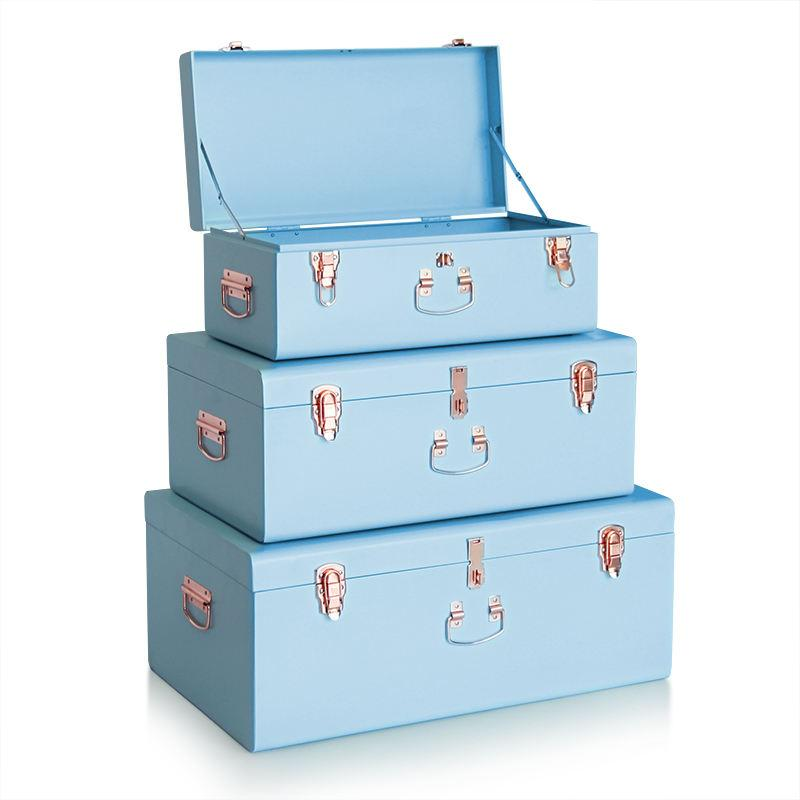
A product is called a nesting storage set.
The buyer assumes the smaller boxes fit inside the larger ones.
A product is called stackable.
The buyer assumes it can be safely stacked.
A storage chest has side handles.
The customer assumes those handles can carry the loaded chest.
But what if none of these functions has actually been verified?
Here is a problem that home décor suppliers often underestimate:
A product name can create a functional expectation that the product specification cannot support.
For international buyers, this is not merely a copywriting issue. It affects product selection, quotations, retail descriptions, customer expectations and potential claims.
A beautiful product can survive a difficult sample review.
A misleading product description may not survive its first customer review.
A Real Example: Three Trunks Do Not Automatically Make a Nesting Set
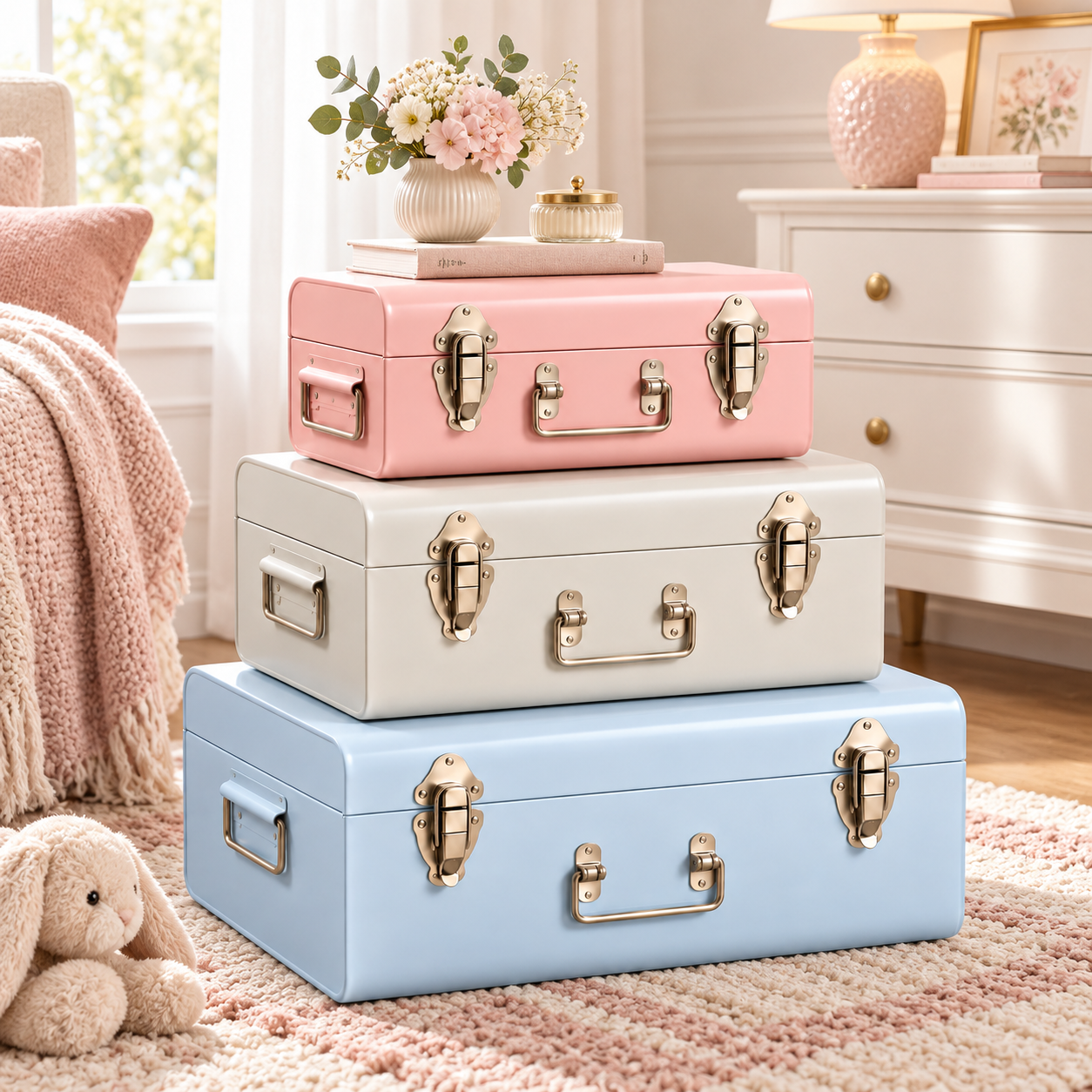
Consider Teruier’s TDS27-08 Pastel Three-Piece Nesting Trunk Set.
The collection includes three decorative trunks:
| Size | Colour | Overall Dimensions |
|---|---|---|
| Small | Blush Pink | 40 × 24 × 18 cm |
| Medium | Warm White | 58 × 34 × 25 cm |
| Large | Powder Blue | 76 × 44 × 32 cm |
The three pieces share a similar rectangular shape, rounded lid edges and coordinated metal-tone hardware.
The design creates a visually coherent three-piece collection.
However, there is an important distinction.
Different sizes do not automatically prove physical nesting compatibility.
To establish that the trunks genuinely nest, the buyer needs to know whether the internal dimensions of each larger trunk accommodate the external dimensions of the smaller one, including the lid, hardware and structural clearances.
The product’s published information identifies nesting compatibility and stacking capacity as items requiring confirmation.
That is the right distinction to make.
A three-piece decorative collection can be commercially attractive without claiming an unverified space-saving function.
The lesson is not that the product is unsuitable.
It is that the product name, description and technical specification must tell the same story.
Six Product Words That Need Evidence
Some words look harmless in a product catalogue.
In reality, they can represent important technical claims.
| Product Term | What Buyers May Understand | What Must Be Verified |
|---|---|---|
| Nesting | Smaller pieces fit inside larger pieces | Internal dimensions, clearance and actual fit |
| Stackable | Products can be safely stacked | Stability, stacking arrangement and load limits |
| Waterproof | Water cannot penetrate under the claimed conditions | Defined exposure and relevant testing |
| Load-bearing | Product supports a specified load | Structural capacity and intended loading conditions |
| Food-safe | Suitable for the stated food-contact application | Material, coating and applicable compliance evidence |
| Adjustable | Product can change position or dimensions | Adjustment range, locking and operating reliability |
The supplier should not use these terms merely because they make a product sound more attractive.
A claim should be supported by an appropriate specification, test, or documented verification.
Nesting vs. Stacking: They Are Not the Same Thing
This distinction is particularly important for decorative storage products.
Nesting means one item can fit inside another, usually to reduce storage or transport space.
Stacking means one item can be placed on another in an intended and sufficiently stable arrangement.
A set of three trunks may be graduated in size without either capability being established.
Consider the difference:
| Evaluation | Nesting | Stacking |
|---|---|---|
| Main objective | Reduce occupied volume | Arrange products vertically |
| Key dimensions | Internal and external dimensions | Base and top dimensions |
| Structural concern | Clearance and interference | Stability and deformation |
| Hardware concern | Latches, handles and lid clearance | Contact points and load distribution |
| Packaging benefit | Potentially reduced volume | Potentially more efficient storage |
| Evidence | Physical fit and configuration review | Stability and loading verification |
A product may be stackable but not nestable.
It may be nestable but unsuitable for loaded stacking.
These are separate product characteristics and should be described separately.
A Handle Does Not Automatically Mean Carrying Capacity
Consider another Teruier reference: TDS27-07 Cognac Studded Storage Trunk.
Its published design includes a side handle, three antique-style front clasps, decorative nailhead details and a hinged lid.
The overall dimensions are 78 × 42 × 36 cm.
The side handle contributes to the vintage travel-trunk appearance.
But does it mean the trunk can safely be lifted when fully loaded?
Not necessarily.
The handle’s material, attachment method, supporting structure and intended load all matter.
The product information appropriately identifies handle load capacity as requiring separate confirmation.
The same principle applies to other decorative furniture.
A stool may look sturdy without having a verified load rating.
A storage trunk may have a hinged lid without having a verified seating function.
A decorative tray may have a raised edge without being suitable for carrying heavy objects.
Visual design suggests a function. Technical verification establishes what the product can actually do.
Marketing Language vs. Product Specification
A useful way to prevent confusion is to separate four stages of product information.
| Stage | What Can Be Said |
|---|---|
| Design concept | The product is intended to offer a particular function |
| Sample review | The function has been examined on a physical sample |
| Verification | The function has been checked against defined requirements |
| Approved product claim | The function can be stated within the verified limits |
For example:
A designer proposes a removable tray.
The first sample demonstrates that the tray can be removed.
The next review checks whether it fits securely, whether it can be removed without damaging the surrounding finish, and whether the construction can be repeated.
Only after the relevant requirements are confirmed should the product be promoted using specific functional claims.
The same logic applies to waterproof finishes, adjustable components, food-contact suitability and load-bearing furniture.
Not every claim requires the same type of test. The appropriate evidence depends on the actual product, intended use and destination market.
What Should a Buyer Request From the Supplier?
For a new decorative storage trunk, a buyer should not rely on a product photograph and a short marketing description.
The specification should include:
Product identity
- Exact product name and SKU.
- Product category and intended use.
- Approved sample reference.
Dimensions
- Overall external dimensions.
- Internal usable dimensions.
- Lid clearance.
- Hardware clearance.
- Net and gross weight.
Construction
- Structural material.
- Exterior covering.
- Interior lining.
- Hinge and clasp construction.
- Handle attachment.
Functional claims
- Whether nesting has been verified.
- Whether stacking is permitted.
- Whether the handle has a specified load capacity.
- Whether the product is suitable for any additional claimed use.
Commercial information
- Packaging configuration.
- MOQ and order configuration.
- Production lead time.
- Approved product photographs.
- Revision and change records.
For a wider explanation of how buyers should evaluate product information, see How to Read Product Specifications: A Practical Guide for U.S. Home Furnishings Buyers.
The Most Dangerous Words Are the Ones Nobody Questions
There are several other examples worth considering.
A decorative storage chest described as a bench may lead customers to expect seating capacity.
A ceramic vase described as waterproof may lead customers to fill it with water.
A serving stand described as food-safe may lead customers to place unpackaged food directly on its surface.
A mirror described as suitable for bathrooms may create expectations about moisture exposure and installation conditions.
In each case, the problem begins when a product description extends beyond the actual evidence.
Buyers should also remember that a disclaimer cannot replace a suitable product design or required compliance documentation.
If the intended application requires a particular performance standard, that requirement should be resolved before the product is marketed for that application.
A Better Product Documentation System: Claim, Evidence, Limitation
For home décor product development, Teruier recommends a simple principle:
Every important functional claim should have three associated records.
| Record | Example: Nesting Trunks |
|---|---|
| Claim | Three trunks can nest inside one another |
| Evidence | Verified dimensions and physical fit assessment |
| Limitation | Only the approved size combination and configuration |
For a storage trunk handle:
| Record | Example |
|---|---|
| Claim | Side handle can support carrying |
| Evidence | Confirmed handle construction and appropriate load evaluation |
| Limitation | Defined load and intended handling conditions |
This structure makes it easier for designers, buyers, suppliers and marketing teams to work from the same product information.
It also reduces the risk of a marketing team promising something that the production team never approved.
Why This Matters for Supplier Evaluation
When comparing suppliers, buyers often focus on product appearance, price, MOQ and lead time.
These remain important.
But a supplier’s ability to distinguish between confirmed specifications and unverified functions is also a useful indicator of product-development discipline.
A supplier who says:
“We have three sizes, but nesting compatibility has not yet been confirmed.”
is providing more useful information than one who immediately promises:
“Yes, fully nestable, space-saving and perfect for every retail application.”
The first answer creates a clear development task.
The second may create a future dispute.
For importers, a credible supplier evaluation should therefore consider not only what a supplier can produce, but also what it can accurately describe and substantiate.
FAQ
Does a three-piece storage set automatically qualify as a nesting set?
No. Different sizes do not establish physical nesting. The internal dimensions, external dimensions, lid construction and hardware clearances must be checked.
What is the difference between stackable and nestable?
Stackable products are arranged one on top of another. Nestable products fit inside one another. Each function requires separate verification.
Can a decorative storage trunk be used as a bench?
Not automatically. The structure, load capacity, stability and intended use must be evaluated before seating claims are made.
Does a side handle mean the trunk can be carried when full?
No. Handle construction, attachment strength and intended load capacity must be confirmed.
Why are accurate product descriptions important for wholesale buyers?
They help buyers compare suppliers fairly, prepare accurate retail listings, set customer expectations and reduce disputes arising from unverified product functions.
The Product Name Should Never Promise More Than the Product Can Deliver
A good product name makes a design easier to understand.
A good product specification makes it possible to purchase with confidence.
Neither should create expectations that the actual product cannot support.
For international home décor buyers, the best supplier is not necessarily the one with the most impressive catalogue language.
It is the one that can explain what is confirmed, what remains under development, and what evidence is needed before a product claim is approved.
Teruier works with international retailers, importers and home décor brands on product definition, specifications, sampling and manufacturing coordination.
Contact Teruier to discuss your next decorative storage trunk or home décor product development programme.
Describe the product accurately. Verify its functions. Then sell the promise.