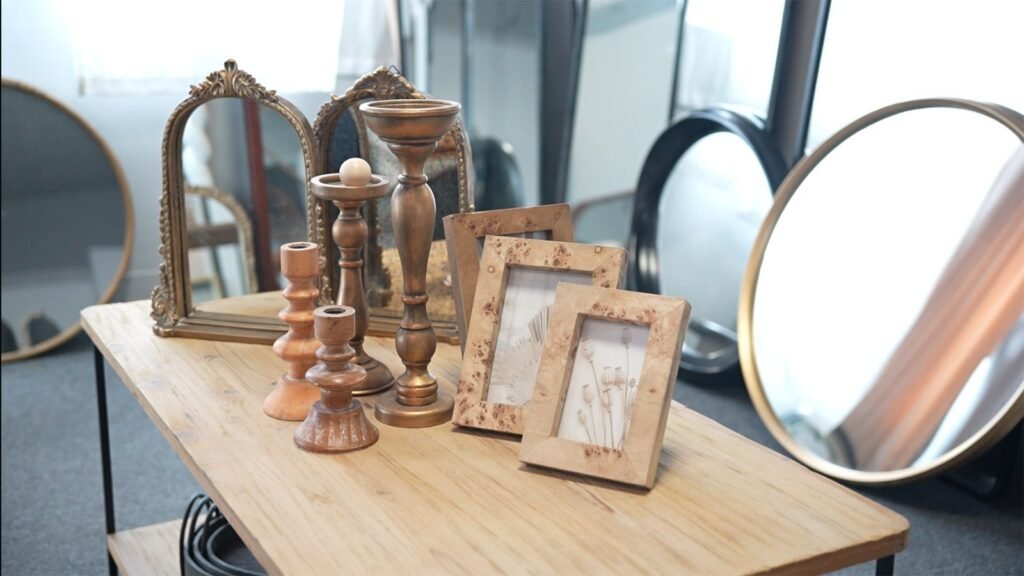
Materials and finishes are not “details”. They are the product.
Retail buyers know this problem very well.
The product photo looks good.
The finish looks warm.
The ceramic glaze looks expensive.
The mirror light looks soft.
The supplier says, “Very popular style.”
Lovely.
Then the sample arrives.
The brass is too yellow.
The ceramic glaze looks different.
The oyster plate decor feels too fragile.
The anti-fog mirror works, but only in a tiny area.
The specification sheet is vague enough to start a small argument.
This is why home decor materials and finishes matter so much for German retail buyers.
Customers may not know the technical name of a finish. But they can feel when a product looks cheap, fragile, badly matched or difficult to place.
And customers, sadly, are very good at noticing problems after buying.
What are home decor materials and finishes?
Home decor materials and finishes refer to the surfaces, textures, coatings, colours and material choices that define how a product looks, feels, performs and fits into a room.
They include:
- mirror frame finishes
- LED mirror specifications
- ceramic glaze finishes
- fabric textures
- metal coatings
- wood tones
- stone-look surfaces
- decorative ceramic surfaces
- packaging-related material protection
For German retail buyers, materials and finishes are not only about aesthetics.
They affect:
- perceived value
- customer trust
- reorder stability
- shelf presentation
- product explanation
- return risk
- assortment coordination
A product with the wrong finish does not simply look “different”.
It becomes harder to sell.
LED mirror IP44 specification: useful, but do not treat it like decoration
LED mirrors can be strong retail products because they offer both function and design.
But the technical specification matters.
The LED mirror IP44 specification is especially relevant when buyers are considering bathroom-related products. IP44 generally means protection against solid objects larger than 1 mm and splashing water from any direction. For retail buyers, this should not be treated as a casual marketing phrase.
German buyers should ask:
- Is the LED mirror IP rating clearly stated?
- Is it suitable for the intended bathroom use?
- Are installation notes available?
- Is the voltage listed?
- Is the wattage listed?
- Is the CCT listed?
- Is the switch type clear?
- Are the same components used in reorder?
A bathroom mirror with unclear specs is not “modern”.
It is a future customer service conversation with lighting.
Anti-fog bathroom mirror: the defogger detail buyers often miss
Anti-fog bathroom mirrors sound easy to sell.
Nobody likes a foggy mirror after a shower.
Very reasonable. Very human.
But buyers should check the anti-fog bathroom mirror defogger wattage heating pad size before placing an order.
Important questions:
| Detail | Why German Buyers Should Ask |
|---|---|
| Defogger pad size | tells how much of the mirror clears |
| Wattage | affects performance and technical review |
| Heating pad position | should match the useful viewing area |
| Clearing time | affects customer expectation |
| Mirror size | defogger area must make sense |
| Specification note | avoids misunderstanding at retail level |
The problem is not always whether the anti-fog function works.
The problem is whether the customer expects the whole mirror to clear, while only the centre clears.
That is not a mirror defect.
That is a product explanation defect.
And those are also expensive.
Ceramic glaze finishes: beautiful, but they need limits
Ceramic glaze finishes are powerful in home décor because they create texture, depth and perceived craft value.
Good glaze directions for retail include:
- warm white glaze
- matte beige glaze
- soft green glaze
- terracotta glaze
- reactive glaze
- glossy majolica-style glaze
- stone-look ceramic finish
- tonal ceramic finishes
But ceramic glaze must be controlled.
A little variation can feel handmade. Too much variation feels inconsistent.
German buyers should confirm:
- approved colour range
- matte or glossy level
- surface smoothness
- acceptable speckling
- glaze thickness
- batch consistency
- packaging protection
- decorative or functional use
A ceramic product should look crafted.
It should not look like the kiln made all the design decisions.
Oyster plate decor: small accent, real retail question
Oyster plate decor can be a useful accent product for retail buyers.
It works in:
- coastal home décor
- table styling
- boutique shelf displays
- summer collections
- restaurant-inspired home stories
- giftable decorative assortments
It is easy to explain, which is always helpful.
But buyers should still check:
- shell shape consistency
- glaze colour
- edge thickness
- surface finish
- whether it is decorative or food-safe
- individual packaging
- reorder colour standard
An oyster plate should look charming and intentional.
It should not look like a shell had a difficult meeting with a glaze bucket.
For retail buyers, the key is clarity. If it is decorative, say decorative. If it is suitable for serving, the supplier must provide the right product information.
Small products can create big confusion when use cases are unclear.
Wholesale home decor materials: buy the material system, not just the item
German buyers should not evaluate wholesale home decor materials one product at a time.
A mirror, ceramic plate, ottoman and tray may all sit in the same retail story.
So the finishes need to work together.
| Product Type | Material / Finish to Check | Buyer Logic |
| LED mirror | IP rating, frame finish, CCT | function and bathroom trust |
| Anti-fog mirror | defogger size, wattage, heating area | customer expectation control |
| Oyster plate decor | glaze, edge, use note | small accent with clear selling point |
| Ceramic vase | glaze tone, surface, packaging | shelf value and reorder stability |
| Ottoman | fabric texture, colour, seam | touch and room coordination |
| Tray / box | coating, surface, weight | add-on retail value |
A retail-ready range should feel connected.
If the mirror is cool chrome, the ceramic is warm terracotta, the ottoman is grey-blue, and the tray is glossy green, the shelf may begin to look like several suppliers were trapped in one display.
Not ideal.
Easy to work with supplier for interior designers — and retail buyers too
An easy to work with supplier for interior designers is also valuable for retail buyers.
Why?
Because both designers and buyers need clear product answers.
A good supplier should provide:
- material options
- finish references
- product notes
- spec sheets
- carton information
- MOQ and lead time
- sample approval records
- packaging details
- reorder standards
Retail buyers do not need a supplier who only says, “This is popular.”
Popular where?
For whom?
In which finish?
At what price point?
With what packaging?
Can it be reordered?
These are not rude questions.
They are buying questions.
Cheap finish vs retail-ready finish
| Buyer Point | Cheap Finish | Retail-Ready Finish |
| First impression | may look acceptable in photos | looks stable in real product |
| Reorder | colour may shift | controlled standard |
| Customer trust | weaker if material feels cheap | stronger perceived value |
| Shelf coordination | often random | easier to combine |
| Supplier support | vague | documented |
| Long-term value | risky | more reliable |
A cheap finish can make a product look good for five seconds.
A retail-ready finish helps it sell, reorder and survive customer handling.
Five seconds is not a business model.
Teruier’s value translation: from material choice to retail decision
For this article, Teruier’s value translation approach is the right lens.
A retail buyer may say:
“We need bathroom mirrors that feel reliable.”
“We need ceramic pieces with warmer finishes.”
“We want decorative accents, but not fragile-looking products.”
“We need materials that work together on the shelf.”
A factory may answer in production language:
“What glaze?”
“What wattage?”
“What IP rating?”
“What carton?”
“What finish tolerance?”
“What MOQ?”
Teruier’s value translation connects these two sides.
It turns retail intent into product decisions:
- “reliable bathroom mirror” becomes LED mirror IP44 specification, wattage, CCT and installation notes
- “anti-fog function” becomes defogger pad size, wattage and heating area
- “crafted ceramic look” becomes approved ceramic glaze finishes
- “small coastal accent” becomes oyster plate decor with clear use and packaging notes
- “retail-ready shelf” becomes coordinated wholesale home decor materials
That is what retail buyers need.
Not more vague product descriptions.
Better buying decisions.
FAQ
What are home decor materials and finishes?
Home decor materials and finishes are the surfaces, textures, coatings, colours and material choices that define how a product looks, feels, performs and fits into a room.
Why are materials and finishes important for German retail buyers?
They affect perceived value, customer trust, shelf presentation, reorder stability, product explanation and return risk.
What does LED mirror IP44 specification mean?
LED mirror IP44 specification generally refers to protection against solid objects larger than 1 mm and splashing water from any direction. Buyers should still check full product documentation and intended use.
What should buyers check in anti-fog bathroom mirror specs?
They should check defogger wattage, heating pad size, heating area, mirror size, clearing performance, switch type and whether the same components are used in reorder.
Why do ceramic glaze finishes need control?
Ceramic glaze can vary during production. Buyers should define acceptable colour, surface, gloss, speckling and batch variation so the product remains retail-ready.
Is oyster plate decor suitable for retail buyers?
Yes. Oyster plate decor can work as a coastal, table styling or boutique accent product. Buyers should check glaze, edge quality, packaging and whether it is decorative or food-safe.
What are wholesale home decor materials?
They include mirror glass, frame finishes, ceramic glazes, fabrics, metal coatings, wood tones, stone-look surfaces and packaging materials used across home décor products.
What makes a supplier easy to work with?
Clear product specs, finish references, useful product notes, packaging details, realistic MOQ, stable lead time and honest communication about product limitations.
Final thought: good finishes make products easier to sell
For German retail buyers, home decor materials and finishes are not cosmetic details.
They decide whether a product feels trustworthy, sellable and reorderable.
An LED mirror needs clear IP and lighting specs.
An anti-fog mirror needs defogger details.
Oyster plate decor needs use clarity.
Ceramic glaze finishes need approved tolerance.
Wholesale home decor materials need shelf coordination.
Good materials make products easier to explain.
Good finishes make them easier to buy.
And good suppliers make both less painful.