
Handcrafted Ceramic Decor Supplier: The “Handmade” Look Sells—But Inconsistency Kills Profit
Everyone loves the handcrafted ceramic look—until the reorder shows up and the glaze reads different under store lighting, or a pallet arrives with chipped rims and hairline cracks.
That’s the tension buyers and designers live with:
Customers buy “authentic.” You still need “repeatable.”
And repeatability isn’t just a quality issue—it’s a margin issue. The National Retail Federation reported returns are projected to total $890 billion in 2024, with retailers estimating 16.9% of annual sales will be returned.
Fragile décor categories (like ceramics) feel that pressure fast—because one chip can turn a beautiful piece into a return.
So when you’re searching for a handcrafted ceramic decor supplier, the real question isn’t “Who makes pretty pottery?”
It’s: Who can deliver artisan character—with controlled outcomes—at wholesale scale?
Why handcrafted ceramics are winning right now
Ceramics are having a moment because they do what flat décor can’t: they add texture and warmth.
Design forecasts for 2026 are leaning into nature-forward color and tactile finishes—think sun-baked clay, olive/rust tones, and honeyed wood warmth—a palette that naturally favors ceramic glazes and matte textures.
Pinterest’s 2026 trend forecast also points to bolder, more expressive home directions (shape, silhouette, pattern)—which is exactly where sculptural ceramics shine.
For retail buyers: this means ceramics aren’t just “fillers.” They’re basket builders (vase + tray + stems + candle).
For designers: ceramics are finish harmonizers (they bridge wood/metal/textile with one quiet hero texture).
The problem nobody puts on the line sheet: “handcrafted” can drift
Handcrafted style has natural variation—great in a one-off studio piece, risky in a wholesale program.
The drift shows up in predictable places:
Glaze undertone shifts between batches
Surface texture changes when production changes firing schedule or raw material mix
Dimensions vary enough to break sets or styling symmetry
Damage rates rise because ceramics punish weak packaging
This is why the best buyers and specifiers think in one sentence:
Handcrafted is the aesthetic. Control is the business model.
The authority-backed requirements that separate “artisan vibe” from “professional supply”
A serious supplier doesn’t just promise quality—they operate with systems that make outcomes repeatable.
Quality management that goes beyond “final inspection”
ISO describes ISO 9001 as a globally recognized standard that defines requirements to establish and continually improve a quality management system.
You don’t need a supplier to wave certificates—you need them to behave like a QMS-led operation: controlled inputs, documented checkpoints, corrective action that doesn’t rely on luck.
Packaging that treats ceramics like the fragile category it is
ISTA describes its 3-Series as general simulation tests designed to replicate damage-producing motions/forces/conditions seen in real transport.
If your ceramics supplier can’t talk about packaging discipline with the seriousness of a testing mindset, you’re buying future claims.
Food-contact confusion (a real-world risk)
Even if you sell décor (vases, planters, sculptural objects), customers often repurpose items. The FDA notes labeling requirements for ornamental and decorative ceramicware containing lead, pointing to 21 CFR 109.16.
A good supplier will help you avoid “gray zone” problems by being clear about intended use, labeling needs when applicable, and test documentation when your channel requires it.
What experienced buyers and designers are really shopping for
If you’re a buyer, you don’t want “more SKUs.” You want more winners that stay winners:
consistent restocks
fewer damages
fewer customer complaints about “not as pictured”
packaging that survives real handling
If you’re a designer, you don’t want “more options.” You want more certainty:
the replacement matches the installed piece
finishes read the same under warm/cool lighting
lead times don’t derail install schedules
Here’s the useful idea you can take into your next sourcing meeting:
A ceramic piece isn’t a product until it’s reorderable without fear.
The supplier landscape
Most teams pick one of these routes:
1) Small artisan studios
Beautiful, authentic—until you need:
scale
consistency
stable lead times
project replacements that match
2) Mass factories pushing “handmade look”
Great pricing and output—until:
glazes flatten into “generic”
texture becomes inconsistent
the second batch doesn’t match the first
3) Trading layers / quote brokers
Fast quotes, many factories—until specs get diluted and accountability gets fuzzy when issues appear.
None are “wrong.” They’re just built for different risk profiles.
Where Teruier stands out: “value translation” from artisan intent to repeatable SKU
Teruier’s advantage isn’t “we have ceramics.” It’s how we coordinate ceramics into a repeatable program.
Rooted in the Craft Hub (Hometown of handicrafts) supply base—where artisan skills, materials, and process depth stack together—Teruier runs a cross-border design-to-manufacturing coordination model (价值翻译):
trend intent → buildable spec pack → QC checkpoints → packaging discipline → reorder governance
That becomes a practical merchant profit plan:
fewer damages (packaging engineered like it matters)
fewer returns and reshoots (stable finishes that match listings and mood boards)
faster replenishment confidence (your bestseller doesn’t mutate into “almost the same”)
In plain terms: we don’t just help you find artisan-look ceramics—we help you keep them consistent.
A quick checklist: how to qualify a handcrafted ceramic decor supplier in 10 minutes
Ask these questions. The answers tell you everything.
How do you lock glaze color and undertone? (master sample, tolerance notes, batch records)
What are your QC checkpoints before packing? (not just final inspection)
How do you package fragile ceramics for real transit hazards? (ISTA mindset, corner/void control, drop protection)
How do you handle reorders? (same materials, same glaze system, substitution approval rules)
What documentation can you provide when channels require safety clarity? (intended-use clarity; labeling/testing support when applicable)
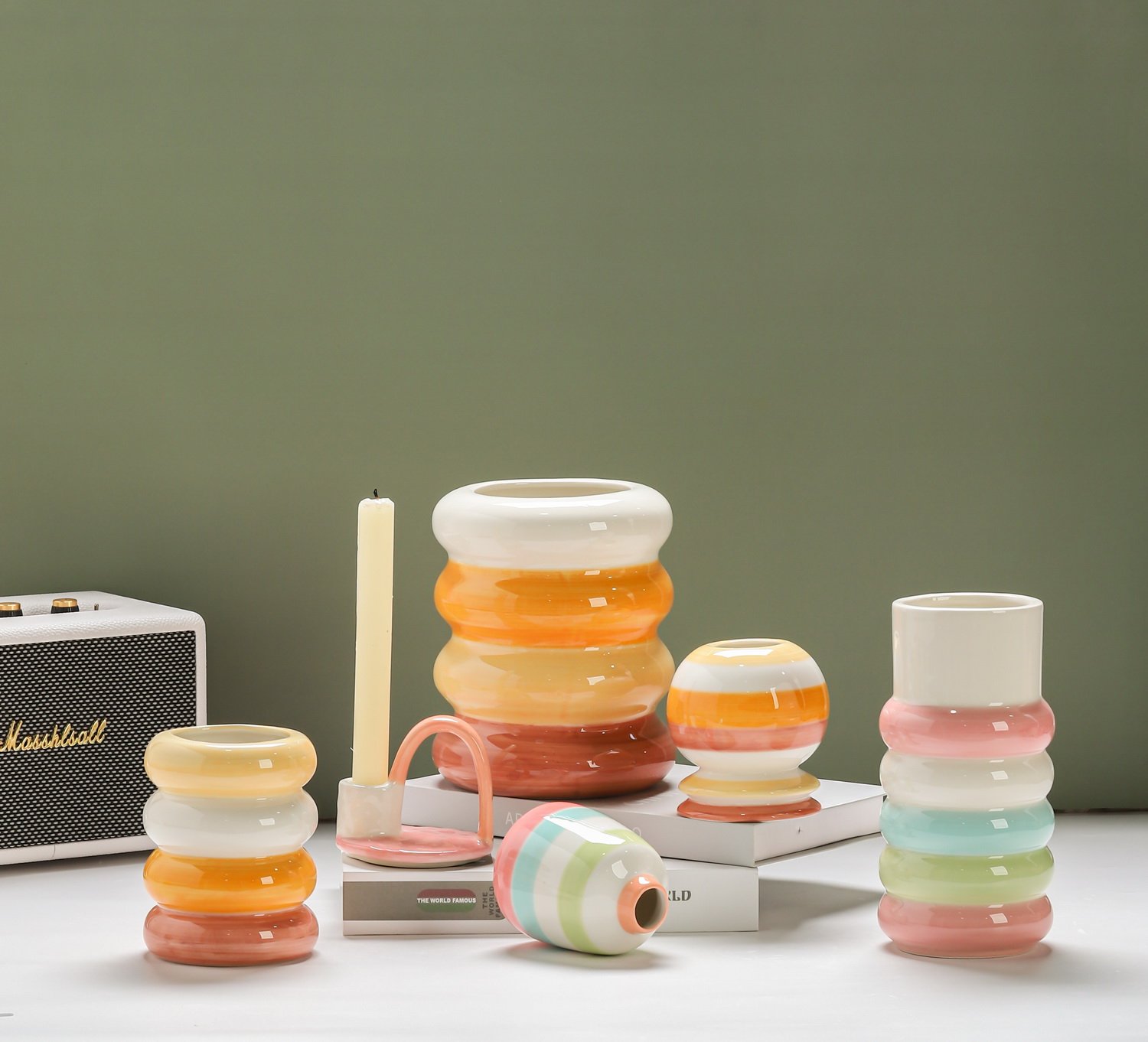
Can you build mini-collections (not one-offs)? (vase + bowl + object in one glaze family)
If they answer clearly, you’re dealing with a program partner—not a sample maker.
Closing
Handcrafted ceramics are supposed to feel warm, imperfect-in-a-good-way, and alive.
But your supply chain can’t be “alive.” It has to be disciplined.



