For a home décor buyer, finding an attractive product at Canton Fair is easy. The harder question is whether that product can become a coherent, commercially useful collection.
A strong coordinated home décor collection does not simply repeat the same color across several items. It gives each product a distinct role while controlling the materials, proportions, finishes, manufacturing risks, packaging, and target price points.
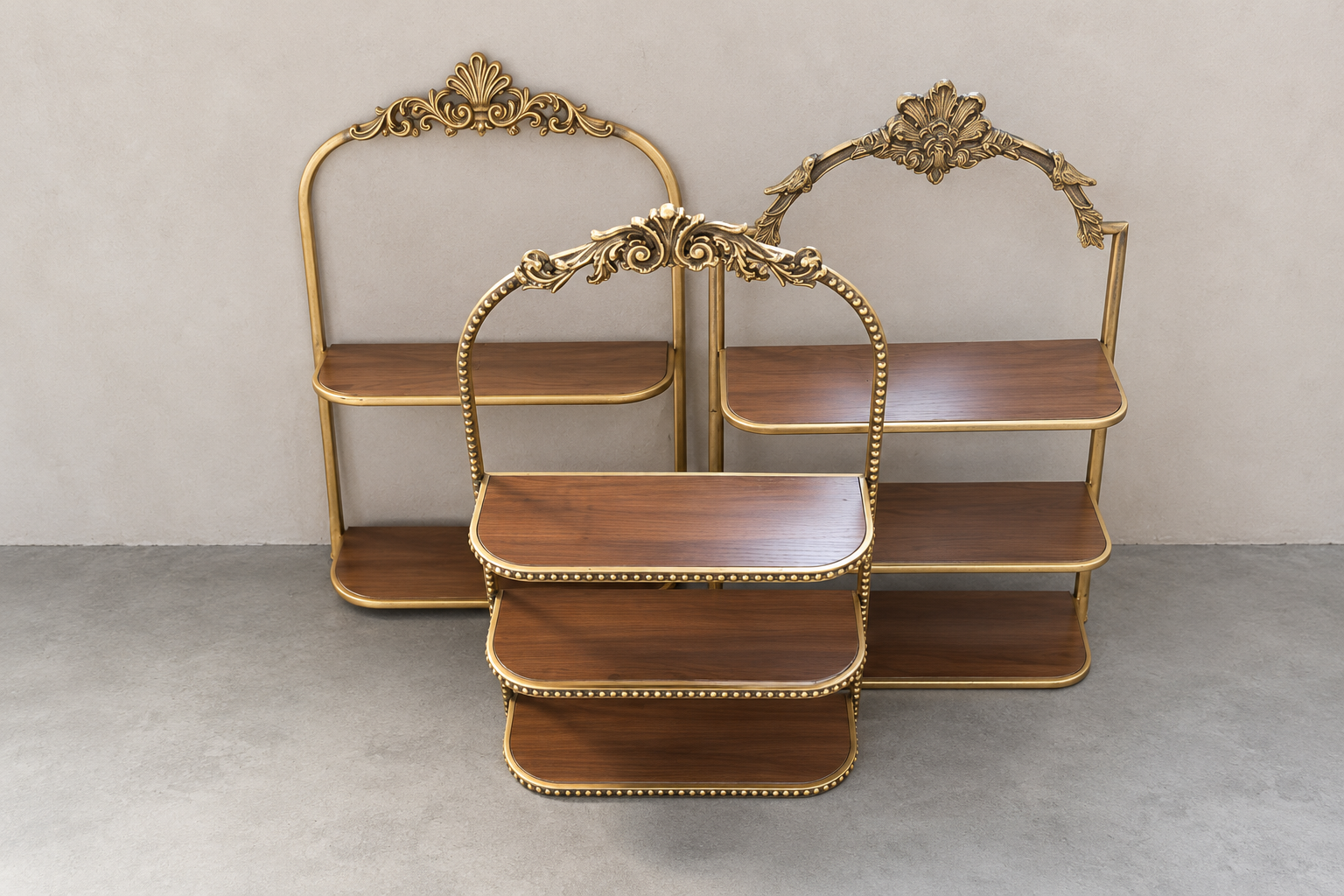
The three vintage decorative shelving units developed for Teruier’s Canton Fair presentation illustrate this process. They share antique-gold metalwork, walnut-toned shelves, three-level display capacity, and European-inspired crest details. However, their heights, frame shapes, and visual weight are intentionally different.
That difference turns three related products into an assortment rather than three near-duplicate SKUs.
Quick Answer for Home Décor Buyers
When evaluating a coordinated collection, buyers should confirm five things:
- The products share recognizable design rules.
- Each SKU serves a different merchandising or price-point role.
- Materials and finishes can be repeated consistently.
- Structural details are practical for production and retail use.
- Packaging allows the collection to ship without losing its margin advantage.
What the Canton Fair Reveals About Collection Buying
The 140th Canton Fair positions Phase 2 as “Quality Home Life,” bringing home decorations, gifts, household goods, furniture, ceramics, and related categories together. This cross-category structure reflects how many buyers now source: not as isolated departments, but as connected interior stories.
For a buyer comparing potential suppliers, this makes collection thinking increasingly important. A decorative shelf may need to coordinate with mirrors, serving pieces, storage boxes, small furniture, or seasonal accessories.
The commercial opportunity is not merely finding more products. It is finding products that can share a retail environment without looking repetitive.
A Real Development Case: Three Decorative Shelves, One Visual Language
The Market Signal
The starting direction combined two themes visible across European and North American interiors: warm dark wood and aged metallic finishes.
The opportunity was not to reproduce a fully traditional antique. It was to translate that visual richness into compact decorative storage suitable for contemporary entryways, bedrooms, dressing areas, gift departments, and boutique displays.
The design team therefore defined several shared elements:
- Walnut-toned shelves with softly rounded corners
- Antique-gold metal frames
- Three vertical display levels
- Ornamental crests inspired by scroll, shell, and leaf forms
- A narrow footprint suitable for smaller interiors
These became the collection rules. Height, frame profile, and decorative intensity could then change without losing the family identity.
Why the Structure Was Refined
The first challenge was balancing decoration with stability. A tall arched frame creates a recognizable silhouette, but it can also magnify misalignment, visible welds, and uneven shelf spacing.
Teruier refined the structure so the high decorative back created the visual identity while quieter horizontal supports carried the shelves. The ornate crest remained concentrated at the top instead of being repeated around every shelf.
The result was easier to read from a distance, more practical to manufacture, and less visually crowded when merchandise was placed on the shelves.
A lower version with a beaded frame and central scroll crest was retained as the more decorative statement piece. The taller versions offered stronger vertical presence for perfume, jewelry boxes, candles, and small home accents.
How the Minhou Supply Chain Solved the Manufacturing Question
This collection required several processes to work together: metal forming, welding, wood-panel cutting, edge finishing, color matching, surface treatment, and final assembly.
The production issue was not whether each process could be completed separately. It was whether all three models could maintain the same antique-gold tone, walnut color, shelf spacing, and frame alignment.
The Minhou production network addressed this through shared finish references and model-specific assembly templates. Metal arches and shelf positions could be checked against fixed dimensions before surface finishing, reducing the risk of discovering alignment problems after the antique-gold treatment was complete.
The finished exhibition samples provided visible evidence for buyers to inspect:
- Whether the tall frames remained vertical
- Whether the shelves appeared level
- Whether welded areas were visually controlled
- Whether the gold and walnut finishes worked consistently across all models
- Whether each variation still belonged to the same collection
This type of evidence is more valuable in supplier evaluation than a general promise of manufacturing capability.
Decorative Shelf or Three-Tier Serving Stand?
Searches for three tier serving stand wholesale often lead to products intended for cakes, fruit, or tabletop entertaining. The Canton Fair samples serve a different commercial purpose.
| Product format | Primary use | Buyer priority |
|---|---|---|
| Three-tier serving stand | Food and tabletop presentation | Food-contact surface, assembly, tray spacing |
| Decorative three-tier shelf | Storage and interior display | Stability, shelf capacity, finish, merchandising versatility |
| Coordinated shelving collection | Multi-SKU retail program | Shared design language, price ladder, packaging, reorder consistency |
Correct product classification matters. If a decorative shelf is quoted or marketed as a serving stand, buyers may receive the wrong specifications, packaging assumptions, or compliance information.
Assortment Planning: Give Every SKU a Job
In effective assortment planning, related products should not compete for the same customer.
The lower ornate shelf can work as the collection’s visual statement. A tall arched version can provide greater display capacity, while a simpler leaf-crested model can offer broader styling compatibility.
This creates three possible commercial roles:
- A hero piece for windows, catalogs, and styled photography
- A core model with wider retail appeal
- A complementary model for grouped displays or expanded price architecture
For buyers involved in global home décor sourcing, this structure also makes order planning more disciplined. Instead of purchasing three products because they look similar, the buyer can decide how many units each retail role requires.
A Compact B2B Sourcing Guide
Before selecting a Canton Fair home decor supplier, buyers should request evidence covering:
- Final dimensions and shelf clearances
- Recommended load and anti-tip requirements
- Metal and wood-finish references
- Acceptable handmade or antiqued variation
- Carton dimensions and internal protection
- Assembly or mounting instructions
- MOQ by model and mixed-collection options
- Replacement and reorder controls
This is the central lesson of a practical home furnishings buying guide: evaluate the system behind the sample, not only the sample itself.
Buyer Summary
- A coordinated collection needs shared design rules and distinct SKU roles.
- The three exhibition shelves use antique gold, walnut tones, and tiered display space to create one recognizable family.
- Structural refinement kept the ornate details visible without allowing them to interfere with shelf support.
- Production templates and finish references helped align multiple manufacturing processes.
- Buyers should evaluate specifications, packaging, and reorder controls before expanding a fair sample into a program.
FAQ
What makes home décor products a coordinated collection?
Products form a coordinated collection when they share controlled materials, colors, proportions, or decorative details while serving different functions, merchandising positions, or price points.
What should buyers inspect on a decorative metal-and-wood shelf?
Check frame alignment, shelf level, weld finishing, color consistency, edge treatment, stability, load guidance, anti-tip provisions, and carton protection.
Should every product in a collection use identical decoration?
No. Repeating every detail can make an assortment look redundant. A stronger collection repeats selected visual cues while varying scale, silhouette, function, and decorative intensity.
CTA
Teruier’s Canton Fair collection demonstrates how a market direction can become a structured sourcing program rather than a single decorative sample. Contact our team to review the exhibition models, specifications, mixed-SKU options, packaging approach, and development opportunities for your next B2B home décor sourcing project.