Quick Answer for Buyers
A designer resource center for interior designers should help buyers decide when a product should remain standard and when it should be customised. For European and North American buyers, customisation is most valuable when a product needs to fit a specific retail story, interior scheme, project requirement or brand collection.
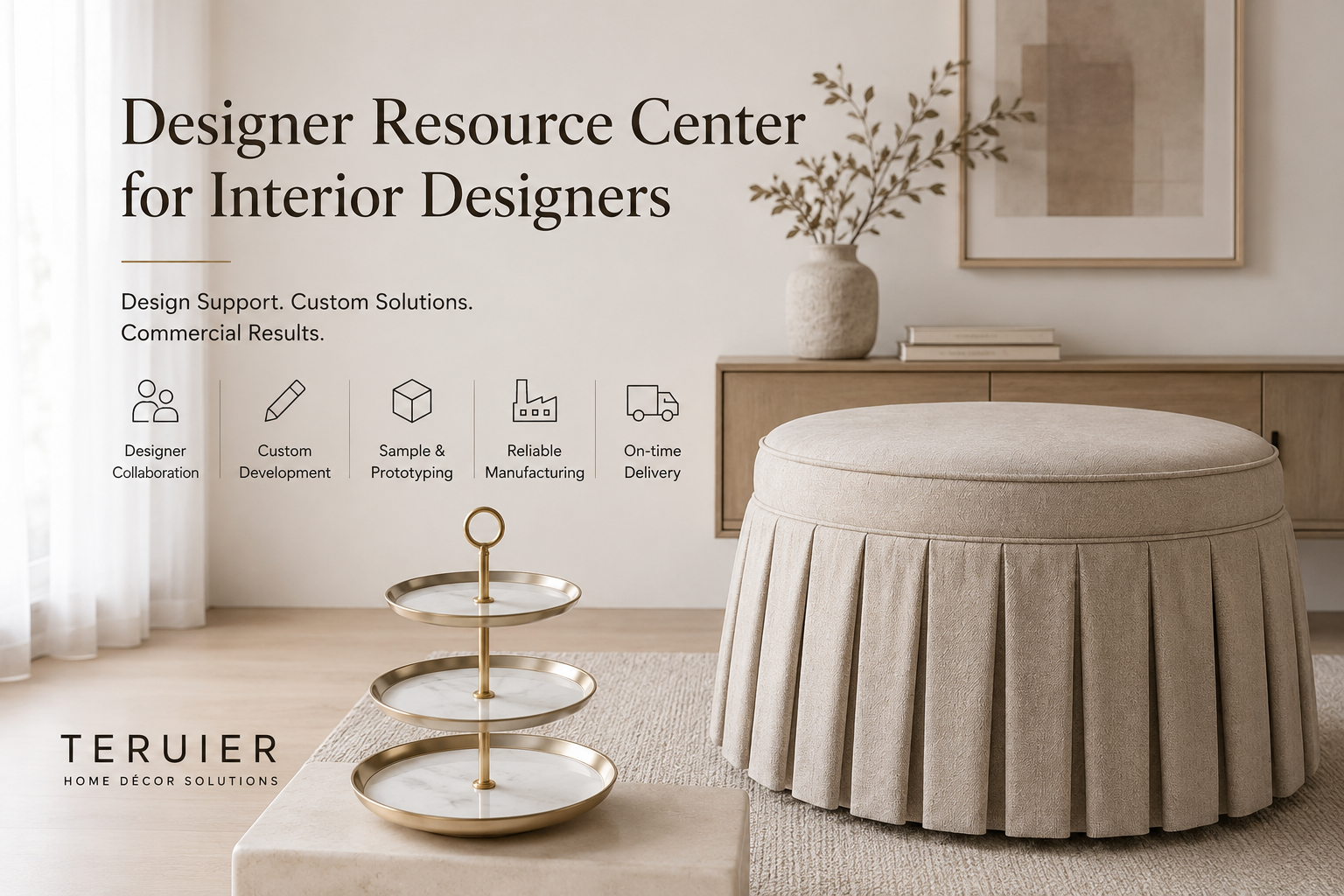
For Teruier, the key position is clear: a home décor supplier that supports customization and design support for interior designers. This means not only offering catalogue products, but helping buyers and designers turn a trend direction into a workable, cost-aware and production-ready item.
Why Designer Support Matters in Home Décor Sourcing
Interior designers and retail buyers often see opportunities before a factory does. They notice a shape at a European fair, a colour in a hospitality project, or a material direction in a retail display. The question is not always “Can this product be made?” The better question is:
Can this idea become a product that is attractive, stable, packable, priced correctly and suitable for the buyer’s channel?
That is where European American designer collaboration becomes valuable. Designers bring market sensitivity, room-setting logic and proportion control. Suppliers bring materials, engineering, costing, sampling and production knowledge.
A useful supplier team should help bridge these two sides.
European Trade Fair Trend Analysis
European fairs are showing a clear movement towards products with stronger material identity, craft value and interior relevance. Heimtextil Trends 26/27 uses the theme “Craft is a verb”, showing how craftsmanship and technology can work together rather than compete. This is relevant for upholstered products such as a box pleat ottoman, where textile choice, stitching and proportion affect the final perceived value.
Maison&Objet also presents itself as a meeting point for interior designers, decoration professionals and exceptional design signatures, with attention to craftsmanship, hospitality solutions and creative sourcing. Salone del Mobile 2026 discussions also placed materiality, craftsmanship and durability at the centre of contemporary interiors.
For home décor buyers, this means customisation should not be random. It should respond to visible market signals: softer forms, richer surfaces, better material stories, practical storage, entertaining rituals and products that support complete interior schemes.
A Buyer Story: From Trend Observation to Product Adjustment
At a European fair, a buyer noticed two different but connected directions.
The first was the return of small hosting rituals: layered table settings, compact serving pieces and decorative objects that make casual entertaining feel more considered. This made a three tier serving stand wholesale item interesting again, but not as a traditional cake stand only. The buyer wanted it to work for small apartments, gift ranges and café-style home displays.
The second direction was soft structured seating. A designer pointed out that many ottomans looked either too plain or too decorative. A box pleat ottoman wholesale concept could offer a better balance: tailored, textile-led and suitable for bedrooms, dressing corners and boutique hospitality rooms.
Instead of sending only existing catalogue items, Teruier reviewed both ideas with the designer. For the serving stand, the team adjusted tier spacing, handle proportion, tray depth and packing method. For the ottoman, the team checked pleat height, foam density, base stability, fabric direction and carton volume.
The Minhou supply chain then helped turn these decisions into practical sample details: stable metal fittings for the serving stand, cleaner tray edges, more consistent pleat stitching, stronger internal ottoman structure and packaging that could protect the product without making freight cost unreasonable.
The buyer did not choose the final direction because it was “custom”. They chose it because the design change solved real buying questions: better proportion, clearer use, safer packing and a more retail-ready product story.
When Should Interior Designers Customise a Product?
Customise when the standard product does not fit the room story
If a serving stand, ottoman or mirror looks almost right but misses the required proportion, colour or finish, customisation can make sense.
Customise when the product must match a brand collection
Retailers and home décor brands often need exclusive colours, fabrics, surface finishes or packaging. A standard product may be too easy to compare with competitors.
Customise when the product has a project requirement
Interior designers may need a certain size, height, fabric, fixing method or delivery format for hotels, show apartments, villas or retail spaces.
Customise when the change improves commercial value
Not every change is worth making. A good supplier should explain whether a custom option improves sell-through, reduces risk or supports better merchandising.
Designer Resource Center: What Buyers Should Expect
A practical designer resource center for interior designers should provide more than inspiration images. It should support decision-making.
Useful support can include:
- Product dimensions and proportion notes
- Material and finish options
- Fabric and colour references
- Sample development suggestions
- Packaging and carton information
- Care and maintenance notes
- Cost adjustment options
- Project and retail use recommendations
- Product notes for internal buyer review
For European American designers, this information helps move a concept from moodboard to quotation, from sample to approval, and from approval to production.
Catalogue Product vs Designer-Supported Customisation
| Buying Approach | Catalogue Product | Designer-Supported Customisation |
|---|---|---|
| Starting point | Existing item | Buyer need, room story or trend direction |
| Design control | Limited | Size, colour, fabric, finish and structure can be reviewed |
| Example category | Standard ottoman | Box pleat ottoman with adjusted pleat, fabric and height |
| Product story | Generic | Linked to a retail or interior concept |
| Risk control | Basic | Sampling, structure, packaging and costing reviewed together |
| Best use | Fast reorder | Exclusive collection, project use or differentiated retail range |
Product Examples: Where Customisation Works
Three Tier Serving Stand Wholesale
A three tier serving stand can be customised by tray size, spacing, handle style, finish, material combination and packaging. For European buyers, the opportunity is to reposition it from formal entertaining to everyday hosting, gifting and café-style home décor.
Box Pleat Ottoman Wholesale
A box pleat ottoman can be adjusted by fabric, pleat depth, foam, height, base construction and carton size. It works well for buyers who need a softer, more tailored upholstered accent.
Wholesale Ottoman Manufacturer Support
A suitable wholesale ottoman manufacturer should not only produce the shape. It should help test stability, fabric direction, foam feel, seam quality, packing efficiency and repeat-order consistency.
FAQ
What is a designer resource center for interior designers?
It is a supplier resource area that helps designers and buyers review product dimensions, materials, finishes, custom options, product notes and sampling information before making sourcing decisions.
When should interior designers customise a product?
Interior designers should customise a product when the standard version does not fit the room scheme, project requirement, brand collection or buyer’s commercial positioning.
How does Teruier support European American designer collaboration?
Teruier supports designer collaboration by reviewing trend direction, product proportion, materials, sampling details, packaging and production feasibility before bulk order decisions.
Can a three tier serving stand be customised for wholesale buyers?
Yes. A three tier serving stand can be customised in tier size, spacing, handle design, surface finish, material mix and retail packaging.
What should buyers check when sourcing a box pleat ottoman wholesale?
Buyers should check fabric quality, pleat consistency, foam density, frame stability, seat height, carton size and whether the supplier can support repeatable production.
Conclusion
For European and North American home décor buyers, customisation should be treated as a commercial decision, not a decorative experiment. The best results come when designers, buyers and suppliers work from the same evidence: trend direction, room use, structure, material, packaging and delivery needs.
Teruier supports interior designers, importers and home décor brands with product notes, sample development and practical customisation guidance for selected categories, including three tier serving stands, ottomans and other home décor accessories.
Buyers who need customization and design support for interior designers can contact Teruier to discuss product ideas, sample requirements, specifications or wholesale project support.