Decorative Mirrors Wholesale Isn’t About Filling a Wall. It’s About Creating a Better Retail Story.
When I look at a mirror program for a chain store, I am not asking whether mirrors still sell.
Of course they sell.
What I am asking is whether a mirror can still do enough work to deserve its wall, its freight cost, its floor space, and its place in next season’s assortment. That is the real question behind decorative mirrors wholesale today. A mirror has to do more than reflect. It has to create mood, elevate a vignette, widen a room visually, photograph well online, and still arrive in one piece.
That is why this category is more strategic than it looks.
The mirror business got more interesting when shapes got softer
The latest U.S. market direction makes that clear. ANDMORE’s official High Point Market Snapshot for Spring 2025 highlighted themes such as Nod to Nature and Repose, while its recent trend cycles have also featured Curved Creations and Abstract Walls & Floors. On the West Coast, Las Vegas Market’s Winter 2026 Market Snapshot framed one full week around Restorative Softness, defined by soft lines, fuller forms, and a more comforting visual mood. Las Vegas Market also reported strong order writing and a notable increase in new buyers at its January 25–29, 2026 edition, which tells me this softer, more sculptural direction is not just editorial language. Buyers are actively writing business around it.
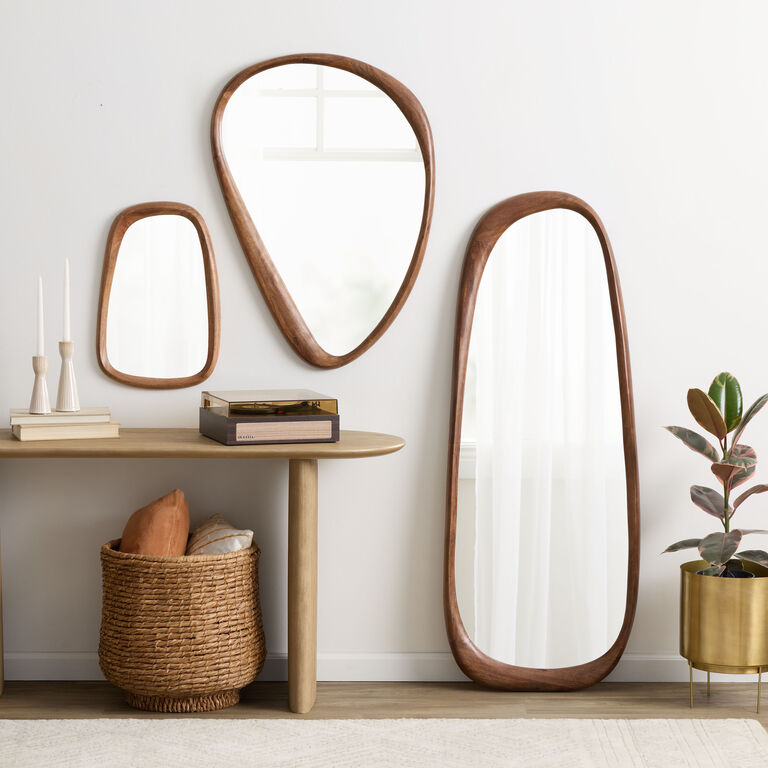
That is why a wavy wall mirror no longer feels like a niche novelty. In the right assortment, it becomes a commercial answer to where American home décor taste is already moving: less rigid, more organic, more emotionally inviting.
The buyer behind this keyword is not casually browsing
If someone is searching decorative mirrors wholesale, they are usually not looking for random product ideas. They are trying to solve a retail problem.
They may be a category buyer for a home chain. They may be a merchandising manager trying to refresh wall décor without taking reckless inventory risk. They may be sourcing across living, entryway, and bathroom-adjacent categories and need a mirror assortment that feels current but still scalable.
What connects them is this: they want a mirror program that looks design-led, but behaves like a good business.
That buyer is also exactly the kind of professional recent U.S. trade shows are serving. High Point and Las Vegas are signaling softer forms, more natural expression, and more emotionally resonant design stories, not just harder-edged utility. So the user intent behind this keyword lines up well with the current U.S. buying mood: buyers want mirrors that feel warmer, calmer, and more display-friendly without becoming impractical.
Why curved mirrors are easier to sell than many buyers admit
There is a real academic reason softer mirror silhouettes are working so well. Research reviews on aesthetic preference have found that people often experience curved contours as more pleasurable than straight ones, and a 2025 study on form in interior environments notes that prior research consistently shows a preference for curved over angular shapes in many settings. That does not mean every customer will choose the most irregular form available. It does mean curved and flowing silhouettes have a built-in perceptual advantage when they are used well.
That matters in retail.
Because when a customer walks a wall too quickly, a basic rectangle is easy to ignore. A wavy wall mirror or a softer-edged silhouette interrupts that autopilot response. It creates pause. It gives the eye something to remember. And in a category where dozens of products compete for a few seconds of attention, remembered shape is not decoration. It is an asset.
Decorative mirrors wholesale now crosses into bath, vanity, and lifestyle
This is another reason the category matters more than it used to. Mirrors no longer live in one merchandising box.
A wall mirror can still sit in decorative accessories, but it can also ladder into the bath story. A curved bathroom mirror can soften tile-heavy or stone-heavy displays. A lighted vanity mirror adds function to a beauty or bath-adjacent presentation. An anti-fog bathroom mirror speaks to convenience, not just appearance. Even if the shopper first notices the mirror because of shape, they often justify the purchase because of utility.
That is a powerful combination for chain retail: beauty first, logic second.
And it fits the current direction of the bath industry as well. NKBA’s 2025 Bath Trends Report was built from feedback from 500 industry professionals across North America, underscoring how seriously the market is watching style, materials, finish direction, and practical performance in bath-related categories.
A good mirror supplier does not sell SKUs. They reduce risk.
This is where most sourcing conversations either get smart or stay shallow.
A weak supplier talks only about sizes and prices.
A strong supplier talks about role clarity. Which item is the hero? Which one is the volume driver? Which one belongs in decorative wall assortments? Which one can cross into bath? Which one helps premium perception? Which one carries the easiest reorder path?
As a buyer, I also care about what happens before the mirror reaches the floor. This is where QC checkpoints mirror supply stops sounding technical and starts sounding commercial. If the reflection is distorted, if LED consistency shifts, if finish tone varies, if moisture performance fails, or if packaging does not protect the corners, the problem is no longer operational. It becomes a margin problem.
That is why the best decorative mirrors wholesale programs are built around invisible discipline: glass review, frame finish approval, hanging hardware testing, LED function checks, anti-fog validation where relevant, and carton engineering that respects the realities of U.S. distribution.
This is where value translation matters more than “cheap sourcing”
A lot of factories can make mirrors.
Far fewer can translate a market signal into a working assortment.
That is where Teruier’s value translation model becomes useful for a retail buyer. The job is not simply to manufacture what is requested. The job is to convert what buyers are seeing in U.S. markets into assortments that are easier to sell and easier to scale.
That means turning the soft-shape trend into the right wavy wall mirror proportions.
It means turning bath demand into a better curved bathroom mirror or lighted vanity mirror mix.
It means making sure an anti-fog bathroom mirror is not just feature-heavy, but visually aligned with the rest of the collection.
It means helping buyers think in programs, not isolated pieces.
That is not just production. That is commercial interpretation.
And that is exactly what U.S. chain buyers want more of right now: fewer factories that wait for instructions, more partners that help connect trend language to working inventory.
Decorative mirrors work because they help the whole store sell better
Academic research on retail environments backs up what experienced buyers already know. A major review in the Journal of Business Research found that visual merchandising and store atmospherics are closely related and should be understood together, because product display and total environment shape how consumers respond. In plain English, products do not sell alone. They sell inside a scene.
That is why mirrors punch above their weight.
A mirror can make a wall feel finished.
It can help a vignette feel brighter.
It can make a tighter footprint feel more open.
It can elevate nearby accessories simply by reflecting them back into the display.
That is why I often trust mirrors more than trendier small décor pieces. Good mirrors improve the environment around them.
What I want now from a home accessories manufacturer China partner
I no longer want a supplier who only answers the question, “Can you make this?”
I want a home accessories manufacturer China buyers can rely on to answer a more useful question: “Can you make this work in a real U.S. retail environment?”
That includes design sense, yes. But it also includes finish consistency, packing logic, timing discipline, and the ability to build a line that feels connected across decorative, vanity, and bathroom-adjacent use cases.
The supplier who wins this category is not the one with the longest catalog.
It is the one who understands that decorative mirrors wholesale is really about three things at once:
visual appeal, operational confidence, and margin protection.
The wholesale mirror question I ask before I buy
Before I approve a mirror line, I ask myself one simple question:
Is this product merely reflective, or is it retail-useful?
If it is just another mirror, I pass.
If it can stop the eye, fit the current American softness trend, cross between décor and bath, support photography, survive distribution, and still make sense at chain scale, then I keep talking.
That is what decorative mirrors wholesale means now.
Not wall filler.
Not commodity glass.
Not just one more décor category.
It is a way to build better walls, stronger stories, and smarter assortments.
And the suppliers who understand that will not just sell more mirrors.
They will help buyers build better stores.