
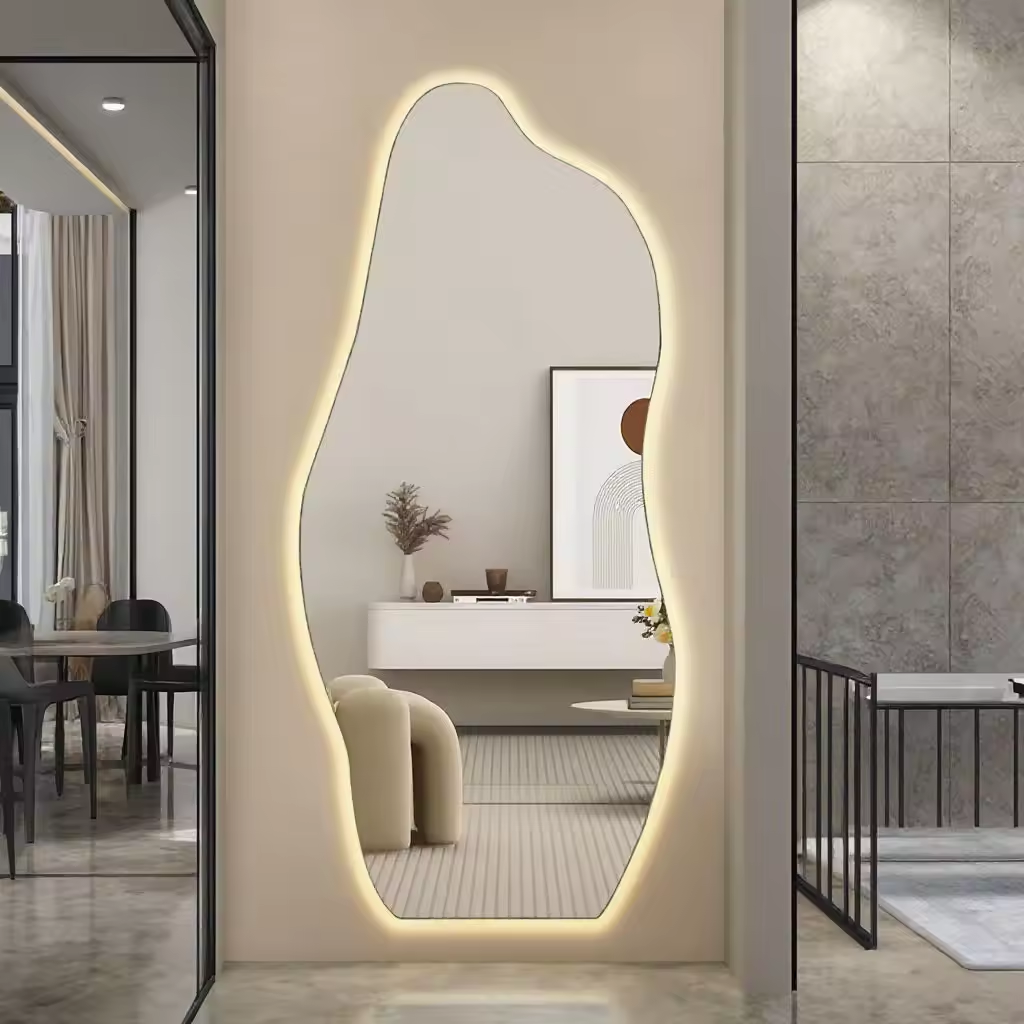
When I review a mirror assortment for a chain store, I am not asking one simple question anymore.
I am not asking, “Do we need mirrors?”
I am asking, “Which mirrors will stop a customer, soften a room, lift perceived value, and still survive the realities of freight, replenishment, and multi-store merchandising?”
That is the real business behind decorative mirrors wholesale today. A mirror is no longer just a functional reflective surface. In the best assortments, it becomes wall art, light management, visual expansion, and retail theater all at once.
And that is exactly why this category has become more strategic.
The market has moved from “basic mirror” to “emotional mirror”
Recent U.S. market direction makes that shift hard to ignore. At Spring 2025 High Point Market, official trend themes included Nod to Nature and Repose, both pointing toward softer living, natural textures, and calmer visual language. In the same design cycle, U.S. trend coverage tied 2025 demand to rounded forms, oblong mirrors, and more elaborately arched silhouettes, reflecting the continued strength of organic modern styling at recent trade shows. Meanwhile, Las Vegas Market’s Winter 2026 programming emphasized themes such as Restorative Softness, and the market itself drew buyers from all 50 states and more than 80 countries, reinforcing how commercially relevant these shape-and-mood shifts have become for retail buying.
That matters because buyers do not build modern wall assortments the old way anymore. We are not just filling vertical space. We are building environments that feel calmer, warmer, and more intentional.
The buyer searching “decorative mirrors wholesale” is easy to understand
This keyword sounds broad, but the buyer intent behind it is actually very specific.
It is usually someone trying to solve several problems at once:
How do I make a wall décor assortment feel new without becoming risky?
How do I create premium perception without going too high on retail?
How do I buy pieces that work in-store, online, and in styled photography?
How do I source a mirror that fits both trend language and replenishment logic?
That buyer may sit inside a regional home chain, a national décor retailer, a bath-and-living crossover category, or a multi-format furniture store. What they want is not “more choice.” They want fewer bad choices.
That is why decorative mirrors wholesale performs best when it is treated as an assortment strategy, not a sourcing transaction.
Why curved and arched mirrors are winning attention
There is real design science behind why softer silhouettes are working so well. A broad academic review on curvature found that people often experience curved contours as more pleasurable than straight ones, and later studies have continued to show that curved forms tend to score higher on beauty, liking, and even feelings of rest, while angular forms can read as more stressful. A 2025 interior-preference study also notes that prior research consistently linked curvature with visual pleasantness, even while real-life preferences can vary by context and user.
For a retailer, that translates into something very practical: softer shapes are easier to sell because they feel easier to live with.
An arched LED mirror does not just look current. It softens hard lines in tile-heavy or casegood-heavy settings. A curved bathroom mirror can make a bath display feel more elevated without becoming overly ornate. A sculptural luxury wall mirror can anchor a vignette without requiring a lot of extra décor to justify its presence.
In other words, the silhouette is doing real merchandising work.
Decorative mirrors wholesale now touches more than one category
One of the biggest shifts I see in U.S. buying is that mirrors are no longer confined to one aisle logic.
A smart assortment can begin with decorative wall mirrors, then extend naturally into bath-adjacent and vanity-adjacent programs. That is where a smart vanity mirror becomes relevant. It is not only a tech product. It is a bridge product between personal routine, lighting, and lifestyle presentation.
Likewise, an arched LED mirror is no longer just a bathroom spec item. In the right finish and scale, it becomes part of a broader premium-living narrative. That matters to chain buyers because cross-category products often do more work per SKU: they widen the audience, expand display flexibility, and support better storytelling across both physical stores and digital merchandising.
Good mirror programs are built like collections, not catalogs
This is where many suppliers still get it wrong.
They think buyers want dozens of unrelated SKUs. We do not. We want role clarity.
We want one hero shape that brings people in.
We want one safer volume piece that supports replenishment.
We want one entry price point that keeps conversion moving.
We want one or two premium pieces that lift the whole collection.
We want the whole story to feel connected.
That is how decorative mirrors wholesale becomes commercially intelligent.
A capable supplier understands that a mirror collection should behave like a family. One luxury wall mirror may create aspiration. One curved bathroom mirror may bring softness to bath. One smart vanity mirror may attract function-minded shoppers. One arched LED mirror may become the bridge between décor and utility. When those items share a design language, the buyer is not just buying mirrors. The buyer is buying an easier merchandising decision.
Why mirrors have such strong selling power in-store
The academic side supports what experienced buyers already know intuitively. Research on visual merchandising and store atmospherics shows that product-driven display and overall store atmosphere are closely connected, and atmospheric cues influence consumer evaluations and behavior. Separate retail research also found that lighting conditions significantly affect how people perceive space and retail identity.
That is a major reason mirrors outperform their footprint.
A mirror can make a vignette look brighter, deeper, cleaner, and more finished without requiring the same floor commitment as larger furniture. It can help a compact display read as layered. It can make a narrow wall feel designed rather than empty. It can improve online lifestyle imagery because it adds reflection, depth, and visual rhythm.
For a buyer, that is not decoration. That is sell-through support.
What a chain-store buyer now expects from a wall mirror supplier
Today, a true wall mirror supplier has to do more than offer glass and frame options. They need to understand retail use cases.
Can the frame survive transit?
Is the packaging engineered for lower damage risk?
Does the size ladder make sense for different store footprints?
Does the finish story align with current U.S. preferences?
Can the mirror sit next to ceramics, consoles, upholstery, and lighting without looking disconnected?
Can the line support both planned launches and reorders?
This is where the sourcing conversation becomes more sophisticated than price.
Because price alone does not solve margin. Good decisions solve margin.
Where Teruier’s value translation matters
This is exactly where Teruier’s cross-border design-manufacturing collaboration model becomes commercially useful.
For a buyer, the challenge is not spotting a trend. The challenge is turning trend language into a SKU plan that can actually work in stores. That is the gap between inspiration and inventory.
A strong Fuzhou mirror manufacturer should not behave like a passive factory waiting for a spec sheet. It should behave like a translation partner: reading what American buyers are seeing in the market, understanding where softness, arches, LED functionality, and premium finishes are going, and then converting that into assortments with clearer commercial roles.
That is value translation.
It means turning “arched is trending” into the right proportion, right finish, right carton, right price architecture, and right display logic.
It means turning “customers want better bathrooms” into a smarter curved bathroom mirror and smart vanity mirror program.
It means turning “luxury feeling” into a luxury wall mirror that looks elevated without becoming impossible to scale.
That is not just manufacturing. That is merchandising support upstream.
The best wholesale mirror partners understand the new American mood
The U.S. buyer this year is not only responding to style. They are responding to mood.
Softness matters.
Warmth matters.
Shape matters.
Usefulness matters.
Photography matters.
Reorder confidence matters.
That lines up closely with what recent markets have highlighted: natural influence, gentle forms, restorative softness, and more sculptural but livable silhouettes. It is why arched forms, rounded profiles, and softer visual geometry now feel commercially safer than they did a few years ago.
And it is why decorative mirrors wholesale has become such a high-intent keyword. Buyers using this search term are not casually browsing. They are looking for a better answer to a real retail problem.
The question I ask before I approve a mirror program
So before I say yes to a mirror supplier, I ask myself one final question:
Is this just another mirror line?
Or is this a collection that helps me build a better wall, a stronger story, and a more profitable assortment?
If the answer is the second one, I keep talking.
Because that is what decorative mirrors wholesale means now.
Not a commodity buy.
Not a filler category.
Not just something reflective.
It is one of the smartest ways to create perceived value, visual impact, and commercial flexibility in modern home retail.
And the suppliers who understand that will not just sell more mirrors.
They will help buyers build better stores.



