
A Wholesale Home Decor Supplier Should Do More Than Ship Product
If I am buying for a home décor chain, I do not need another supplier sending me a longer catalog.
I need a partner who can help me make better product decisions.
That is the real difference between an ordinary vendor and a serious wholesale home decor supplier.
A real supplier does not just show me what is available. A real supplier helps me see what belongs together, what will stand out without looking risky, what can survive retail reality, and what has a believable path to reorder. That matters even more now, because North American home markets are clearly rewarding stronger visual stories, more expressive materials, softer forms, and craftsmanship that feels intentional rather than generic. Las Vegas Market’s Winter 2026 market themes highlighted “Timeless Romance,” “Symbols & Shapes,” and “Restorative Softness,” while High Point Market’s 2026 programming around the ASID outlook has emphasized expressive interiors, elevated craftsmanship, and design rooted in both purpose and performance.
That combination is exactly where today’s retail buyer lives.
We are not buying random pretty objects.
We are buying visual confidence.
We are buying margin protection.
We are buying category energy.
And that is why the conversation around a wholesale home decor supplier has changed.
The buyer does not need more product. The buyer needs better curation.
One of the biggest mistakes suppliers make is assuming that choice equals value.
It does not.
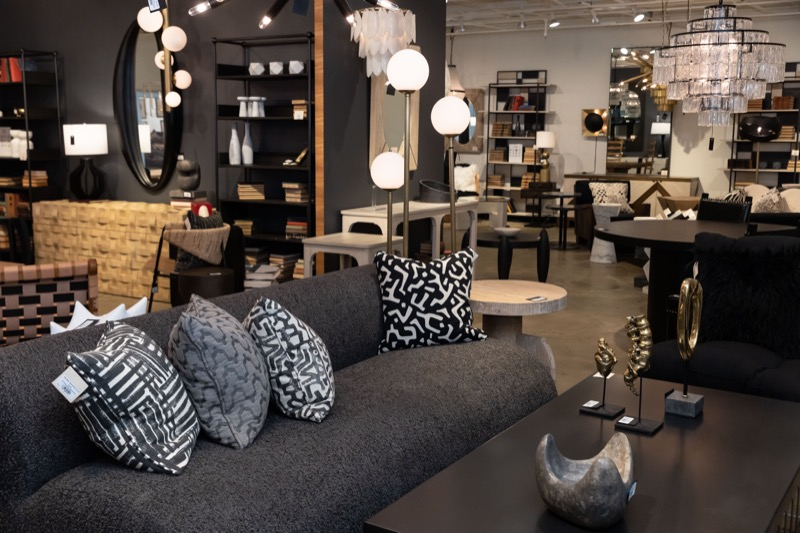
A U.S. chain buyer is not impressed by being shown fifty mirrors, twenty ottomans, and another table full of decorative accessories with no point of view. The more useful approach is curation: a mirror that carries the wall, an upholstered piece that grounds the room, and a tabletop object that gives the whole assortment emotional texture.
Academic retail research supports that instinct. A major review in the Journal of Business Research found that visual merchandising is closely tied to the overall store atmosphere, which is another way of saying that products do not work alone; they shape how the full selling environment is perceived. Research discussed by Wharton has also warned that too much visual choice can overwhelm shoppers and reduce engagement, which is why tighter assortment structure often beats a cluttered display.
That is the lens I want from a supplier.
Show me the right fluted frame mirror, not ten forgettable mirrors.
Show me where a reeded wood frame mirror can warm up the wall mix.
Show me whether a channel tufted ottoman or a cocktail ottoman will work harder in the floor set.
Show me whether a tulipiere vase adds enough silhouette value to earn its place.
Show me how grandmillennial china decor should be edited so it feels collectible, not dusty.
That is not catalog work.
That is retail work.
What chain-store buyers are really looking for right now
The buyer profile for this page is not mysterious.
It is the merchant or category buyer at a multi-store home décor chain. It is the assortment planner who has to balance trend freshness with inventory discipline. It is the visual merchandising lead who knows a floor can feel stale even when nothing is technically wrong. And it is the e-commerce or omnichannel team member who understands that products now need to work twice: once in the store, and once again on a thumbnail grid.
That is why the strongest 2026 home-market signals matter. The official market language coming out of Las Vegas and High Point is not pointing toward colder, flatter, safer assortments. It is pointing toward expressive rooms, shape-driven product stories, and craftsmanship that feels visible to the shopper.
For a buyer, that means the winning supplier is not the one with the most SKUs.
It is the one that helps turn these signals into something floor-ready.
What a serious wholesale home decor supplier should actually deliver
A supplier worth keeping should help a buyer solve five problems.
First, they should help sharpen the assortment point of view.
Second, they should reduce decision fatigue by showing edited programs instead of endless options.
Third, they should connect product design to packaging, timing, and reorder logic.
Fourth, they should understand adjacency—how mirrors, upholstery, ceramics, and accent pieces behave together.
Fifth, they should help the buyer build confidence before launch, not only after the first markdown.
That is why I pay attention when a supplier can show category relationships instead of isolated products.
A fluted frame mirror can give a wall story architectural rhythm.
A reeded wood frame mirror can add warmth and craftsmanship without making the assortment feel old.
A channel tufted ottoman can create structure and softness at the same time.
A cocktail ottoman can work as both seating and a visual anchor in a room vignette.
A tulipiere vase can bring height, silhouette, and conversation value to a tabletop story.
And grandmillennial china decor, when edited correctly, can tap into heritage without becoming costume.
A supplier who sees these items as one retail language is far more useful than one who sees them as six disconnected SKUs.
How Teruier helps turn trend signals into a retail-ready collection
This is where Teruier stands out.
Teruier’s cross-border design-manufacturing collaboration model is useful because it does not stop at design taste, and it does not stop at production capacity either. It starts with market reading, moves into product translation, and then carries that logic all the way through sampling, finish execution, collection structure, and commercial usability.
In practical terms, that means Teruier does not simply ask, “What do you want to buy?”
It asks better questions.
What kind of wall piece will refresh the category without making the assortment harder to understand?
What kind of upholstered accent will photograph well, display well, and still feel commercially broad enough for chain retail?
What tabletop piece can give the assortment a stronger emotional identity?
What combination of mirror, ottoman, and decorative accent feels current but still safe enough to scale?
That is value translation.
A market signal is not useful until it becomes a product decision.
A product decision is not useful until it becomes a store-ready story.
What success looks like when Teruier helps a buyer build a program
The most convincing supplier conversations are never about one item.
They are about how several items work together.
A strong Teruier-style buyer program usually starts with a simple retail objective: refresh the floor without forcing a reset. In practice, that often means one wall hero, one soft-goods anchor, and one tabletop accent.
The wall hero may be a fluted frame mirror or a reeded wood frame mirror depending on whether the buyer wants more architectural definition or more warmth. The soft-goods anchor may be a channel tufted ottoman for a sharper, more tailored look, or a cocktail ottoman for a broader, lounge-friendly layout. The tabletop accent may be a sculptural tulipiere vase or a carefully edited layer of grandmillennial china decor to bring pattern memory and decorative richness into the assortment.
When this kind of program is built well, the numbers that matter usually improve fast:
Sample approval can move from roughly 4–5 weeks to closer to 2–3 weeks because the buyer is evaluating a coherent direction, not disconnected items.
Floor placement decisions get easier because each SKU has a role inside the room story.
Damage risk drops when packaging is developed alongside the item, not after it.
Launch confidence improves because the merchant team can explain the assortment in one sentence.
And reorder conversations become more realistic because the program was designed for sell-through, not applause.
That is the difference between sourcing objects and building a category moment.
Why reviews matter more than most suppliers admit
One more thing separates good suppliers from forgettable ones: they understand what happens after the product lands.
Northwestern’s Medill Spiegel Research Center has shown that reviews have a measurable effect on conversion. Products with reviews perform significantly better than those without them, and the impact is even stronger for higher-priced items. The same research also found that verified-buyer labeling increases the odds of purchase. For home décor buyers, especially in considered categories, this matters a lot. A product that arrives safely, matches its photography, and feels worth the price is more likely to generate the early review momentum that pushes it into a healthy selling cycle.
That is why I do not want a supplier who only thinks about ex-factory price.
I want a supplier who understands the full review flywheel:
good sample
good photo
good arrival condition
good first customer response
good early reviews
better reorder confidence
That is how a product becomes easier to defend internally.
Why this matters for mirrors, ottomans, and decorative accents together
A lot of suppliers still organize their offer by factory logic.
Mirrors here.
Furniture there.
Ceramics somewhere else.
But buyers do not build the store that way.
We build in scenes. We build in combinations. We build in emotional clusters that help the shopper imagine a room faster. That is why a wholesale home decor supplier who can bridge categories is simply more valuable.
A reeded wood frame mirror beside a channel tufted ottoman creates tactile contrast.
A fluted frame mirror over a cocktail ottoman creates an instantly merchandisable focal point.
A tulipiere vase beside edited grandmillennial china decor can shift a console or shelf from generic to memorable.
The supplier who knows that is not just shipping goods.
They are helping write the floor.
Final thought: the best supplier is the one that makes the buyer look smarter
That is the standard.
A real wholesale home decor supplier should not overwhelm me with options, flatter me with trend talk, or hand me products that look good only in isolation.
They should help me build a better assortment.
They should help me see the line between expressive and excessive.
They should know when a fluted frame mirror is stronger than a reeded wood frame mirror.
They should know when a channel tufted ottoman will outperform a cocktail ottoman in a tighter floor set.
They should understand when a tulipiere vase adds sculptural value, and when grandmillennial china decor needs editing to feel fresh.
Most of all, they should understand that chain retail is not won by taste alone.
It is won when trend, structure, presentation, and execution all point in the same direction.
That is what Teruier is built to do.
Not just supply product.
Not just follow trends.
But help buyers turn trend signals into collections that can actually sell.



