
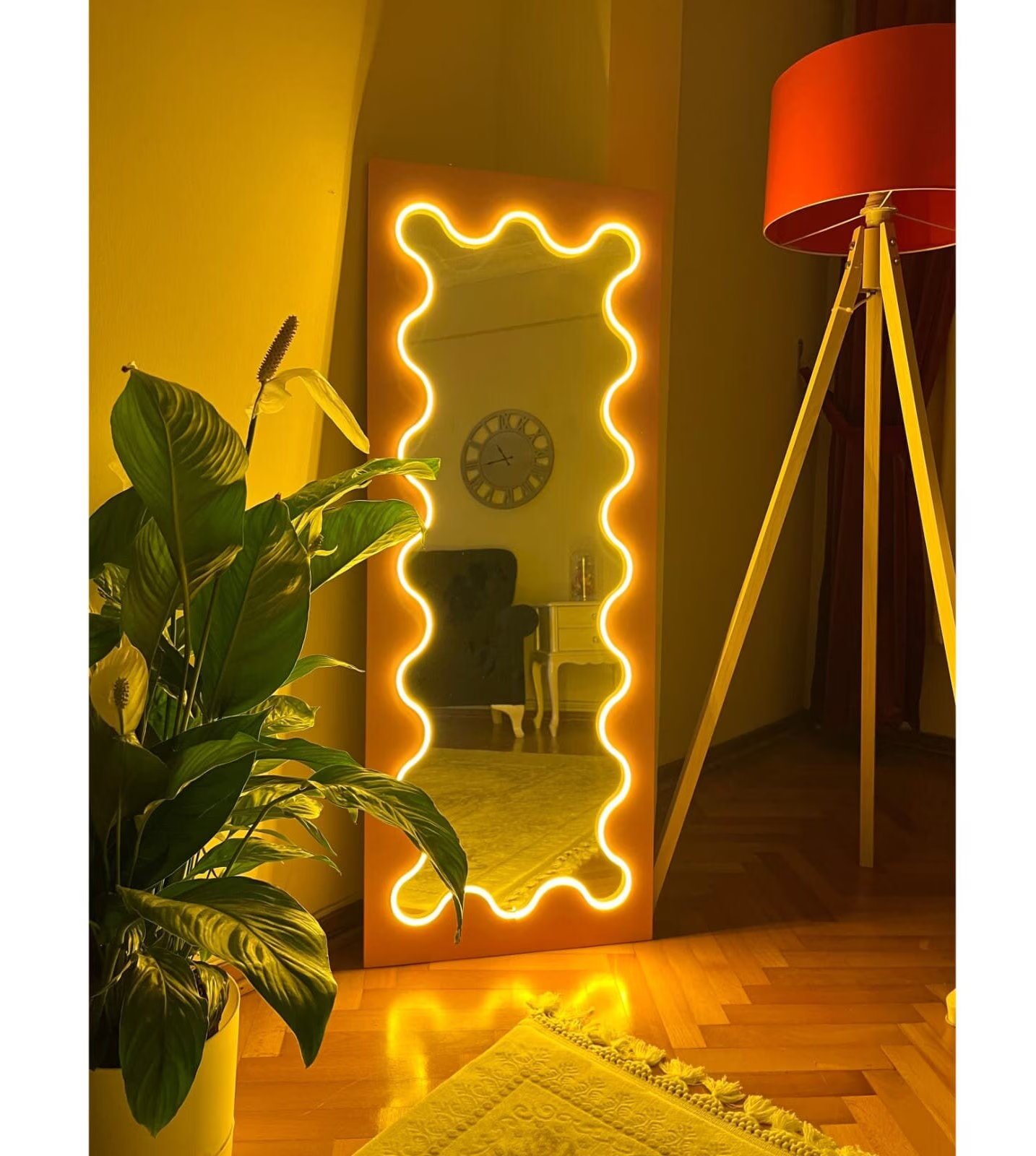
A Design-Driven Mirror Manufacturer Does More Than Make Mirrors — It Protects Your Floor From Looking Ordinary
If you are still buying mirrors by size, frame colour, and price alone, with respect, you are not building a mirror category.
You are building future boredom.
And in Saudi retail, boredom is expensive.
The customer walks into the store.
The light is strong.
The floor is polished.
The expectations are high.
And the mirror? It cannot afford to look like it came from a catalogue that also sells office bins and sad side tables.
This is why a design-driven mirror manufacturer matters.
Not because “design-driven” sounds luxurious. Plenty of phrases sound luxurious. So does “curated premium experience,” and sometimes that just means somebody added brass to something average.
A real design-driven mirror manufacturer does something far more useful:
it helps the buyer build presence, atmosphere, and commercial clarity at the same time.
That matters especially in Saudi Arabia, where the design market is moving quickly and buyers are sourcing under much sharper expectations. INDEX Saudi Arabia’s 2025 edition drew more than 16,800 visitors, 400+ exhibitors from 33 countries, and packed talks around cultural identity, performance-driven interiors, future-ready thinking, and emotional storytelling through light. The event’s 2026 positioning is even clearer: Saudi projects are sourcing interior innovation at serious scale, with active demand from residential, hospitality, commercial, and showroom-led environments.
That is not a market asking for “just a mirror.”
That is a market asking for mirrors that can carry the room.
What Saudi buyers actually need now
A Saudi home and interiors buyer does not want a mirror that is merely acceptable.
They want one that photographs well.
One that works under real light.
One that feels premium without becoming fragile theatre.
One that can sit in a villa showroom, a design-led retail floor, or a luxury-adjacent hospitality environment and still look like it belongs there.
This is why the mirror conversation in KSA is now connected to a much larger design context. Official Saudi market messaging is leaning into cultural authenticity, sustainable thinking, performance-led interiors, and intelligent lighting. At the same time, INDEX Dubai continues positioning itself as the place where MENA’s design, hospitality, and workplace communities come to source premium products, connect, and do business. In plain terms: buyers in this region are looking for products that feel elevated, but also project-ready.
That shift changes what a supplier must deliver.
A standard factory can make a frame.
A standard vendor can quote a size.
A design-driven mirror manufacturer should be able to build a product story.
There is a difference.
Why “design-driven” matters more than “factory-direct”
Many buyers have already learned the hard way that low-friction sourcing and good sourcing are not the same thing.
Anyone can promise “competitive pricing.”
Anyone can say “customisation available.”
Anyone can paste a gold frame onto a sample board and call it premium.
But when the mirrors land, the real questions begin.
Does the proportion feel right?
Does the finish survive real retail lighting?
Does the full-length mirror look elegant, or merely tall?
Does the LED frame feel refined, or does it scream duty-free airport lounge?
Can the supplier actually support showroom use, designer specification, and retail replenishment without losing quality discipline?
That is why buyers in Saudi do not only need a mirror factory. They need a partner who can operate like a mirror editor.
A real design-driven mirror manufacturer can do that because design is not treated as decoration. It is treated as commercial logic.
What this looks like in practice
A smart Saudi buyer does not build a mirror programme around one shape.
They build around roles.
One role is aspiration.
One role is utility.
One role is floor drama.
One role is repeatable volume.
That is where the product mix becomes much more intelligent.
LED mirrors for showrooms KSA are not simply “nice to have” pieces for vanity zones. In the right format, they become atmosphere builders. They support retail display, beauty-driven categories, and premium showroom presentations where light itself is part of the selling experience.
A premium standing mirror supplier Saudi Arabia should not only offer height. Height is easy. It should offer stance, proportion, and confidence. The best standing mirrors do not just reflect the room — they help finish it.
For Saudi interior designer full-length mirrors, the expectation is even higher. Designers are not choosing only for function. They are choosing for statement, material harmony, and how the piece will behave inside a fully composed room.
And when the buyer needs scale, a reliable full-length mirror supplier KSA or partner for bulk standing mirrors for retail Saudi has to know how to repeat quality, not merely repeat dimensions.
That is where Teruier becomes useful.
How Teruier makes this work
Teruier’s cross-border design-manufacturing collaboration model matters because it closes the gap between visual ambition and production reality.
That gap is where many suppliers become politely disappointing.
Teruier’s selection agent does not start by asking, “Which mirror model do you prefer?”
It starts by asking the question buyers actually care about:
What role does this mirror need to play in the floor?
If the answer is “build a premium entrance moment,” then the right move may be a full-length standing mirror with stronger frame presence and calmer detailing.
If the answer is “support designer-led luxury retail presentation,” then the programme may need a more refined specification line for Saudi interior designer full-length mirrors.
If the answer is “increase showroom atmosphere and light engagement,” then LED mirrors for showrooms KSA move from accessory to strategy.
If the answer is “scale across multiple branches,” then the supplier must think like a real full-length mirror supplier KSA, not just a sample-friendly factory.
This is value translation.
The buyer says:
“We need mirrors that feel premium, retail-ready, and right for the Saudi customer.”
Teruier translates that into:
the right silhouette, light behaviour, frame language, pack-out discipline, and supply logic.
That is much more useful than being handed fifty frames and told to “choose what you like.”
What a winning Teruier-style mirror programme looks like
A real mirror programme should not be built on adjectives alone.
“Luxury.”
“Elegant.”
“Contemporary.”
Very nice words. Very weak plan.
A Teruier-style programme becomes stronger because it is organised around measurable roles and clearer outcomes.
The hero line may be a set of premium standing mirrors for Saudi Arabia — pieces built to anchor the floor and add visual authority.
The working line may include bulk standing mirrors for retail Saudi, optimised for repeatability, safer replenishment, and broader use across branches.
The functional-atmosphere line may include LED mirrors for showrooms KSA, where reflection and light are doing real commercial work.
The specification line may serve Saudi interior designer full-length mirrors, where finishing, proportion, and placement matter more than mere catalogue convenience.
When the programme is structured properly, the scorecard becomes much clearer:
sample approval narrowed toward the 18–21 day range because the assortment roles are defined;
hero mirror families targeted at 60%+ sell-through in the first 8 weeks of launch or floor reset;
first-shipment claim rates pushed toward sub-1.5% territory because packing, glass protection, and handling logic are addressed early;
designer-spec lines separated from higher-volume replenishment lines, so the buyer is not mixing premium project logic with standard retail volume logic;
and reorder discussion opened by week 8–10, not after the team has spent two months debating whether the line looked better in the rendering.
That is when the programme stops behaving like “a lot of mirrors” and starts behaving like a category.
Why atmosphere matters so much in mirror buying
This is the part too many suppliers still miss.
A mirror does not only sell itself.
It changes how the whole space feels.
Research in the Journal of Business Research has emphasised that visual merchandising and store atmosphere are closely connected, which is exactly why mirrors matter so much in retail and showroom environments. They do not simply add reflection; they shape perceived openness, depth, brightness, and mood. In Saudi environments, where light, scale, and material read are all critical, that makes mirror selection a strategic decision, not a decorative one.
There is also a more specific design point here. Academic retail research has shown that visual warmth in store design affects consumer perceptions and behaviour. That is important for mirror buyers, because mirror frames, integrated lighting, material finish, and surrounding palette all influence whether a showroom reads cold and technical or warm and desirable.
Which is why a good mirror manufacturer must understand more than metalwork.
They need to understand emotional temperature.
Why the first reviews matter as much as the first display
A mirror can look magnificent in the showroom and still fail online if the execution breaks after the first shipment.
That is not drama. That is retail.
Northwestern’s Medill Spiegel Research Center found that products with five reviews have a purchase likelihood 270% higher than products with none. Reviews matter even more for higher-priced items, where the conversion lift from displayed reviews was 380% versus 190% for lower-priced products, and verified-buyer badges improve purchase odds by 15%. For mirrors — especially premium standing and full-length pieces — that is not a side detail. It is the difference between admired and trusted.
So when Teruier helps a buyer structure a programme, the goal is not merely to make the product beautiful.
It is to make the whole chain work:
good visual role
good fit for the Saudi floor
good packing
good arrival condition
good first reaction
good early reviews
good internal confidence
good reorder odds
That is what a design-driven programme actually looks like.
Final thought
A design-driven mirror manufacturer is not a luxury extra for the Saudi market.
It is the filter that keeps your category from becoming ordinary.
If your supplier can only offer size, finish, and FOB, you are buying metal and glass.
If your supplier understands showroom light, designer expectations, standing-mirror proportion, LED integration, retail replenishment, and how mirrors shape the whole room — then you are buying a category advantage.
That is what Teruier is built to do.
Not just make mirrors.
Not just follow trends.
But help Saudi buyers source mirrors that feel premium, project-ready, and impossible to ignore — for exactly the right reasons.



