
Let’s open with a little bathroom-industry honesty:
If your “premium” bathroom mirror disappears the second someone takes a hot shower, that is not luxury. That is theater.
And buyers are over it.
So this is not another mirror article full of mood words and vague promises about “spa living.” This is a launch-level look at anti-fog bathroom mirror specs—the kind that actually help a chain-store buyer decide whether a supplier understands the job, the channel, and the reason the PO exists in the first place.
Because here is the real issue: the mirror is not just a mirror anymore. It is task lighting, finish story, moisture-resistant electrical product, installation decision, return-rate variable, and increasingly, a content object for online merchandising. If the spec sheet is weak, the product is weak. Full stop.
What anti-fog actually solves
First, the science—because anti-fog is not magic, and buyers should not have to shop like it is.
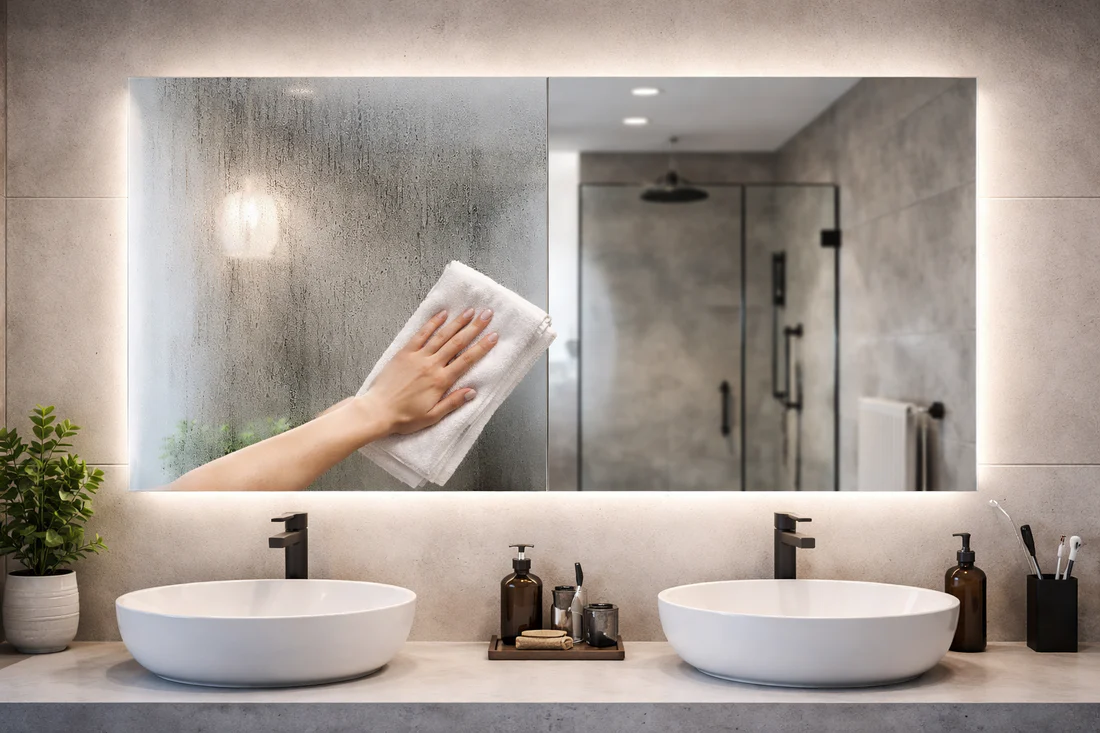
Washington State University explains the basic mechanism clearly: mirrors fog because warm water vapor hits a cooler mirror surface, condenses, and forms tiny droplets. That is the problem anti-fog technology is designed to interrupt. In practice, the common retail answer is a heated demister area behind the glass that keeps the reflective surface warm enough to reduce condensation.
That matters because it shifts the buying question from “Does it have anti-fog?” to “How well is the anti-fog zone designed, how quickly does it respond, how much of the viewing area does it actually protect, and is the electrical spec credible for a bathroom environment?”
Now we are asking grown-up questions.
Why this matters more in North America right now
Because the bathroom itself has changed.
NKBA’s 2026 Bath Trends reporting shows that bathrooms are getting bigger, more wellness-oriented, more hotel-influenced, and more lighting-sensitive. Lighting quality is a top consideration for 91% of respondents; 92% say task lighting should always be included in the primary bath; and 47% favor integrated lighting in mirrors over the next three years. Larger showers and spa-like features are also rising, which means more steam, more mirror exposure, and more opportunities for a bad spec to embarrass itself.
That is why a good LED bathroom mirror or backlit bathroom mirror is no longer just a builder-basic upgrade. It sits right at the intersection of wellness, grooming, design, and daily-use frustration reduction.
In other words: the category got smarter.
So the buying standard should too.
The specs buyers should actually care about
Here is where most supplier copy gets fluffy. Let’s not do that.
If I am buying against anti-fog bathroom mirror specs, I want to see six things immediately:
1. Mirror construction
What glass are we talking about?
A credible program should specify mirror type, thickness, edge treatment, backing protection, and whether the mirror is copper-free or built for better corrosion resistance in wet environments.
2. Anti-fog zone logic
Not “anti-fog included.” That tells me nothing.
I want to know:
- demister coverage size
- whether the heated area is centered or full-vision priority
- activation method
- warm-up expectation
- whether anti-fog is linked to the light switch or separated for energy control
Because if the demister only clears a polite little rectangle in the middle while the rest of the mirror fogs like a train window, then congratulations, you sold me a feature and delivered a loophole.
3. Lighting performance
For an illuminated mirror, light quality is not decorative. It is functional.
Geberit’s bathroom-lighting guidance explains the core language buyers should already know: color temperature is measured in Kelvin, CRI/Ra measures color rendering, and in bathrooms a value above 90 Ra is recommended for more natural skin-tone rendering. The same guide notes that warm, neutral, and cool whites serve different purposes, and that brightness and illuminance are context-dependent. IES likewise maintains detailed recommended illuminance criteria for quality lighting design across applications.
That means a serious spec sheet should tell me:
- Kelvin range
- CRI
- dimming capability
- front-lit vs backlit vs dual-light effect
- whether the product is built for real grooming visibility or just ambient glow
A backlit bathroom mirror that looks dramatic in a render but throws weak face light in an actual bathroom is not design-forward. It is underperforming with confidence.
4. Finish and frame fit
This is where the assortment gets interesting.
A chrome wall mirror speaks one language: cleaner, sharper, often modern or hospitality-adjacent.
A smoked mirror speaks another: moodier, more layered, more boutique.
A reeded wood frame mirror works when the buyer wants warmth, texture, and a less technical look without abandoning function.
The spec sheet should help buyers understand how those finishes map to actual spaces:
- primary bath
- powder room
- hospitality vanity
- condo upgrade
- department-store decorative bath edit
- chain-store home-improvement assortment
That is not styling fluff. That is channel logic.
5. Electrical and moisture-safety credibility
This one matters more than the pretty packaging ever will.
UL states that line-voltage luminaires are evaluated to UL 1598, including applicable wet-location requirements, and notes that products may also be evaluated for ingress protection. UL also issued a 2024 public notice warning that certain LED illuminated bathroom mirrors bore an unauthorized UL Certification Mark and had not been evaluated to the appropriate safety standards.
Translation: “looks compliant” is not compliant.
For a retail buyer, that means I want clear language on:
- listing/certification status
- voltage
- driver setup
- wet or damp suitability
- installation environment assumptions
If the certification language feels slippery, keep your hand away from the PO.
6. Installation and service logic
Hardwired or plug-in?
Mount orientation?
J-box alignment?
French cleat or bracket style?
Replacement process for transit damage?
Field-failure handling?
Because a mirror that photographs beautifully but turns every installation into a support ticket is not a hero product. It is an outsourced headache.
What a retail-ready anti-fog mirror program looks like
This is where Teruier’s cross-border design-manufacturing coordination model actually becomes useful.
A buyer does not just need “a mirror.”
They need a mirror program that translates design intent into usable retail specifications.
That usually means building a good-better-best assortment like this:
- Good: 24″ x 36″ LED bathroom mirror, anti-fog center zone, 3-color temperature switching, clean rectangular form for volume retail
- Better: 30″ x 40″ backlit bathroom mirror, stronger face illumination, dimmable control, full-family primary bath placement
- Better/Decorative: 28″ x 36″ reeded wood frame mirror, anti-fog capability with a softer furniture look for warmer bathroom stories
- Modern upgrade: 24″ x 36″ chrome wall mirror, crisp silhouette for apartment, condo, and builder-upgrade channels
- Design-led option: 30″ round or pill-shape smoked mirror variant for boutique bath edits and moodier hospitality-inspired assortments
That is how buyers think.
Not “one mirror for everyone,” but “which finish, light output, and anti-fog configuration belongs in which retail story?”
An illustrative Teruier selection-intelligence case
Here is the kind of sourcing case this article is really about.
A U.S. home chain wants to refresh its bath-mirror wall with three customer types in mind:
- the practical remodel shopper
- the design-conscious younger homeowner
- the higher-margin decorative-bath shopper
The old sourcing approach would be:
“Pick three mirror shapes, add lights, add anti-fog, ship them.”
The better Teruier-style approach is:
- analyze which stores skew renovation vs décor
- decide where a backlit bathroom mirror drives better visual conversion
- keep a chrome wall mirror in the line for cleaner modern demand
- introduce one warmer reeded wood frame mirror to soften the assortment
- use one smoked mirror as a design-led traffic generator, not the volume hero
- tighten spec language around CRI, color temperature, anti-fog coverage, driver access, and installation method before samples ever leave the factory
Illustrative result model:
A smarter assortment usually improves sample-approval speed, reduces spec-related back-and-forth, and lowers the risk of buyer disappointment because the product is being judged against real use cases, not just showroom lighting. The gain is not only aesthetic. It is commercial clarity.
The user profile this speaks to
This article is really for one type of buyer:
The chain retail buyer who is tired of being sold adjectives.
They do not need more suppliers saying “luxury,” “smart,” “modern,” or “premium.” They need someone who can explain:
- whether the mirror will stay clear after a steam-heavy shower
- whether the lighting is flattering or clinically weird
- whether the frame finish suits the target customer
- whether the spec is reliable enough for stores, projects, or e-commerce
- whether the certification language is real
- whether this supplier understands bathrooms as systems, not just mirrors as objects
That buyer is exactly where the North American market is headed now: more wellness, more lighting intelligence, more integration, more performance expectations.
Final word
A fog-free mirror is not revolutionary.
But a mirror with the right specs, the right light, the right finish, the right safety story, and the right retail fit?
That gets interesting.
Because the job is not to sell a mirror that looks good in a catalog.
The job is to sell a mirror that works in real bathrooms, survives real buyer scrutiny, and earns real reorder confidence.
That is what anti-fog bathroom mirror specs should mean.
Not a gimmick.
Not a bullet point.
A buying standard.



