Here is an uncomfortable question for home décor suppliers:
If your catalog contains 300 products, why should a busy retail buyer spend an afternoon figuring out which ten are worth discussing?
Suppliers love showing how much they can offer.
More mirrors. More ceramic vases. More upholstered stools. More colours, materials, finishes and variations.
The message is familiar: “Look at our extensive product range.”
But a retail buyer is not necessarily impressed by the number of products available.
The buyer has a category to manage, a budget to protect, a retail customer to understand and a purchasing decision to justify.
For professional retail buyer sourcing, a large product library can be valuable. An unstructured catalog dump can create unnecessary work.
The difference is not how many products a supplier has.
It is how quickly the supplier helps a buyer identify the products worth buying.
The Catalog Arms Race: More Products, Less Direction?
The home décor industry has become very good at producing attractive catalogs.
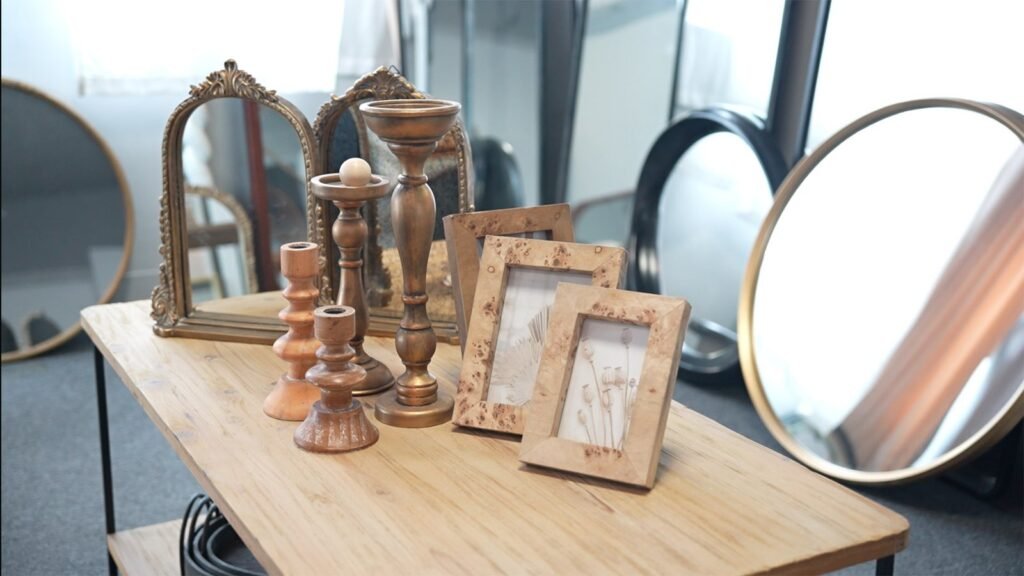
A supplier may present hundreds of mirrors, ceramic accessories, decorative storage products and accent furniture designs.
Each product has a photograph. Some have dimensions. Others include materials, finishes and brief descriptions.
But the buyer still faces difficult questions.
Which designs fit my customers?
Which products belong together?
Which models are available for sampling?
Which can be produced at my target price?
Which are worth presenting to my category manager?
A large catalog may answer “What can you supply?” while leaving “What should I buy?” almost entirely unanswered.
That is a missed opportunity.
Teruier has presented more than 20 product catalogs backed by physical samples, covering several hundred designs across home décor and accent furniture categories.
That breadth is useful. It allows buyers to explore different styles and product opportunities.
But a comprehensive product library and an effective first purchasing proposal should not be the same document.
The library demonstrates range.
The proposal should demonstrate judgment.
Does Too Much Choice Really Reduce Sales?
The popular argument is that more choice automatically creates decision paralysis.
Research suggests a more complicated reality.
A meta-analysis published in the Journal of Consumer Research, examining 50 experiments and 5,036 participants, found no consistent average negative effect from having more choices. Outcomes varied substantially across studies.
So simply reducing a catalog from 300 products to 20 is not a scientifically proven way to increase sales.
However, product discovery still matters.
Baymard Institute’s research into e-commerce product listings shows that clear filtering, comparison information and effective product presentation help shoppers navigate large assortments.
Those findings relate primarily to consumer e-commerce, not directly to wholesale purchasing. Nevertheless, they offer a useful design principle: customers need ways to find relevant options.
For B2B home décor suppliers, the practical question becomes:
Are you providing more relevant choices, or simply more pages to review?
Your Buyer Doesn’t Need Every Product. They Need the Right Decision.
Imagine a hypothetical European retailer looking for a small tabletop décor collection.
The buyer wants natural colours, contemporary sculptural shapes and products suitable for a mid-market retail environment.
Supplier A sends a complete product catalog.
Supplier B asks three questions:
What is your target retail price range?
Which materials are acceptable?
Are you purchasing for physical stores, online retail or both?
Supplier B then prepares a focused selection of suitable products, with the full catalog available for further exploration.
Which approach is more useful?
That depends on the buyer. An experienced sourcing team may prefer direct access to the full range.
But Supplier B has already demonstrated an understanding of the purchasing problem.
A useful shortlist does not restrict the buyer’s freedom.
It gives the buyer a more efficient starting point.
A Better Model: Full Library, Focused Proposal
Suppliers should not abandon large catalogs.
They should organize the information into two levels.
| Full Product Library | Buyer-Specific Proposal |
|---|---|
| Broad product discovery | Focused purchasing decision |
| All available categories | Selected relevant categories |
| Multiple design directions | One defined market brief |
| General product references | Comparable product specifications |
| Open exploration | Clear next steps for samples and RFQs |
The full library remains available.
The proposal presents the most relevant opportunities.
For example, a retailer interested in decorative accessories can explore Teruier’s Decor Collection.
A buyer looking for compact furniture and storage can explore the Furniture Collection.
But when a buyer requests a specific quotation, the supplier should move beyond category browsing.
The next document should identify a manageable selection of models and explain why each belongs in the proposed range.
The Most Important Catalog Page Might Be the One You Delete
Not every product variation deserves its own place in an initial buyer presentation.
Consider a hypothetical collection of 12 decorative stools.
Six models share essentially the same dimensions, structure and commercial role. Only their upholstery colours differ.
Presenting all 12 as unrelated products may make the range look broader.
But it can also hide the underlying design structure.
A more useful approach may be to present six base models, with their available colour and material options clearly shown.
Now the buyer can compare actual design differences.
This does not mean removing colour variations from the ordering system.
It means separating product decisions from configuration decisions.
The same logic applies to mirrors, storage pieces and ceramic décor.
The Bouclé Accent Ottoman Stool, model 23T209, for example, has a defined rounded upholstered form and gold-tone metal legs.
A buyer comparing this product with another stool should first understand its structural and visual role. Fabric options, finishes and dimensions can then be discussed as product-specific purchasing requirements.
The job of a catalog is not to make every variation look like an entirely new invention.
It is to make meaningful differences easy to understand.
What Should Every Shortlisted Product Explain?
A buyer-specific proposal should do more than display attractive photographs.
For each proposed SKU, it should answer four questions.
Why this product?
Explain its design character, intended retail role and relevance to the buyer’s market.
Why this version?
Identify the selected size, material or finish, and any available alternatives.
What needs confirmation?
Make clear which details require sample review, technical verification or commercial approval.
What happens next?
Provide the product code and information needed to request a sample or quotation.
Teruier’s Home Decor Spec Sheets: Where Pretty Products Go to Become Real Business explains how dimensions, materials, packaging and purchasing details connect product presentation with commercial decisions.
For buyers, that information is often more useful than another page of beautifully styled products.
Don’t Confuse Curating With Choosing for the Customer
There is an important objection to the curated-catalog approach.
What if the supplier recommends the wrong products?
A supplier may understand manufacturing but know relatively little about the retailer’s customers.
That is why a shortlist must remain a recommendation, not a substitute for the buyer’s judgment.
Buyers should be able to challenge it, request alternatives and explore the wider collection.
A strong proposal should explain its assumptions.
For example:
“We selected these products because your brief prioritizes natural finishes, compact dimensions and a moderate price position. Other styles are available if you wish to explore a more decorative direction.”
This is a more credible approach than declaring that certain products are guaranteed bestsellers.
A supplier cannot establish demand simply by saying a product will sell.
Actual customer response, channel performance and purchasing economics still need to be tested.
For more on defining SKU roles, see Teruier’s Retail Assortment Planning: How U.S. Home Décor Buyers Build Collections That Actually Sell.
Test the Catalog Strategy Instead of Arguing About It
A supplier does not need to guess whether focused proposals work better.
The approach can be tested.
For a defined group of comparable buyer inquiries, compare two methods:
Approach A: Send the standard product catalog with a general introduction.
Approach B: Send a buyer-specific shortlist with relevant product details, while making the full catalog available.
Measure what happens next.
| Measure | What It Reveals |
|---|---|
| Qualified RFQ rate | Whether buyers progress to specific purchasing questions |
| Sample requests | Whether products become candidates for physical review |
| Time to first meaningful response | How quickly a conversation advances |
| Proposal revisions | Whether the initial recommendation matches buyer needs |
| Confirmed orders | Whether interest eventually converts into purchasing |
Buyer type, market, inquiry quality and follow-up effort should be considered when comparing results.
The objective is not to prove that fewer products always win.
It is to determine which presentation method helps a particular buyer segment make better decisions.
Teruier’s Wholesale Home Décor Catalog & Sample Guide explains the next stage: turning catalog selections into physical sample review and a defined RFQ.
What This Means for Teruier
Teruier combines product development and manufacturing coordination through the Fuzhou–Minhou home décor supply network.
Its product scope includes decorative mirrors, upholstered furniture, storage and tabletop accessories.
The opportunity is to make this breadth easier for international buyers to use.
For example, instead of treating every inquiry as a request for all available products, a buyer conversation can begin with a defined category, design direction, price position and purchasing objective.
The relevant products can then be selected from the wider collection, supported by sample references and confirmed technical information.
This is a proposed buyer-service approach, not a claim that every Teruier buyer already follows this exact process.
The principle applies to any supplier with a broad product range.
Don’t make buyers discover your value by themselves. Help them evaluate it.
FAQ
Is a large wholesale home décor catalog bad for buyers?
No. A broad catalog can support product discovery and flexible sourcing. The problem arises when buyers cannot easily identify relevant options or compare products against their requirements.
Should suppliers send fewer products to every customer?
Not necessarily. Some buyers want the full catalog. Others prefer a focused proposal. Suppliers should accommodate both approaches.
What should a curated home décor proposal contain?
Relevant product references, dimensions, materials, available finishes, intended retail roles, sample information and the details required for a meaningful quotation.
Can a curated catalog improve sales conversion?
It may improve the relevance and clarity of buyer discussions, but conversion gains should be measured rather than assumed. Buyer quality, product suitability, pricing and supplier follow-up also affect outcomes.
Your Catalog Shows What You Have. Your Proposal Shows What You Understand.
A beautiful catalog can attract attention.
A comprehensive product library can demonstrate range.
Neither guarantees a purchase order.
The next step is helping buyers move from browsing to a decision they can defend commercially.
Teruier welcomes international retailers, importers and home décor brands looking for focused product selection, physical samples and coordinated wholesale sourcing.
Contact Teruier with your target market, product categories, design direction and purchasing requirements to discuss a more relevant selection from the available collections.
The goal is not to show buyers less. It is to make the right products easier to find—and easier to buy.