A Coordinated Mirror Pair for Boutique Hotel Headboard Walls
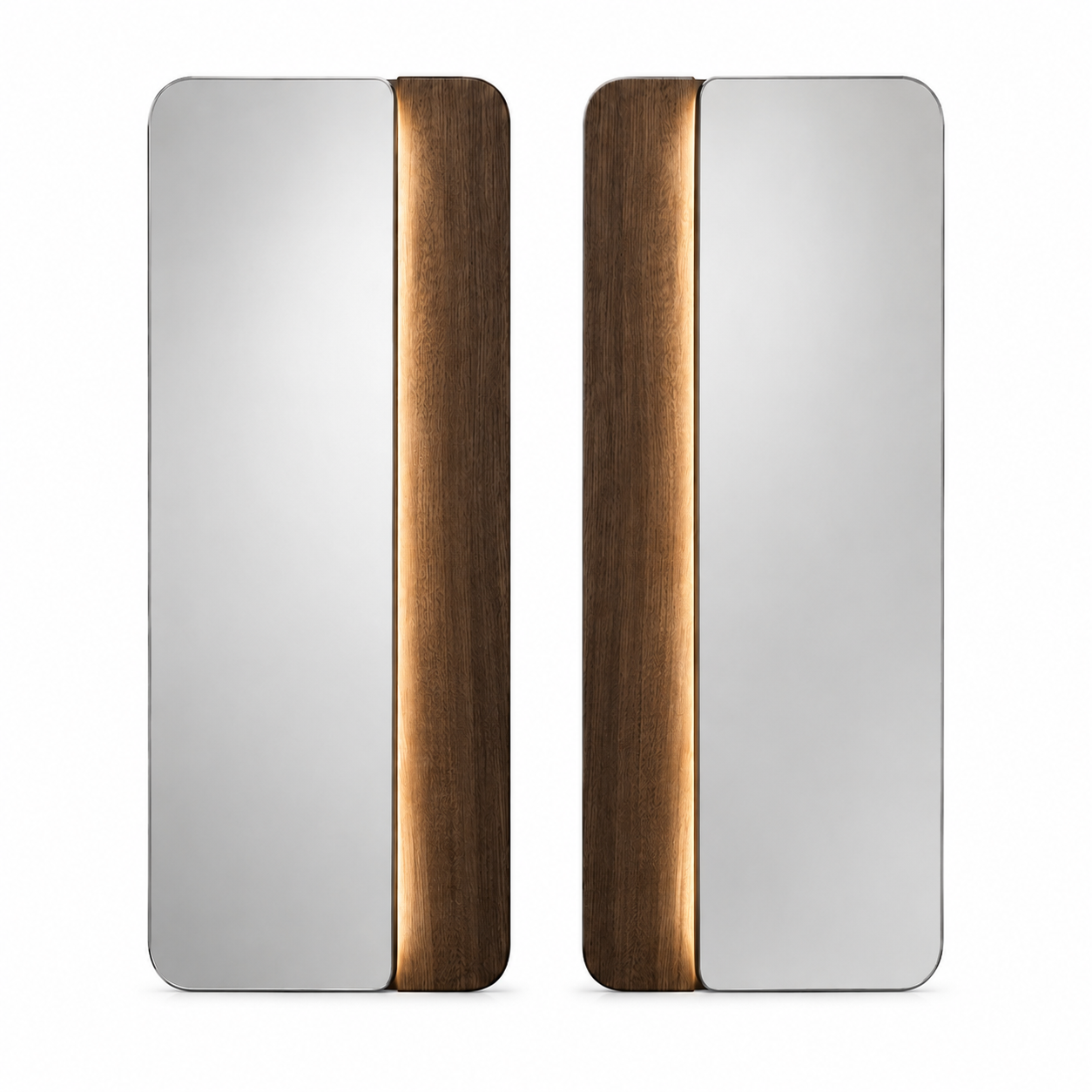
The TMR27-H15 Inward Oak Bedside Duet is a matched pair of illuminated wall mirrors designed for boutique hotels, branded guest rooms, serviced apartments, and coordinated hospitality interiors.
Unlike conventional mirrors selected primarily for personal use, H15 is designed to organize the materials, reflections, and ambient light across an entire headboard wall. Smoked oak, deep bronze, recessed mirror surfaces, and concealed warm lighting work together to create a quiet architectural composition around the bed.
The two mirrors are supplied as a dedicated left-hand and right-hand set. Their smoked-oak wings face inward toward the center of the bed, while the mirror panels face outward toward the room.
Product Specifications
- Model: TMR27-H15
- Product name: Inward Oak Bedside Duet
- Product type: Matched illuminated bedside wall-mirror pair
- Recommended size: 360 × 760 × 42 mm per mirror
- Imperial size: 14.2 × 29.9 × 1.7 in per mirror
- Sales unit: One matched pair containing two mirrors
- Mirror: 4 mm silver mirror
- Wood detail: W1 smoked-oak inner wing
- Wood-wing width: Approximately 76 mm
- Metal detail: M1 deep-bronze inner reveal
- Mirror recess: 8 mm
- Corner profile: R22–25 mm
- Lighting: Concealed warm reflected light inside each inward-facing reveal
- Installation: Fixed wall-mounted installation
- Primary applications: Boutique hotels, standard guest rooms, serviced apartments, branded bedroom programs, and hospitality renovation projects
Project options may include customized dimensions, oak tones, bronze finishes, voltage, color temperature, dimming, wiring positions, mounting systems, and contract packaging.
A Strictly Mirrored Left-and-Right Design
The orientation of the pair is essential to the H15 design.
The mirror installed on the left side of the bed has its mirror panel on the outer left and its smoked-oak wing on the inner right. The mirror installed on the right side reverses this arrangement, placing the oak wing on the inner left and the mirror panel on the outer right.
When installed correctly, both oak wings point toward the center of the bed. This creates a clear visual boundary around the headboard while allowing the reflective surfaces to open toward the surrounding room.
H15 must not be supplied as two mirrors with the same orientation. It is also not intended to have the wood elements facing the outside walls.
Smoked Oak, Deep Bronze, and Recessed Mirror
Each unit combines a 76 mm smoked-oak wing with a slim deep-bronze reveal and a recessed silver mirror.
The mirror surface sits approximately 8 mm behind the wood element, producing a controlled shadow line and giving the product the depth of a fixed architectural component. The R22–25 mm rounded-rectangle profile softens the vertical form without turning it into a decorative curved mirror.
This material combination coordinates naturally with upholstered headboards, warm-gray wall panels, oak or walnut casegoods, pale stone nightstands, and bronze guest-room hardware.
Concealed Ambient Lighting
A concealed warm light source is positioned inside the reveal between the mirror and the inward-facing oak wing. The light reflects softly across the mirror surface and adjacent headboard wall.
The LED source remains hidden from direct view. There is no bright perimeter frame, exposed light strip, or illuminated outer edge.
The lighting is intended to support the room’s ambient atmosphere. It does not replace bedside reading lamps, ceiling lighting, or other functional task lighting required by the hotel’s lighting plan.
Designed for Hotel and Contract Projects
TMR27-H15 supports repeated installation across hotel guest rooms where consistent orientation, spacing, wiring, and finish control are important.
For project development, our team can review:
- Bed and headboard dimensions
- Left-hand and right-hand installation positions
- Bedside-table locations
- Electrical outlets and wiring exits
- Required voltage and color temperature
- Wood and metal finish references
- Mounting conditions
- Project packaging and room-by-room labeling
Clear left and right identification can be incorporated into drawings, packaging, and installation instructions to reduce orientation errors during site installation.
H15 Compared With Two Standard Wall Mirrors
Two identical retail mirrors may provide basic reflection, but they do not establish a coordinated relationship with the center of the bed. If both mirrors repeat the same wood-wing direction, one side of the headboard wall will appear visually incorrect.
H15 uses two purpose-built mirrored orientations. The inward-facing oak wings frame the bed center, while the outward-facing mirror panels help visually expand the room.
A conventional illuminated mirror also tends to use a full perimeter light or bright front-facing LED edge. H15 uses only two concealed inner lightwells, creating a quieter and more hospitality-focused result.
Example Guest-Room Application
In a boutique hotel king room, one H15 mirror can be installed above or behind each nightstand. The smoked-oak wings face the upholstered headboard, and the mirror panels face toward the outside of the room.
Warm reflected light creates two controlled vertical accents without competing with the bed or bedside lighting. The result is a more complete headboard-wall composition built from material, depth, and light rather than additional decorative objects.
For a coordinated room package, H15 can be specified with TMR27-H01, TMR27-H05, and TMR27-H12 to carry the smoked-oak and deep-bronze material language through the bathroom, vanity, dressing, and bedside areas.
Frequently Asked Questions
Is TMR27-H15 sold as one mirror or as a pair?
H15 is sold as one matched set containing two mirrors: one left-hand unit and one right-hand unit.
Can we order two mirrors with the same orientation?
That configuration is not recommended. The defining feature of H15 is that both oak wings face inward toward the center of the bed.
Can the oak wings face the outside walls?
No. Reversing the direction would change the approved composition and remove the bed-centered visual relationship.
Is H15 intended to be the room’s primary dressing mirror?
No. Its main role is to organize the headboard wall through reflection, wood, bronze, depth, and ambient light. A separate full-length dressing mirror should be specified where required.
Can the dimensions follow our headboard elevation?
Yes. Size, installation height, spacing, mounting points, and wiring positions can be reviewed from approved guest-room elevations.
Can the lighting specification be customized?
Yes. Voltage, color temperature, dimming method, driver location, and control requirements can be reviewed for qualified hotel projects.
Request a Project Quotation
Send us your guest-room elevation, bed and headboard dimensions, bedside-table locations, required quantity, installation country, voltage, finish references, and project schedule.
Our hospitality project team can provide orientation guidance, recommended spacing, finish options, technical drawings, sampling support, contract packaging, and a project quotation for your hotel guest-room program.