
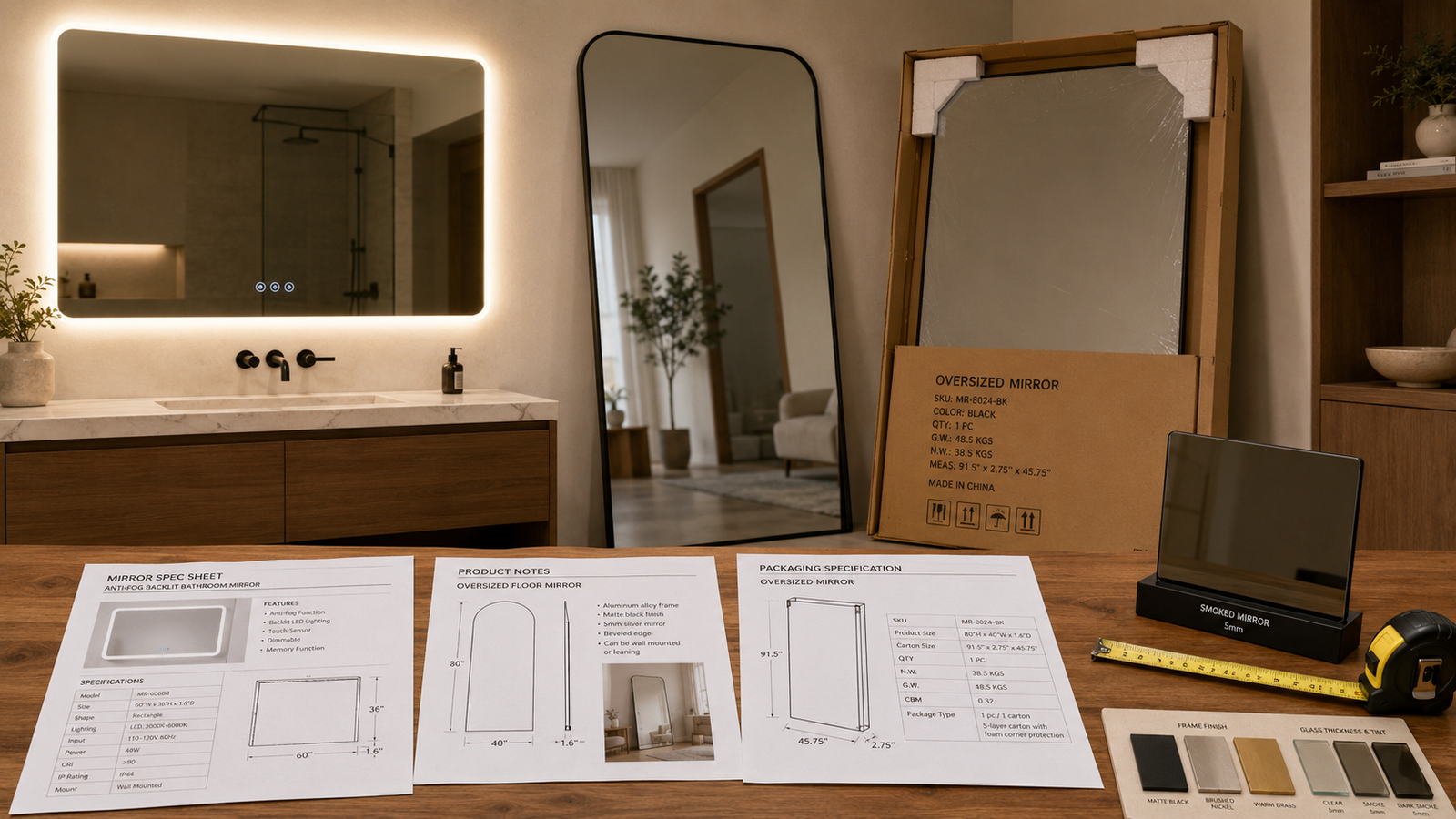
The Buyer Story: The Designer Loved the Mirror, But Purchasing Could Not Approve It
A U.S. home décor buyer was reviewing a new mirror collection for a retail and designer channel launch.
The product looked strong.
There was a smoked mirror for a moody bedroom story, an anti-fog bathroom mirror for renovation buyers, and an oversized leaning mirror for furniture stores and online marketplaces.
The interior design team liked the look.
The merchandising team saw the commercial potential.
But the purchasing team stopped the order.
The supplier had beautiful photos, but the spec sheet was incomplete.
There was no confirmed glass thickness.
No tint level.
No clear anti-fog bathroom mirror specs.
No carton size for the oversized leaning mirror.
No product notes explaining installation, packaging, or retail use.
That is where many mirror sourcing projects fail.
For U.S. buyers, a mirror is not ready for purchase just because it looks good. It becomes ready when the supplier can turn the product into clear, usable, retail-ready documentation.
Why Spec Sheets Matter More in Today’s Home Décor Market
U.S. home décor buyers are working in a more complex product environment.
At High Point Market, the Style Spotters program highlights trend discovery through interior designers and product experts, showing how important design interpretation has become for home furnishings buyers. At Spring 2026 High Point Market, trend coverage also pointed to oversized forms, layered materials, softer shapes, and performance-driven products, all of which increase the need for clearer product information.
Las Vegas Market continues to position itself around cross-category sourcing across furniture, home décor, gift, lifestyle, and seasonal products, with Summer 2026 promoted across 3,500-plus brands. Atlanta Market also serves retailers, buyers, interior designers, architects, specifiers, and purchasing companies, which means products increasingly need documentation that works for both retail and project channels.
For mirror buyers, this market direction creates a practical rule:
A product photo sells the idea.
A spec sheet approves the order.
What a Good Spec Sheet Should Do
A good spec sheet should remove uncertainty.
It should answer the questions that buyers, designers, warehouse teams, installers, customer service teams, and e-commerce teams will ask later.
A mirror spec sheet should usually include:
| Section | What Buyers Need |
|---|---|
| Product identity | SKU, product name, collection name |
| Dimensions | Width, height, depth, mirror thickness, frame thickness |
| Materials | Glass type, frame material, backing, hardware |
| Finish | Frame color, surface treatment, tint level, texture |
| Function | Anti-fog, LED, backlit, touch switch, dimming |
| Electrical data | Voltage, wattage, CCT, IP rating if applicable |
| Packaging | Carton size, carton structure, foam protection, weight |
| Installation | Wall mounted, leaning, vertical/horizontal, hardware |
| Product notes | Use case, care notes, retail display notes |
A supplier that provides this information early helps buyers move faster and with less risk.
Spec Sheets and Product Notes: Why Both Are Needed
Spec sheets and product notes are not the same thing.
The spec sheet is the technical document.
The product notes explain how the product should be sold, handled, installed, or displayed.
For example, a spec sheet may say:
“Mirror thickness: 5 mm.”
A product note may say:
“Recommended for bedroom, entryway, or boutique hospitality use. Not designed for wet-zone bathroom installation.”
Both pieces of information matter.
Buyer Example
A smoked mirror may look beautiful in a product image. But without product notes, the buyer may not know whether the tint is designed for decorative atmosphere, dressing-room use, or bathroom use.
Good product notes make the product easier for sales teams, designers, and online listing teams to understand.
Anti-Fog Bathroom Mirror Specs: The Details Buyers Should Request
Anti-fog bathroom mirror specs are often too vague in supplier catalogs.
Many suppliers write “anti-fog function” without explaining performance.
That is not enough for a U.S. buyer.
The buyer should ask:
How large is the defogging area?
Where is the heating pad positioned?
How many watts does the anti-fog pad use?
Is it controlled by a separate switch or shared switch?
How fast does the mirror clear under normal bathroom humidity?
Is the anti-fog feature optional or standard?
Anti-Fog Bathroom Mirror Spec Checklist
| Spec Item | Why It Matters |
|---|---|
| Heating pad size | Determines how much of the mirror clears |
| Heating pad position | Affects real user experience |
| Wattage | Impacts energy use and electrical planning |
| Control method | Affects usability |
| Safety documentation | Important for bathroom use |
| Packaging note | Protects electrical components during shipping |
For buyers serving bathroom renovation, hospitality, or multifamily projects, anti-fog details should be confirmed before final quotation.
Smoked Mirror Thickness Tint Level Specification
A smoked mirror thickness tint level specification is important because smoked mirrors are sold by mood and atmosphere, but purchased by measurable detail.
A smoked mirror can vary from a light gray reflective tone to a deep bronze or charcoal effect.
Without a clear tint specification, the production batch may not match the approved sample.
What Buyers Should Confirm
Glass thickness.
Tint color direction.
Tint depth or approved reference sample.
Reflective clarity.
Batch tolerance.
Lighting condition for sample approval.
Frame compatibility.
For U.S. retail, the supplier should provide physical samples or approved reference images under different lighting conditions.
A smoked mirror may look premium in warm showroom lighting but too dark in a small apartment bedroom. Buyers should test the tint in realistic environments before placing large orders.
Oversized Leaning Mirror Packaging Spec Carton Size
An oversized leaning mirror packaging spec carton size is not just a logistics detail.
It directly affects cost, damage rate, warehouse handling, and customer satisfaction.
Oversized leaning mirrors are high-impact products, but they carry shipping risk because of glass size, frame weight, and corner vulnerability.
What the Packaging Spec Should Include
| Packaging Detail | Buyer Question |
|---|---|
| Carton size | Will it fit warehouse and delivery limits? |
| Net weight / gross weight | Can teams handle it safely? |
| Inner foam structure | Does the mirror move inside the carton? |
| Corner protection | Are impact points reinforced? |
| Carton strength | Is it suitable for long-distance shipping? |
| Loading quantity | How many units per container? |
| Parcel vs. freight note | Can it ship by small parcel, LTL, or only palletized freight? |
For e-commerce buyers, carton size is especially important. A mirror that looks profitable at unit cost can become expensive after oversized shipping surcharges, damage claims, or return handling.
Spec-Ready Supplier for Interior Designers
A spec-ready supplier for interior designers understands that designers need more than product names and photos.
Interior designers often need:
Dimensions.
Finish samples.
Material descriptions.
Installation method.
Care instructions.
Lead time.
Availability.
Project notes.
For designers, missing information slows down the project. For buyers, missing information creates repeated questions and weakens confidence in the supplier.
What Makes a Supplier Spec-Ready?
A spec-ready supplier can provide:
- Clean product spec sheets
- Finish and material samples
- Installation notes
- Packaging details
- High-quality images
- Product notes for room use
- Clear customization options
- Repeat-order consistency
This is especially important for mirrors because designers often specify mirrors by room, finish, scale, and mood.
How U.S. Buyers Should Read a Mirror Spec Sheet
A buyer should not read a spec sheet from top to bottom only.
The better method is to read it by risk.
Risk 1: Visual Risk
Check:
Frame finish.
Glass tint.
Mirror clarity.
Size proportion.
Color consistency.
Risk 2: Functional Risk
Check:
Anti-fog system.
LED function.
Mounting method.
Electrical data.
Moisture suitability.
Risk 3: Shipping Risk
Check:
Carton size.
Weight.
Foam protection.
Corner guards.
Loading plan.
Risk 4: Retail Risk
Check:
Product notes.
Care instructions.
Listing information.
Images.
Display use case.
A good buyer uses the spec sheet to predict where problems may appear before production starts.
Example: What a Better Spec Sheet Looks Like
Product
Smoked Oversized Leaning Mirror
Dimensions
Overall size: 72″ H × 36″ W
Glass thickness: 5 mm
Frame depth: 1.25″
Mirror Type
Smoked mirror glass
Tint level: medium gray-bronze reference sample
Approved sample code: SMK-02
Frame
Aluminum frame
Finish: brushed dark bronze
Installation
Leaning use recommended
Wall safety kit included
Indoor dry-area use
Packaging
Carton size: 76″ × 40″ × 4.5″
Inner protection: foam corner guards + edge protection
Gross weight: 58 lb
Shipping: palletized or LTL recommended
Product Notes
Suitable for bedroom, dressing area, entryway, boutique retail, and hospitality lounge styling.
This type of document helps buyers, designers, and logistics teams work from the same information.
Supplier Questions Before Placing a Purchase Order
Before confirming a mirror order, U.S. buyers should ask the supplier:
Can you provide a complete spec sheet?
Can you provide product notes for retail or designer use?
Can you confirm anti-fog bathroom mirror specs?
Can you define smoked mirror tint level?
Can you provide carton size for oversized leaning mirrors?
Can you provide packaging photos before production?
Can you provide approved sample references?
Can you keep the same specifications for repeat orders?
A supplier that cannot answer these questions may still produce mirrors, but may not be ready for serious B2B retail or designer channels.
Structured Buyer Summary
A spec sheet is a technical product document that defines mirror size, materials, finish, function, packaging, and installation details. Product notes explain how the product should be used, displayed, handled, or sold.
For mirror buyers, important details include anti-fog bathroom mirror specs, smoked mirror thickness and tint level specification, oversized leaning mirror packaging spec carton size, and supplier documentation quality. A spec-ready supplier for interior designers should provide product data, finish samples, installation notes, packaging information, and retail-ready product notes.
For U.S. buyers, spec sheets and product notes reduce sourcing risk, speed up internal approval, and make mirror collections easier to sell across retail, designer, hospitality, and e-commerce channels.
Final Buyer Takeaway
The best mirror supplier is not only the supplier with attractive designs.
It is the supplier that can document what it produces.
A good spec sheet protects the buyer.
Good product notes help the sales team.
Good packaging specs protect the margin.
And a spec-ready supplier helps buyers turn a product idea into a reliable retail or designer program.
In today’s home décor market, documentation is not paperwork.
It is part of the product.
FAQ
What is a spec sheet in mirror sourcing?
A spec sheet is a technical document that lists key product details such as dimensions, materials, finish, mirror thickness, electrical data, installation method, packaging, and carton size.
Why do buyers need product notes?
Product notes explain how a mirror should be used, displayed, handled, or sold. They help designers, retailers, e-commerce teams, and customer service teams understand the product beyond technical measurements.
What should anti-fog bathroom mirror specs include?
Anti-fog bathroom mirror specs should include heating pad size, position, wattage, control method, performance expectations, and safety documentation.
What is smoked mirror thickness tint level specification?
It refers to the defined glass thickness and tint depth of a smoked mirror. Buyers should confirm color direction, approved sample, tint consistency, and reflective clarity.
Why is carton size important for oversized leaning mirrors?
Carton size affects shipping cost, warehouse handling, damage risk, and return management. Buyers should review carton dimensions and packaging protection before placing orders.



