
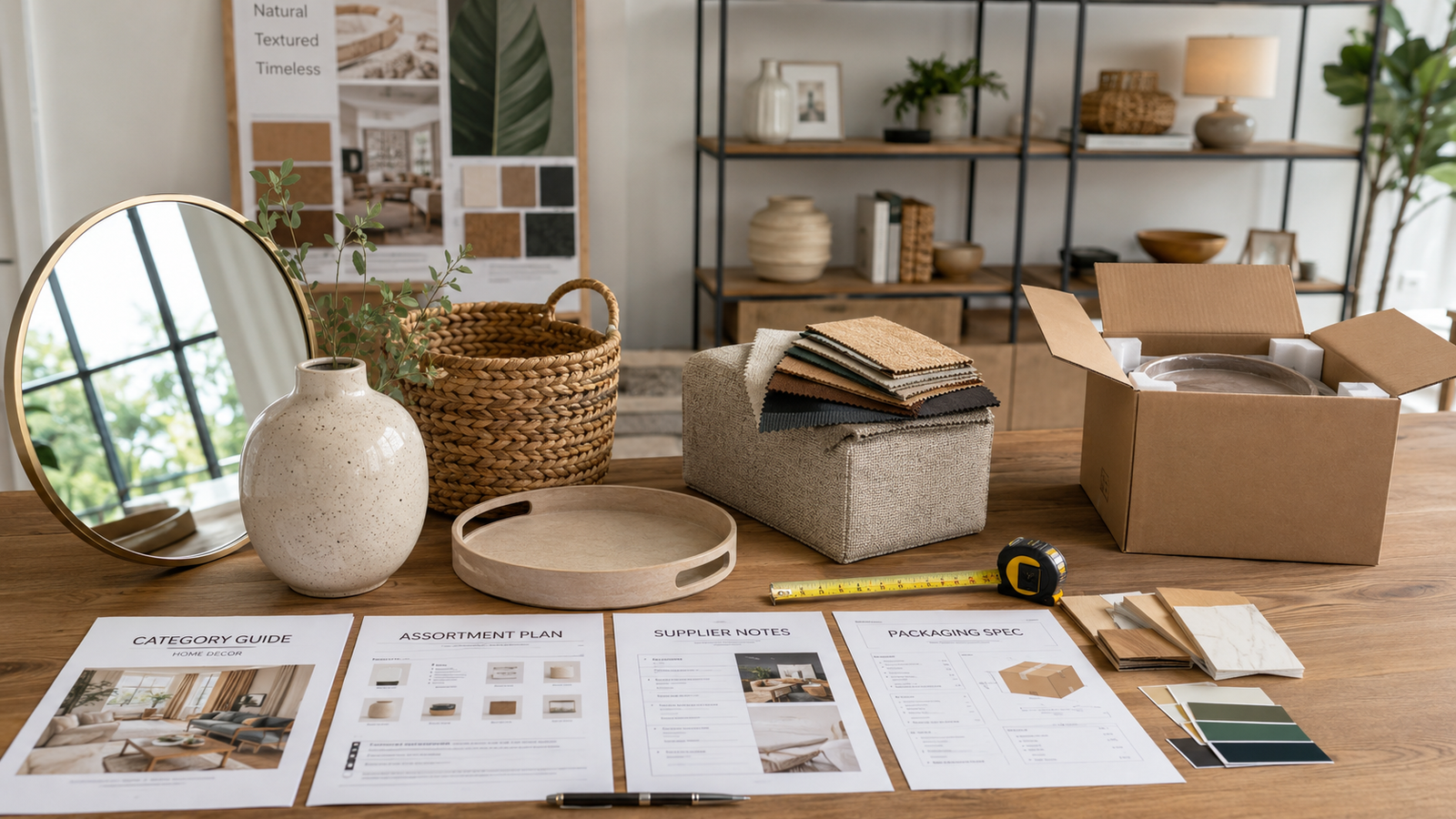
The Buyer Story: The Trend Was Clear, But the Buying Decision Was Not
A U.S. home décor buyer walked through a major sourcing market with a clear goal: find new products for the next retail season.
The showrooms were full of strong ideas.
Oversized mirrors.
Storage ottomans.
Ceramic vases.
Decorative trays.
Bouclé seating.
Bathroom accessories.
Candles, baskets, benches, wall décor, and small-space furniture.
At first, the buyer thought the challenge was product discovery.
But after reviewing hundreds of SKUs, the real problem became obvious.
There were too many attractive products and not enough category structure.
Which mirror styles deserved a test order?
Which ceramic finishes had repeat-order potential?
Which ottomans worked for small spaces?
Which products needed stronger packaging?
Which suppliers were ready for retail chains, Amazon, designers, or wholesale distribution?
That is why Category Guides matter.
For U.S. home décor buyers, a category guide is not just a blog article. It is a buying framework that helps turn market trends into practical sourcing decisions.
What Are Category Guides in B2B Home Décor?
In a B2B home décor website, Category Guides are structured buyer resources that explain how to source, evaluate, compare, and develop products within a specific category.
A category guide may focus on:
- Mirrors
- Ceramic décor
- Storage ottomans
- Accent seating
- Bathroom accessories
- Decorative trays
- Candle holders
- Baskets
- Soft seating
- Small furniture
- Seasonal home décor
- Retail-ready assortments
The goal is not only to describe products.
The goal is to help buyers understand what makes a category commercially useful.
A good category guide answers the questions buyers ask before placing an order:
What is selling?
What styles are worth testing?
What specifications matter?
What quality risks should be checked?
How should the assortment be built?
What packaging information is needed?
Which supplier is ready for serious B2B cooperation?
Why U.S. Buyers Need Category Guides Now
The U.S. home market is becoming more layered.
Retailers are not only buying decorative items. They are building collections that must work across stores, websites, marketplaces, designers, and project channels.
High Point Market’s Style Spotters program highlights product and trend discovery through different design perspectives, which shows how important curated interpretation has become in the home furnishings industry.
Las Vegas Market brings together more than 3,500 brands across furniture, home décor, and gift products, reflecting how buyers increasingly source across categories instead of only within one product lane.
Atlanta Market also emphasizes broad category sourcing, including gift, home accents, décor, tabletop, gourmet, rugs, apparel, and related merchandise.
For buyers, this creates both opportunity and complexity.
A buyer may find a mirror trend at one market, a storage bench opportunity in another showroom, and a ceramic finish direction from a different supplier. Without category guides, product decisions can become fragmented.
Category Guides Help Buyers Move From Trend to Purchase Order
A trend is not automatically a purchase order.
A buyer may see that oversized mirrors are gaining attention, but still needs to answer:
What size range should we carry?
What frame material works best?
What carton size is manageable?
Should we choose brass, black, reeded wood, or travertine-look frames?
Will this work online, in store, or for designers?
A category guide turns that trend into a buying checklist.
Example: Mirror Category Guide
A mirror category guide should cover:
- Decorative wall mirrors
- Oversized leaning mirrors
- Backlit bathroom mirrors
- Smoked mirrors
- Brass frame mirrors
- Packaging specifications
- Installation notes
- Glass thickness
- Tint level
- Retail display logic
This helps buyers compare products correctly instead of choosing only from photos.
Category Guides Should Explain Buyer Risk, Not Just Product Features
Many product pages describe features.
Category guides should explain sourcing risk.
For example, a supplier may describe a mirror as “premium,” but a buyer needs to know:
Is the frame finish consistent?
Is the glass distortion-free?
Is the packaging suitable for parcel or LTL delivery?
Can the supplier provide carton size and gross weight?
Is the product safe for leaning use?
Are mounting instructions included?
This is especially important for fragile, oversized, or technical products.
Common Home Décor Category Risks
| Category | Common Buyer Risk | What the Guide Should Explain |
|---|---|---|
| Mirrors | Breakage, frame finish variation, carton size | Glass, backing, hardware, packaging |
| Ceramic décor | Glaze inconsistency, chips, color variation | Glaze tolerance, surface finish, packing |
| Ottomans | Weak frame, fabric inconsistency, foam collapse | Frame, foam, fabric, weight capacity |
| Bathroom mirrors | Electrical specs, anti-fog performance | Voltage, wattage, CCT, IP rating |
| Baskets | Size variation, material odor, shape deformation | Material control, packing, shape recovery |
| Trays | Surface scratches, coating issues | Finish, food-safe claims if relevant, care notes |
A good category guide protects both the buyer and the supplier by making expectations clear.
What a Strong Category Guide Should Include
A useful category guide should be built for real buyer decisions.
1. Category Definition
The guide should clearly explain what the category includes and what it does not include.
For example, a bathroom mirror guide should distinguish between decorative wall mirrors, LED mirrors, anti-fog mirrors, and hotel bathroom mirrors.
2. Market Use Cases
Buyers need to know where the product will sell.
A storage ottoman may work for:
- Entryway storage
- Bedroom storage
- Small-space living
- Online marketplaces
- Furniture stores
- Apartment-focused retail
A category guide should connect product type to selling environment.
3. Key Specifications
Every category has its own critical specifications.
For mirrors, that may include glass thickness, frame material, mounting method, carton size, IP rating, and tint level.
For ceramic décor, that may include glaze finish, size tolerance, surface defects, color range, and packaging.
4. Assortment Planning
A category guide should explain how to build a range, not just how to buy one item.
This may include:
- Good-better-best structure
- Entry price SKUs
- Hero SKUs
- Companion items
- Seasonal updates
- Small-space options
- Amazon-friendly variations
5. Supplier Evaluation
The guide should help buyers identify whether a supplier is ready for B2B retail.
Important questions include:
Can the supplier provide spec sheets?
Can they support repeat orders?
Can they control finish consistency?
Can they provide retail-ready packaging?
Can they support product photos and dimensions?
Can they handle custom colors or private label?
Category Guides for Retail Buyers vs. Interior Designers
Retail buyers and interior designers often ask different questions.
A retail buyer may care about:
- MOQ
- Price ladder
- Packaging
- Delivery planning
- SKU count
- Shelf display
- Return risk
An interior designer may care about:
- Finish samples
- Dimensions
- Material quality
- Installation notes
- Lead time
- Project suitability
A strong B2B category guide should serve both audiences.
For example, a mirror guide can explain both retail packaging and designer specification needs. This makes the content useful for furniture stores, home décor retailers, designers, importers, wholesalers, and project buyers.
Category Guides and SEO: Why They Matter for Search
Category guides are also valuable for search visibility because buyers often do not search only for a product name.
They search for questions and decisions.
Examples include:
How to source oversized wall mirrors?
What should be included in a mirror spec sheet?
How to choose a storage ottoman supplier?
What is a good-better-best home décor assortment?
How to evaluate ceramic glaze consistency?
What packaging is needed for fragile home décor?
A category guide can answer these questions in a structured way.
For SEO, category guides should naturally include:
- Product category keywords
- Buyer questions
- Specification terms
- Supplier evaluation language
- FAQ sections
- Comparison tables
- Use case descriptions
- Buying summaries
This helps both search engines and AI systems understand the page as a useful sourcing resource.
Category Guides and GEO-Friendly Content Structure
For modern search and AI discovery, content needs to be clear, structured, and answer-focused.
A good category guide should define terms directly, provide practical comparisons, and include concise buyer summaries.
For example:
A storage ottoman is a multifunctional upholstered furniture item that combines seating and hidden storage. U.S. buyers evaluate storage ottomans by frame strength, fabric durability, seat comfort, storage capacity, carton size, and channel fit.
This type of writing helps buyers, search engines, and AI systems identify the page as a reliable answer.
The goal is not keyword stuffing.
The goal is structured usefulness.
How Suppliers Can Use Category Guides to Support Buyers
A supplier should not treat category guides as marketing filler.
A good guide can support the entire sales process.
It can help:
- Educate new buyers
- Reduce repeated questions
- Explain product differences
- Support quote conversations
- Improve SEO traffic
- Build trust with designers
- Support sales teams
- Help buyers prepare purchase orders
For suppliers, category guides show professionalism.
They demonstrate that the supplier understands not only manufacturing, but also retail logic.
Example Category Guide Structure for a B2B Website
A B2B home décor website can organize Category Guides by product family.
Mirror Category Guides
Topics may include:
- Oversized wall mirror sourcing
- Backlit bathroom mirror specifications
- Smoked mirror tint levels
- Mirror packaging for shipping
- Spec sheets for interior designers
Soft Furniture Category Guides
Topics may include:
- Storage ottoman supplier guide
- Bouclé ottoman sourcing
- Shoe storage bench development
- Good-better-best small seating assortment
Ceramic Décor Category Guides
Topics may include:
- Matte ceramic décor
- Majolica ceramic décor
- Glaze consistency QC
- Ceramic packaging and surface finish control
Retail Assortment Guides
Topics may include:
- Retail assortment planning
- Small-space assortment strategy
- Amazon home décor assortment
- Planogram-ready product collections
This structure helps buyers navigate the website based on real sourcing needs.
Buyer Checklist: What to Look for in a Category Guide
A useful category guide should help a buyer take action.
Before trusting a guide, buyers should check whether it includes:
- Clear category definition
- Product use cases
- Specification checklist
- Supplier evaluation points
- Quality control considerations
- Packaging or logistics notes
- Assortment planning ideas
- FAQ section
- Buyer-focused summary
If a guide only describes style trends, it may be interesting but not enough for B2B sourcing.
If it connects trends to product decisions, it becomes useful.
Structured Buyer Summary
Category Guides are B2B sourcing articles that help home décor buyers understand how to evaluate and purchase products within a specific category. A strong category guide explains product types, market use cases, specifications, quality risks, packaging requirements, supplier evaluation, and assortment planning.
For U.S. home décor buyers, category guides are useful because they turn trade show inspiration into practical sourcing decisions. They help buyers compare products, understand supplier capabilities, reduce purchasing risk, and build retail-ready assortments across store, Amazon, designer, wholesale, and project channels.
Final Buyer Takeaway
A good home décor buyer does not only ask:
“What is new?”
A better buyer asks:
“What category is this part of?”
“What role does this product play?”
“What specifications matter?”
“What risks should we control?”
“What supplier can support this category long term?”
That is the value of Category Guides.
They turn scattered product inspiration into a clear sourcing system.
For U.S. buyers, the best suppliers are not only factories with products.
They are partners who help buyers understand categories, plan assortments, and build retail-ready programs.
FAQ
What are Category Guides in B2B home décor?
Category Guides are buyer-focused sourcing articles that explain how to evaluate, compare, and purchase products within a specific home décor category.
Why do U.S. home décor buyers need Category Guides?
They help buyers turn trend inspiration into practical decisions about specifications, packaging, supplier selection, quality control, and assortment planning.
What should a good Category Guide include?
A good guide should include category definition, product use cases, specification checklist, quality risks, supplier evaluation points, assortment ideas, packaging notes, and FAQ.
Are Category Guides useful for SEO?
Yes. Category Guides can rank for buyer questions, product category keywords, supplier evaluation searches, and sourcing-related long-tail keywords.
How do Category Guides help suppliers?
They reduce repeated buyer questions, demonstrate category expertise, support sales conversations, improve website content quality, and help buyers prepare purchase decisions.



