
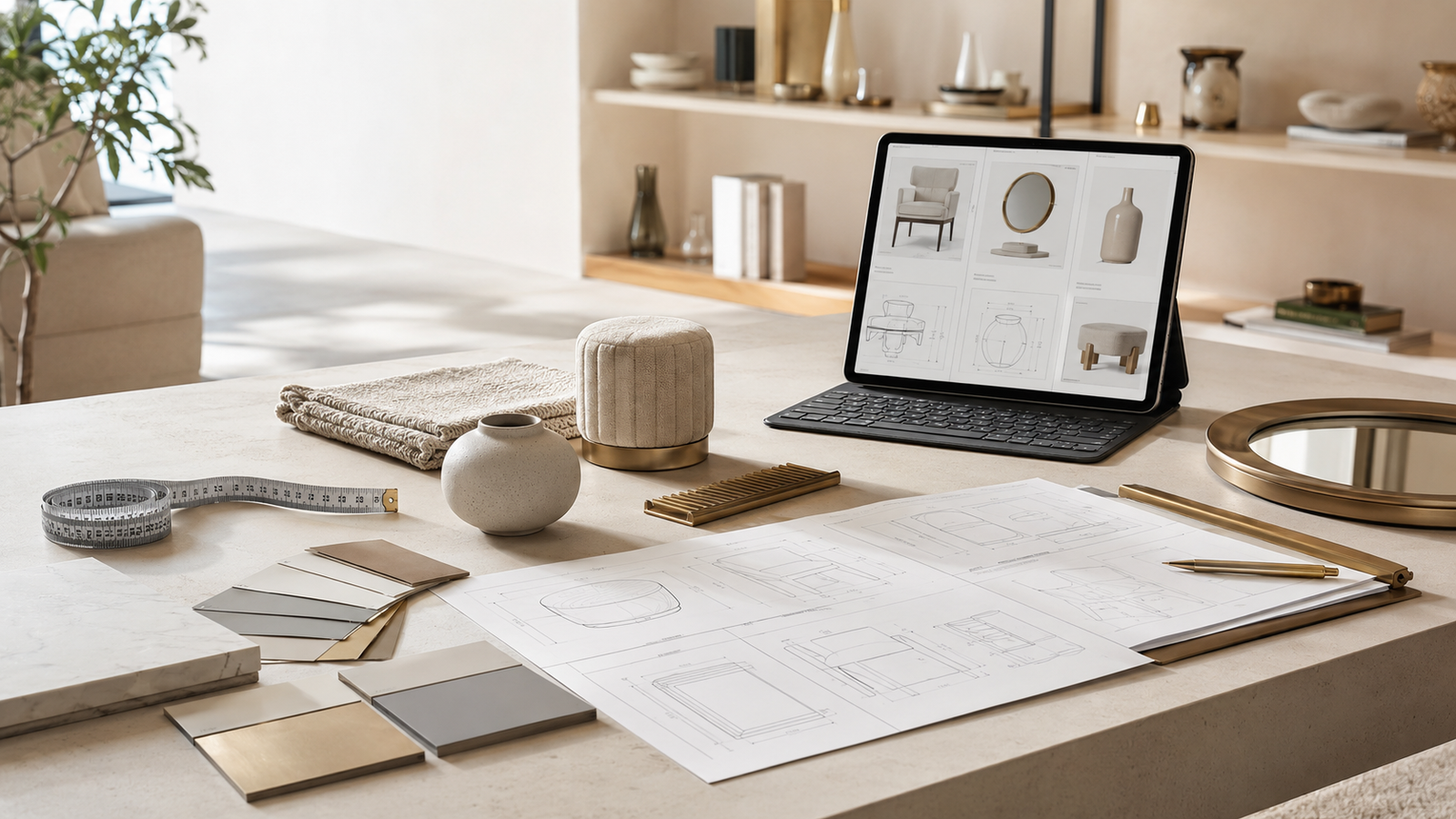
Home Decor Specification Guide: Because “Nice Product” Is Not Enough for B2B Buyers
The Trade Fair Lesson: Trends Are Getting Smarter, So Product Information Must Too
The latest home decor fairs are giving buyers a very useful message: the market wants more texture, more personality, more sculptural form, more craft feeling, and fewer products that look like they were designed by a spreadsheet having a nervous breakdown.
Good.
But here is the buyer’s problem.
A trend is not a spec sheet.
A moodboard is not a purchase order.
A beautiful product photo is not a delivery plan.
For B2B buyers, home decor products must do more than look charming under exhibition lighting. They must be understood, quoted, sampled, packed, shipped, displayed, sold, and reordered.
That is why Teruier built its Spec & Knowledge Center, Spec Sheets & Product Notes, and Designer Resource Center around one simple idea: better product knowledge leads to better buying decisions.
Not more words. Better words.
What Is a Home Decor Specification Guide?
A home decor specification guide is a practical buying resource that explains the product details a buyer, designer, importer, wholesaler, or project sourcing team needs before making a decision.
It helps answer questions such as:
What is the product made of?
What size is it?
What finish does it use?
What category does it belong to?
Where can it be used?
What is the packing logic?
What type of buyer or project is it suitable for?
Can it become part of a collection?
Does it support margin?
In short, a specification guide turns product confusion into product clarity.
And clarity is underrated. Especially in sourcing.
Teruier’s Value Translation: From Design Language to Buying Language
At Teruier, we call this process value translation.
Designers often speak in feeling:
“Warm but not rustic.”
“Luxury but not shiny.”
“Organic but still commercial.”
“Statement piece, but please do not make it ridiculous.”
Buyers speak in business:
MOQ.
FOB price.
Packing.
Lead time.
Reorder.
Margin.
Damage rate.
Private label.
Factories speak in production:
Material.
Mould.
Finish.
Tolerance.
Carton.
Hardware.
Batch control.
Teruier’s role is to translate between these languages.
A buyer may come with a trend direction from a fair, a designer moodboard, or a reference image. Teruier helps turn that idea into product notes, specifications, sample requirements, category logic, and sourcing decisions.
Because “I want something beautiful” is a nice beginning.
It is not yet a sourcing plan.
Why Spec Sheets Matter More Than Buyers Admit
Spec sheets are not glamorous. Nobody walks into a showroom and whispers, “Wow, look at that carton size.”
But spec sheets are where many buying mistakes are prevented.
A good spec sheet should include:
Product name
Item number
Category
Material
Size
Finish
Colour direction
Weight
Packing method
MOQ
Lead time
Usage scenario
Design notes
Buyer value
Project suitability
Without these details, everyone starts guessing.
The buyer guesses the finish.
The supplier guesses the usage.
The factory guesses the tolerance.
The logistics team guesses the packing risk.
And then someone acts surprised when the result is wrong.
This is why Teruier treats spec sheets as buying tools, not paperwork.
Product Notes: The Missing Link Between Design and Sales
A product note should not sound like this:
“Beautiful home decor item, high quality, widely used.”
That sentence has done enough damage. Let it rest.
A useful product note explains why the product matters.
For example:
A mirror is not only a mirror. It may be a visual anchor for entryways, bedrooms, villas, hotel corridors, or retail displays.
An ottoman is not only a soft seat. It may be a flexible accent piece that adds texture, colour, extra seating, and merchandising value.
A ceramic vase is not only a vase. It may be a sculptural tabletop object that supports seasonal display, giftable decor, and shelf storytelling.
A storage box is not only storage. It may be the thing that lets customers hide chaos while pretending they are naturally organized.
That is product value.
Good product notes help buyers, designers, sales teams, and showroom staff understand how to sell the item, not just what the item is.
Comparison: Weak Product Information vs Teruier-Style Product Knowledge
| Product Information Type | Weak Version | Teruier-Style Version |
|---|---|---|
| Product Description | “Modern decorative mirror” | Explains shape, finish, room use, buyer value, and project suitability |
| Spec Sheet | Size and material only | Adds finish, packing, usage, MOQ, lead time, category role, and sourcing notes |
| Product Note | “High quality and beautiful” | Connects design trend, customer use, display value, and margin logic |
| Designer Resource | Pretty images only | Provides style direction, specification logic, and project application |
| Category Guide | Random product list | Helps buyers understand assortment role, price level, and reorder potential |
A product list tells buyers what exists.
A good knowledge center helps buyers decide what is worth buying.
That is a very different thing.
Why Designers Need Better Product Knowledge
Designers do not only need inspiration. They need products that can survive real rooms, real clients, and real delivery schedules.
A mirror must fit the wall.
A bench must match the space.
A vase must have the right scale.
A decorative tray must not look like an afterthought.
An ottoman must feel intentional, not like someone forgot where to put extra fabric.
Teruier’s Designer Resource Center helps connect design ideas with practical sourcing information.
This matters because designers often influence what buyers purchase. If the product information is weak, the designer cannot specify confidently. If the specification is unclear, the buyer cannot order confidently.
And if nobody is confident, the project becomes a group email.
Nobody wants that.
Why Buyers Need Category Guides
A category guide helps buyers understand how a product group works commercially.
For example, mirror buying may include:
Wall mirrors
Full-length mirrors
Vanity mirrors
Decorative mirrors
Inlaid mirrors
Hotel project mirrors
Ottoman buying may include:
Cube ottomans
Storage ottomans
Bench ottomans
Cocktail ottomans
Poufs
Accent stools
Ceramic decor buying may include:
Vases
Bowls
Trays
Candle holders
Planters
Tabletop sculptures
Each product has a different job. Some products attract attention. Some build margin. Some complete a room. Some support add-on sales. Some are safe repeat sellers.
A smart buyer does not just buy products.
A smart buyer builds category logic.
How Teruier Helps Buyers Make Better Decisions
Teruier supports buyers through three layers of product knowledge.
First, trend translation. We look at what is happening in home decor fairs, retail displays, interiors, and buyer demand, then translate those signals into product directions.
Second, specification structure. We help define the product details needed for quotation, sampling, production, packing, and delivery.
Third, commercial positioning. We explain how the product may work for retailers, wholesalers, designers, project buyers, furniture stores, and private label programmes.
This is not about making product pages longer.
It is about making product pages more useful.
FAQ
What is a home decor specification guide?
A home decor specification guide is a practical resource that explains the product details buyers need, including size, material, finish, packing, usage, MOQ, lead time, and sourcing notes.
What is the difference between a spec sheet and a product note?
A spec sheet gives structured technical and commercial information. A product note explains the product’s design value, market use, category role, and buyer benefit.
Why does Teruier provide a Spec & Knowledge Center?
Teruier provides a Spec & Knowledge Center to help buyers understand product categories, specifications, sourcing logic, and design applications before making purchasing decisions.
Who should use the Designer Resource Center?
Interior designers, project buyers, retailers, importers, wholesalers, and showroom teams can use the Designer Resource Center to understand product style, usage scenarios, and specification logic.
Why are category guides useful for buyers?
Category guides help buyers plan assortments instead of buying random items. They explain product types, usage roles, price positioning, and collection potential.
Can better product notes improve sales?
Yes. Better product notes help sales teams, designers, and buyers explain why a product matters. They support clearer positioning, better presentation, and stronger customer understanding.
Does Teruier only provide standard product information?
No. Teruier can support product notes, buyer-facing descriptions, specification guidance, category explanations, private label information, and project sourcing communication.
Final Thought: Better Information Builds Better Orders
In B2B home decor, good taste matters.
But good taste without specification is just decoration with confidence issues.
Teruier believes product knowledge should help buyers move from trend to decision, from image to specification, and from product interest to real order.
That is the purpose of our Spec & Knowledge Center, Spec Sheets & Product Notes, and Designer Resource Center.
Because pretty products attract attention.
Clear product information wins the buyer.



