Beyond the Mood Board: Home Décor Intelligence for the German Market
The latest message from Europe’s design scene is refreshingly direct: design should matter in real life.
At Copenhagen’s 3daysofdesign 2026, the theme “Make This Moment Matter” placed meaningful design above decorative noise. Craftsmanship returned without becoming nostalgic theatre. Materials were expected to feel honest. Classic forms were reconsidered rather than copied, and furniture was presented as part of lived experience rather than as an object waiting patiently for a photographer.
This direction is relevant to the German market.
German buyers do not need another stream of beautiful interiors containing chairs nobody can price, mirrors nobody can pack and side tables apparently designed for homes without coffee cups.
They need to know which ideas can become products, which products can become collections and which collections can produce commercially sensible results.
That is the purpose of the Teruier German Channel.
What Is the Teruier German Channel?
The German Channel is a buyer-oriented home décor resource created for:
- German and European home décor buyers
- Importers and wholesalers
- Furniture and lifestyle retailers
- Interior designers and project professionals
- Product developers and sourcing teams
It connects international design developments with the realities of the German and wider European market.
The channel covers home décor, small furniture and related lifestyle categories, including:
- Mirrors and wall décor
- Ottomans and benches
- Lighting
- Ceramic and tabletop décor
- Occasional furniture
- Soft furnishings
- Storage and organisation
- Outdoor décor
- Category knowledge and buying decisions
This is not an online showroom pretending to be an editorial publication.
Nor is it a design magazine that becomes mysteriously silent when somebody asks about MOQ, packaging or repeat production.
It sits between inspiration and purchasing.
What Does the German Channel Stand For?
The channel is built around a simple principle:
A trend becomes useful only when it improves a product decision.
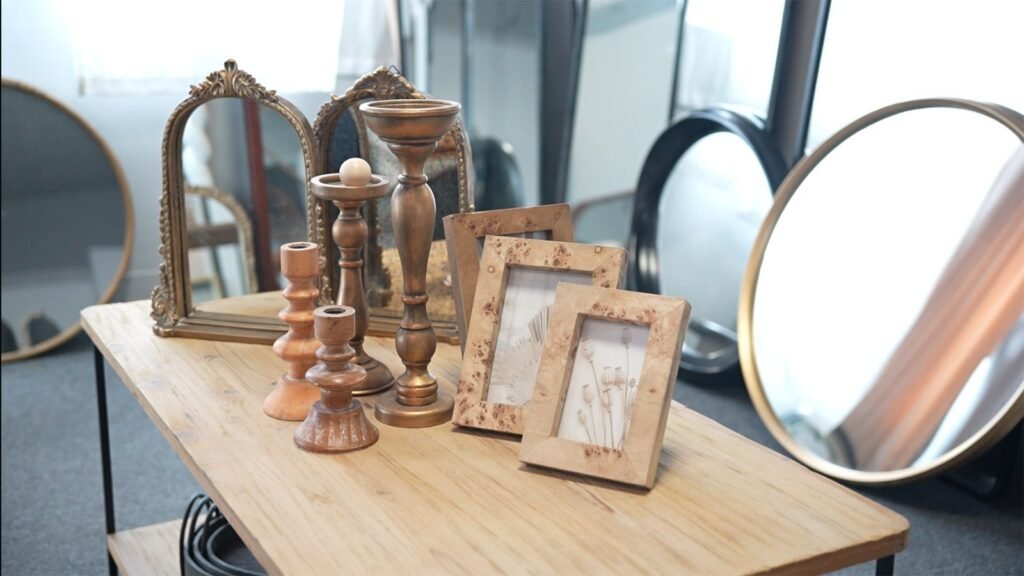
A curved mirror may be visually relevant, but buyers still need to understand its scale, frame construction, hanging system, finish consistency and packaging risk.
A softly rounded ottoman may fit the current interest in tactile, welcoming interiors. It must also have the correct seat height, stable construction, commercially sensible fabric and a packing volume that does not quietly consume the margin.
The German Channel therefore looks at design from several connected perspectives:
Market relevance
Does the idea fit the customer, price level and sales channel?
Product value
Can the customer see and understand why the product is worth its retail price?
Production feasibility
Can the design be made consistently rather than only once for an excellent sample?
Assortment logic
Does the product strengthen a collection, or is it merely another attractive object looking for employment?
Commercial potential
Can the buyer sell, reorder and develop the product with reasonable confidence?
Design remains important.
It simply has to attend the same meeting as logistics and margin.
From Global Inspiration to German Buying Logic
European design fairs provide an enormous amount of inspiration.
The difficulty is not finding ideas. The difficulty is deciding which ideas deserve attention.
A fair may present sculptural furniture, immersive colour, experimental materials and revived historical forms. All may be culturally important. Not all are equally useful for a German volume retailer, independent home store or direct-import programme.
The German Channel asks what happens after the exhibition.
Can a sculptural shape be translated into an accessible mirror?
Can a craft-led ceramic finish be controlled across production?
Can an expressive fabric direction become an ottoman family rather than one heroic sample?
Can a distinctive product be simplified without removing the detail that made it distinctive?
These questions are less glamorous than a trend forecast.
They are also the questions that decide whether the trend reaches the shop floor.
The Role of Value Translation
One of Teruier’s core capabilities is value translation.
Value translation connects factory language, design language and buyer language.
A supplier may describe a mirror as:
Metal frame, antique finish and 4 mm glass.
Technically correct. Commercially rather quiet.
The buyer needs to understand:
- What makes the frame visually distinctive?
- Which interior style does it support?
- Does the finish justify a higher retail position?
- Can the colour be repeated consistently?
- Is the weight practical for wall installation?
- Can the packaging protect the decorative edge?
The same applies to an ottoman described as “plywood, foam and polyester velvet”.
The important questions are not only what it contains, but what those choices achieve.
Does the fabric improve perceived value? Does the shape suit compact European living spaces? Can the product work beside a sofa, beneath a console or within a bedroom collection?
Value translation turns technical details into commercial meaning.
Without it, a specification sheet is simply a list of materials behaving professionally.
Ordinary Trend Content Versus the German Channel
| Consideration | Ordinary Trend Content | Teruier German Channel |
|---|---|---|
| Main focus | What looks new | What may be commercially useful |
| Typical evidence | Styled images and broad observations | Market signals, category logic and product implications |
| Product discussion | Colour, shape and style | Design, function, construction, price and sourcing |
| Target reader | General design audience | Buyers, retailers, importers and designers |
| Main question | “Is this fashionable?” | “Does this deserve development or an order?” |
| Commercial outcome | Inspiration | Better product judgement |
Both forms of content have value.
Inspiration starts the conversation.
Commercial interpretation prevents the conversation from ending with unsold stock.
Why the German Market Needs a Dedicated Perspective
The German market rewards products that balance visual interest with understandable value.
Customers may accept playful colour, unusual shapes and handcrafted surfaces. They still expect the product to work properly, resemble its description and justify its price.
This creates a particular challenge for buyers.
Products cannot be so safe that the assortment becomes invisible. They cannot be so experimental that ordinary use feels like a design test.
The German Channel focuses on this middle ground:
- Distinctive but understandable
- Decorative but functional
- Trend-aware but not trend-dependent
- Well made without unnecessary cost
- Commercial without becoming anonymous
The objective is not to make every product restrained and beige.
Germany already has enough grey weather. The furniture does not need to assist.
The objective is to identify where design adds genuine customer value.
What Makes the Channel Different?
The German Channel combines several types of knowledge that are often separated.
Trend interpretation
It examines colours, forms, materials and ideas emerging from European fairs, design media and retail markets.
Category knowledge
It explains how mirrors, ottomans, ceramics, lighting and other product groups should be defined, compared and evaluated.
Buyer decision support
It considers assortment role, target customer, pricing, sampling and reorder potential.
Manufacturing understanding
It connects design choices with materials, production processes, quality control and packaging.
Commercial judgement
It looks at whether the final product can support a credible retail proposition.
The result is not a list of products Teruier would like to sell.
It is a clearer way to think about the products buyers may wish to buy.
A Mirror Is Never Just a Mirror
Consider two decorative mirrors of similar size.
One uses a familiar thin metal frame in a standard gold finish. The other introduces a softly irregular edge, a more considered profile and a finish with stronger visual depth.
The second mirror may support a higher retail price.
Or it may simply be heavier, more difficult to pack and more expensive.
The German Channel examines the difference.
Is the irregular form visible enough to matter? Does the finish remain consistent? Does the design suit current interiors? Can the added cost be recognised by the customer?
The same logic applies to ottomans.
A fashionable bouclé fabric does not rescue poor proportions. A storage function is useful only when the internal space is practical. A sculptural base is commercially interesting only when it remains stable.
Products should not be praised merely for containing several trend keywords.
Keywords are surprisingly poor at supporting body weight.
Frequently Asked Questions
Is the German Channel written only for German companies?
No. It is useful for European buyers, retailers, importers and designers whose customers share similar expectations regarding design, function, quality and price.
Is the channel a product catalogue?
No. Products may be used as examples, but the channel primarily provides category knowledge, trend interpretation and buying insight.
Does it cover current European design fairs?
Yes. Relevant observations from European furniture, lifestyle and interior events may be used to explain changing design and market directions.
Will the channel discuss prices and margins?
It discusses the factors that influence retail value, landed cost and margin potential. Exact quotations depend on specifications, quantities and delivery conditions.
Does Teruier only discuss products it manufactures?
No. Broader market developments may be discussed when they help buyers understand a category, customer need or design direction.
How is the German Channel different from a trend forecast?
A forecast identifies what may become important. The German Channel also examines how that direction might affect product development, sourcing and assortment decisions.
Does the channel include practical product comparisons?
Yes. Comparisons may cover materials, constructions, functions, finishes, price positions and category roles.
Are craftsmanship and commercial production compatible?
Yes, when handcrafted character is translated into controlled specifications and realistic quality tolerances. “Every piece is completely different” is charming in an art studio and somewhat less charming in a 2,000-piece order.
Better Products Begin with Better Interpretation
The European fair circuit is making one point increasingly clear: customers want products with meaning, material character and a stronger connection to real life.
For German buyers, meaning alone is not enough.
The product must also fit the customer, the assortment, the price structure and the supply chain.
The Teruier German Channel exists to connect these requirements.
It translates international design signals into category understanding, product questions and commercially relevant judgement.
Because buyers do not need more inspiration without context.
They need to know what the inspiration is worth.