The Mirror Looks Perfect. Then the Hotel Tries to Install 180 of Them.
One decorative mirror can be beautiful.
One hundred and eighty decorative mirrors must also be identical, installable, properly packed and available when the hotel discovers that Room 604 requires a replacement.
This is the reality of UAE hospitality fit-out mirror supply.
From my perspective as a Middle Eastern home décor buyer, mirrors for hotels, restaurants, serviced apartments and premium residences cannot be purchased like isolated decorative accessories. They belong to a larger fit-out programme involving drawings, finish approvals, contractors, room schedules and opening dates.
The supplier is not merely selling reflection.
The supplier is helping the project avoid delay.
What Is UAE Hospitality Fit-Out Mirror Supply?
UAE hospitality fit-out mirror supply is the sourcing, customisation, production and delivery of mirrors for UAE hotels, resorts, restaurants, serviced residences and other commercial interior projects.
A project-ready mirror supplier should be able to provide:
- Confirmed dimensions and tolerances
- Frame and finish specifications
- Mirror-glass and safety options
- Mounting details
- Moisture-appropriate construction where required
- Mock-up or approval samples
- Protective project packaging
- Phased delivery support
- Replacement-unit continuity
A retail mirror may need to attract a shopper.
A hospitality mirror must satisfy the designer, buyer, contractor, installer, operator and sometimes the person checking the room at 11:30 the night before opening.
UAE Buyers Do Not Begin with Price Alone
Many enquiries arrive through UAE email RFQ and catalog downloads. The buyer selects a few designs, sends product codes and asks for a quotation.
A weak supplier replies with a unit price.
A useful supplier first asks where the mirror will be used.
Is it for a guest-room dressing area, bathroom vanity, restaurant entrance, lift lobby or private Majlis? Will it be installed on stone, tile, joinery or gypsum board? Is the frame finish brushed, plated, painted or powder-coated? Does the project require a custom size?
These questions reflect real UAE buyer expectations from suppliers.
Buyers expect the supplier to identify risks before production, not explain them after installation.
The RFQ Should Separate Decoration from Specification
A good mirror RFQ should include more than a reference image.
| RFQ Information | Why It Matters |
|---|---|
| Installation area | Determines moisture, traffic and safety needs |
| Required dimensions | Prevents conflicts with joinery and wall finishes |
| Frame material | Affects weight, appearance and durability |
| Finish reference | Supports sample and batch approval |
| Mirror specification | Clarifies thickness, backing and edge treatment |
| Mounting method | Helps contractors prepare the wall correctly |
| Project quantity | Supports cost and production planning |
| Delivery schedule | Coordinates room-by-room installation |
| Replacement requirement | Protects future maintenance continuity |
A picture may show the design intention.
It does not tell the installer where the fixing points are.
Gulf Luxury Requires Control, Not Just Decoration
Hospitality design in the Gulf often balances visual richness with calm architectural surfaces.
A mirror may sit above cool flooring in marble, porcelain or terrazzo. It may reflect a wall in deep jewel tones, a softly lit corridor or a contemporary Mashrabiya screen.
The result should feel generous without becoming visually noisy.
This is particularly important in Majlis-inspired lounges and premium suites. Hospitality is central to the atmosphere, but privacy must still be respected. Mirrors should increase light and spatial depth without creating unwanted views into family areas, private corridors or adjoining rooms.
The placement matters as much as the frame.
A luxurious mirror facing the wrong direction is still facing the wrong direction.
Beating the Summer Heat Also Affects Mirror Decisions
A mirror does not cool a room, but it influences how the room handles light.
In the Gulf, strong sunlight can create glare, expose surface imperfections and make reflective interiors feel harsher than intended. Designers may therefore use mirrors to redirect softer interior light rather than simply placing them opposite the brightest window.
Suppliers should understand how different finishes behave under these conditions.
Highly polished gold may appear warmer and brighter under strong illumination. Matte black can provide architectural contrast but may expose dust. Brushed champagne finishes often sit more quietly beside stone, timber and cool flooring.
For bathroom and humid-area use, the construction behind the visible frame also matters. Moisture resistance, backing, edge protection and appropriate adhesives should be discussed before the order is confirmed.
The front earns approval.
The back prevents trouble.
Majlis Design Needs Hospitality and Family Privacy
The Majlis is designed to welcome, but not to expose the entire home.
This is why mirrors in Gulf residential and hospitality spaces should support visual openness without weakening privacy. A mirror can brighten a guest lounge, strengthen symmetry or create a focal point above a console. It can also accidentally reflect a private passage or family entrance.
Contemporary Mashrabiya-inspired screens offer a useful design principle: filtering rather than completely closing.
The same principle can guide mirror placement. Use reflection to expand the intended guest experience while keeping private circulation visually protected.
For Ramadan-ready interiors, mirrors can also help reception and dining areas feel lighter during evening gatherings. Yet the room still needs practical circulation, additional seating and surfaces for serving.
The mirror is one part of hospitality, not the entire performance.
Fit-Out Buyers Purchase a Room, Not a Lonely Product
Mirror suppliers often focus only on their own category. Buyers do not have this luxury.
A hospitality buyer is evaluating the full room.
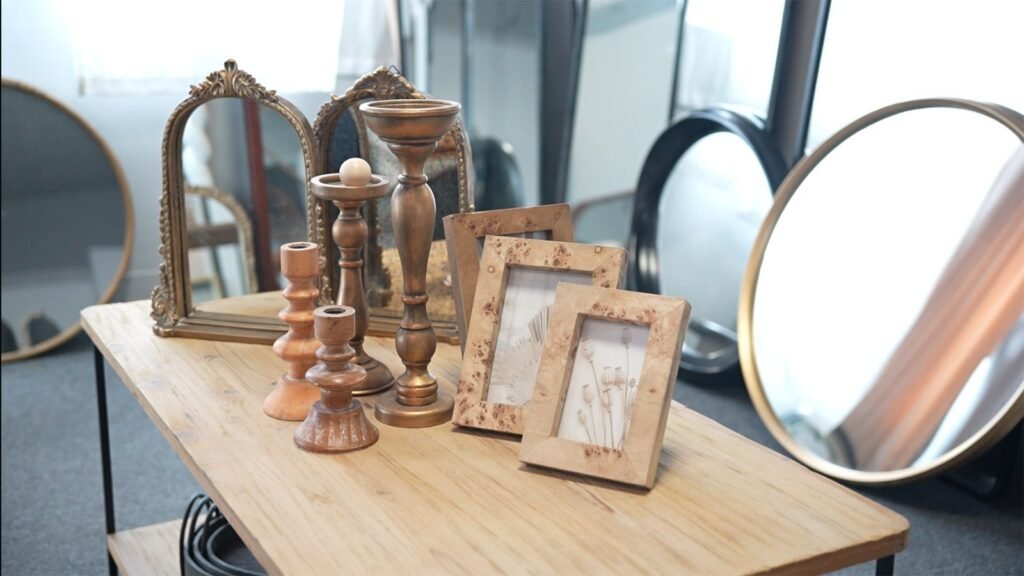
A cocktail ottoman may provide flexible seating in a lounge. A fluted velvet ottoman may introduce tactile depth beside a simpler framed mirror. In a restaurant or Ramadan display, a fish motif ceramic platter can bring a Mediterranean or coastal reference to the table.
A sculptural pear ceramic vase may soften a geometric console arrangement, while a playful tomato vase can work in a more expressive restaurant, boutique hotel or food-led hospitality concept.
These products do not need to match perfectly.
They need to belong to the same commercial story.
For suppliers, this means presenting mirrors with relevant supporting décor can help buyers understand scale, colour and assortment potential. But the styling should not hide the specification. A vase placed in front of the frame is not a technical drawing.
What Recent Dubai Design Events Are Signalling
Dubai Design Week 2025 and Downtown Design 2025 placed visible emphasis on regional design talent, cross-cultural collaboration, material experimentation and the meeting point between design, engineering and technology.
Installations explored alternative materials, biodegradable production, passive cooling ideas and digitally enabled design. Other presentations examined how advanced material processes can create new tactile and visual experiences.
For mirror and décor suppliers, the commercial lesson is clear:
- Regional relevance matters
- Materials should carry a believable story
- Technology should improve the product or process
- Sustainability claims need practical substance
- Contemporary luxury is becoming more thoughtful and less automatic
A gold frame can still sell very well.
It simply needs more justification than “the Middle East likes gold”.
A Resource Centre Should Help Designers Make Decisions
A useful designer resource center for interior designers should do more than display inspirational photography.
For hospitality mirror projects, it should provide downloadable resources such as:
- Dimensioned product drawings
- Frame cross-sections
- Finish swatches
- Installation instructions
- Bathroom-suitability notes
- High-resolution product images
- CAD or specification files where available
- Packaging information
- Sample-request forms
- RFQ templates
This reduces repetitive email exchanges and allows designers to introduce suitable products into a project earlier.
The easier a product is to specify, the less likely it is to be replaced by something easier.
How Buyers Compare Mirror Suppliers
| Basic Mirror Supplier | Project-Ready Mirror Supplier |
|---|---|
| Sends a catalogue | Sends relevant products and specifications |
| Quotes the visible design | Reviews use, size, finish and installation |
| Confirms that customisation is possible | Explains customisation limits and tolerances |
| Packs all mirrors in the normal way | Plans protection for project handling |
| Completes the bulk order | Maintains records for future replacements |
| Answers after problems appear | Identifies likely problems before approval |
The difference is not presentation language.
It is the amount of uncertainty removed from the project.
Frequently Asked Questions
What information should a UAE hospitality mirror RFQ include?
Include the project type, installation area, dimensions, quantity, frame material, finish reference, mirror specification, mounting requirement, delivery schedule and replacement expectations.
Can standard retail mirrors be used in hotel projects?
Sometimes, but they still require a technical review. The buyer must confirm dimensions, installation method, finish consistency, safety requirements and future replacement availability.
Why is a mock-up mirror important?
A mock-up allows the designer and contractor to assess proportion, reflection, finish, fixing method and compatibility with surrounding materials before bulk production.
What should suppliers confirm for bathroom mirrors?
Suppliers should clarify mirror backing, edge protection, frame construction, mounting components and suitability for humid environments.
How can mirrors support family privacy in Gulf interiors?
Mirrors should be positioned to improve light and space without reflecting private passages, family entrances or screened areas. Layout review is therefore important in Majlis and residential hospitality spaces.
What makes an interior Ramadan-ready?
Ramadan-ready interiors support generous hosting, flexible seating, easy serving, comfortable evening lighting, practical storage and clear circulation for larger gatherings.
Why is replacement continuity important?
Hotels may need replacement mirrors after installation or years later. Retaining drawings, finish references and production specifications makes future replacement more reliable.
The Best Supplier Protects the Opening Date
The real purpose of UAE hospitality fit-out mirror supply is not to deliver a large number of attractive mirrors.
It is to deliver the approved mirror, in the approved finish, to the correct rooms, with an installation method the contractor understands—and to reproduce it when the operator needs another one.
At Teruier, mirrors can be considered alongside specifications, finish direction, supporting décor and project communication. This helps buyers move from catalogue selection to a more controlled sourcing decision.
Because the hotel guest may see only a mirror.
The buyer sees everything that could go wrong behind it.