
A Beautiful Sample Is Not Enough: What UAE Buyers Expect from Suppliers
A UAE buyer may admire your product and still decide not to order it.
This is not contradiction. It is procurement.
From my perspective as a Middle Eastern interior designer, the most important UAE buyer expectations from suppliers are not limited to attractive design and competitive pricing. Buyers also want to know whether the finish can be repeated, whether the materials suit Gulf homes and whether the product will still make sense after the photography lights are switched off.
A beautiful sample opens the conversation. Reliable product answers keep it alive.
What Do UAE Buyers Expect from Home Décor Suppliers?
UAE buyer expectations from suppliers can be defined as the commercial, technical and design standards used by UAE retailers, designers and project buyers to judge whether a supplier can deliver products suitable for the local market.
These expectations normally include:
- Consistent quality across repeat orders
- Clear specifications and material descriptions
- Realistic sampling and production schedules
- Packaging appropriate for fragile or bulky décor
- Responsive communication
- Products adapted to Gulf lifestyles, climate and interiors
Research into buyer–supplier relationships has found that trust is strongly connected to traditional supplier performance measures such as product quality and delivery reliability.
In other words, trust does not begin with a long company presentation. It begins when the bulk order looks like the approved sample and arrives when promised.
The UAE Buyer Is Designing for a Lifestyle, Not a Mood Board
Gulf homes must often perform several jobs at once.
They welcome guests generously, protect family privacy, remain comfortable through severe summer heat and still communicate a sense of occasion. This is why imported home décor cannot be selected only according to what looks fashionable in a European apartment.
A UAE-ready collection should work with:
- Formal and family Majlis spaces
- Cool flooring such as stone, porcelain and terrazzo
- Strong natural light and air-conditioned interiors
- Decorative zoning between guest and family areas
- Rich accents, including controlled jewel tones
- Flexible, Ramadan-ready interiors
Luxury here is not simply adding more gold.
Luxury is a room that receives guests beautifully, hides everyday clutter quickly and allows the private parts of the home to remain private.
Mashrabiya Is a Design Lesson, Not Merely a Pattern
The Mashrabiya offers an important lesson for suppliers trying to understand the Gulf market.
Traditionally, its lattice structure helped control sunlight, encourage ventilation and maintain visual privacy. Contemporary designers continue to reinterpret this principle through screens, façades, cabinet fronts and decorative wall elements.
The lesson is not that every product needs an Islamic geometric pattern.
The lesson is that successful Gulf design often combines beauty with climate response and social function.
A room divider should create privacy without making the interior feel closed. A mirror should improve light without reflecting directly into a family area. An ottoman should support additional guests without permanently blocking circulation.
Good regional design solves something. It does not merely decorate it.
Ceramic Buyers Need to See the Finish Range, Not One Perfect Vase
Ceramics are especially suitable for Gulf interiors because they bring texture, sculptural form and colour into spaces dominated by stone, glass and polished surfaces.
But ceramic buyers need accurate finish information.
For tonal ceramic finishes, the supplier should show the acceptable range across several pieces. A warm sand glaze may contain cream, beige and soft brown movement. This can be beautiful—but only when the variation looks intentional.
The same principle applies to ceramic glaze finishes such as:
- Matte or dry-touch surfaces
- Reactive glazes
- Speckled finishes
- Crackle effects
- Semi-gloss tonal glazes
- Hand-applied colour transitions
A catalogue should explain which differences are part of the design and which would be considered defects.
Otherwise, the supplier calls it “natural variation” while the buyer calls it “three different collections in one carton”.
Matte Ceramic Décor Works Well—Until It Becomes Impossible to Clean
Matte ceramic decor has strong relevance in contemporary Gulf interiors.
Its low-reflection surface sits comfortably beside cool flooring, limestone effects, pale woods and brushed metals. It can also soften rooms containing many polished finishes.
However, UAE buyers may ask practical questions:
- Does the surface attract fingerprints?
- Can marks be wiped away easily?
- Is the finish sealed?
- Will the colour become patchy after cleaning?
- Can the same matte level be repeated in a reorder?
A matte finish should feel calm and sophisticated, not unfinished.
Suppliers should therefore provide cleaning guidance, finish samples and close-up photographs under more than one lighting condition.
Cabbageware Ceramics Need Editing for the Gulf Market
Cabbageware ceramics can bring freshness and a playful botanical character to a dining or decorative collection. Their layered leaves and sculptural surfaces also perform well in product photography.
For Gulf buyers, however, the opportunity lies in careful editing.
Rather than offering only traditional bright green, suppliers can explore:
- Soft olive and sage
- Sand and ivory
- Deep emerald as a jewel-tone accent
- Matte white with raised leaf detail
- Date-brown or burgundy seasonal editions
These colours allow cabbageware to work in contemporary villas, Ramadan table settings and hospitality displays without becoming excessively themed.
One cabbage bowl can be charming. An entire room behaving like a vegetable garden may be a more specialised commercial decision.
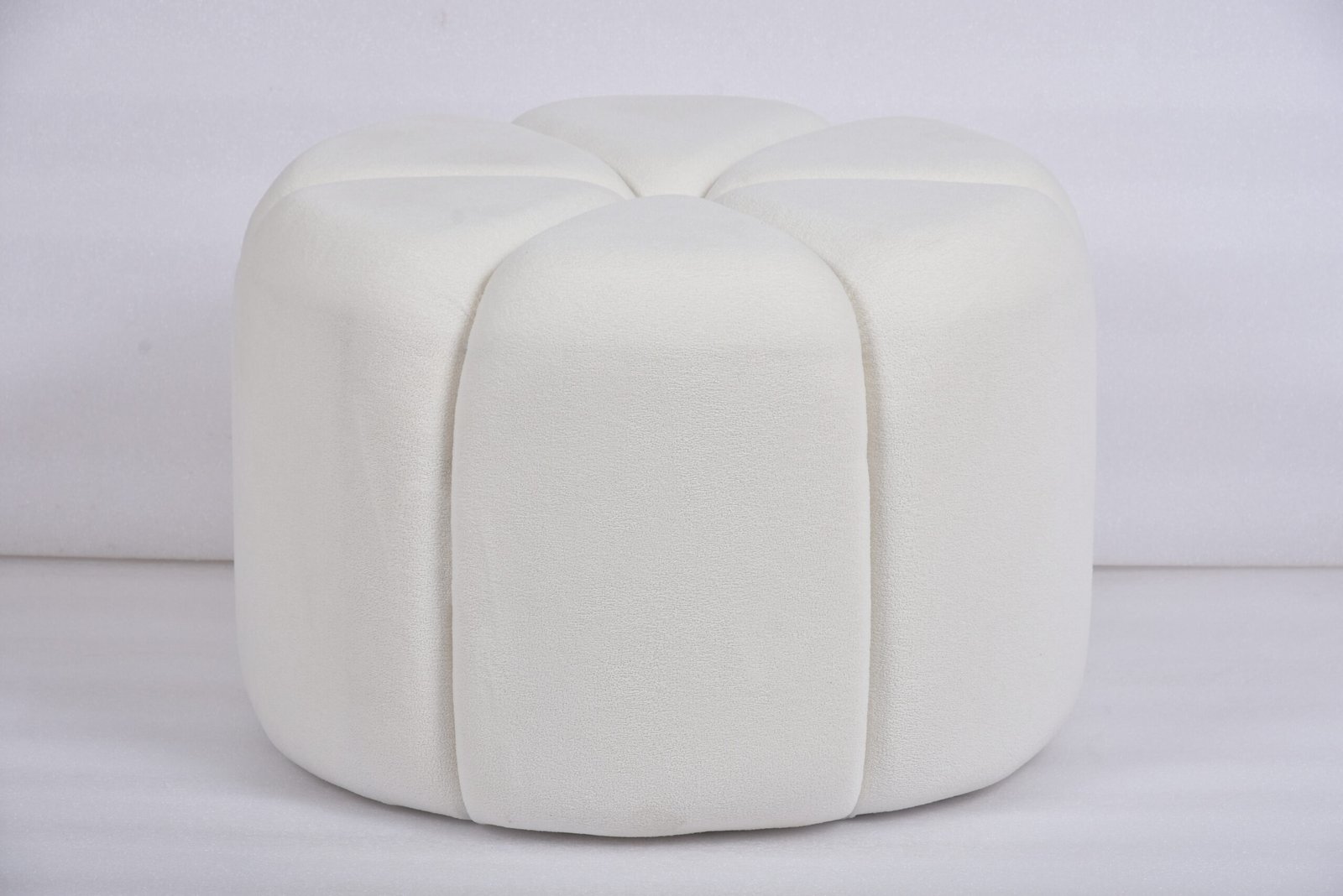
Ottoman Materials Must Survive Real Hospitality
An ottoman in a Gulf home is rarely only a decorative object.
It may become additional seating in the Majlis, a footrest, a serving surface with a tray or a temporary place for handbags when guests arrive.
This means ottoman upholstery materials must be evaluated beyond appearance.
Buyers may need information about:
- Fabric composition
- Abrasion resistance
- Pilling performance
- Colourfastness
- Cleaning method
- Foam density and recovery
- Seam strength
- Fabric direction and shade consistency
A textured upholstery ottoman can add welcome softness to stone-heavy interiors, but deep loops and loose fibres may be difficult to maintain in high-use family or hospitality settings.
Texture should create depth, not collect the full history of every guest who has visited the room.
Why the Round Storage Ottoman Makes Sense in Gulf Homes
A round storage ottoman is particularly useful for flexible Majlis and family spaces.
Its curved form supports circulation, while internal storage can hold cushions, throws, prayer garments, children’s items or seasonal entertaining accessories.
Before approving the product, a UAE buyer may ask:
- Is the lid easy and safe to lift?
- Does it close softly?
- How much weight can the seat support?
- Is the internal lining cleanly finished?
- Can the product be moved without damaging cool flooring?
- Will the round shape remain symmetrical after upholstery?
For Ramadan-ready interiors, this type of furniture offers a practical advantage. The room can move quickly from everyday family use to evening hospitality without introducing another large cabinet.
That is the sort of product logic buyers remember.
What Recent Middle Eastern Design Fairs Are Showing
Recent Dubai design events have placed greater attention on regional creative identity, material experimentation, handcrafted objects and the relationship between design, culture and technology.
For suppliers, the message is useful.
The Gulf market is not asking manufacturers to choose between traditional and contemporary design. It increasingly rewards products that translate regional references into modern, usable forms.
This may include:
- Contemporary Mashrabiya-inspired details
- Tonal ceramics influenced by desert landscapes
- Jewel tones used as controlled accents
- Tactile upholstery beside cool architectural surfaces
- Products with visible craft value and dependable production
- Material stories supported by real technical information
The future of Gulf interiors is not “more decoration”. It is more meaningful decoration.
A UAE-Ready Supplier Checklist
A supplier is more useful to UAE buyers when it can provide the following information before the order becomes urgent:
| Buyer Question | Supplier Answer |
|---|---|
| Will the bulk finish match the sample? | Approved tolerance and batch-control process |
| Can the collection be reordered? | Finish, fabric and mould continuity |
| Is the product suitable for regular use? | Material and performance specifications |
| Will it work in a Majlis? | Dimensions, weight capacity and use guidance |
| Can it withstand frequent cleaning? | Care instructions and surface information |
| Is it suitable for project supply? | Customisation, lead time and documentation |
| Can it arrive safely? | Packing method and transit-test information |
The best supplier does not wait for the buyer to discover every possible problem.
It answers the important questions while the collection is still being evaluated.
Frequently Asked Questions
What do UAE buyers value most in a home décor supplier?
UAE buyers generally value dependable quality, fast and organised communication, realistic lead times, suitable packaging and clear product specifications. Design is important, but repeatability determines whether a product can become a long-term programme.
Are jewel tones still suitable for Gulf interiors?
Yes. Emerald, sapphire, burgundy and deep teal can work well in Majlis and hospitality settings. They are usually most effective as controlled accents balanced with neutral walls, cool flooring and quieter furniture.
Why are ceramic glaze samples important?
Ceramic glazes may vary according to firing, application and material conditions. Showing several approved pieces helps buyers understand the intended tonal range before placing a bulk order.
Which ottoman upholstery materials work best for frequent use?
The choice depends on the project, but tightly woven performance fabrics, suitable velvets and easy-clean textured textiles are often more practical than highly delicate or loosely constructed materials.
How can furniture support family privacy?
Flexible furniture can help define guest and family zones without permanent construction. Screens, console placement, movable seating and storage ottomans can support hospitality while keeping private areas visually controlled.
What makes a collection Ramadan-ready?
Ramadan-ready interiors support larger gatherings, flexible seating, serving surfaces, organised storage and fast room resets. Products should make hospitality easier rather than simply adding seasonal motifs.
The Supplier Who Understands the Room Wins the Order
Ultimately, UAE buyer expectations from suppliers are based on one question:
Does this supplier understand how the product will actually be used?
The buyer is not purchasing a ceramic vase in isolation. They are placing it against cool flooring, under strong light and beside other finishes. They are not purchasing an ottoman only for photography. They are placing it in a Majlis where family, guests, children and hospitality rituals all meet.
At Teruier, product development connects visual direction with material choices, finish control and commercial practicality. This helps buyers evaluate ceramic décor and occasional furniture as parts of a complete Gulf interior—not simply as attractive objects in a catalogue.
Because in the UAE, style attracts the eye.
Understanding earns the order.



