
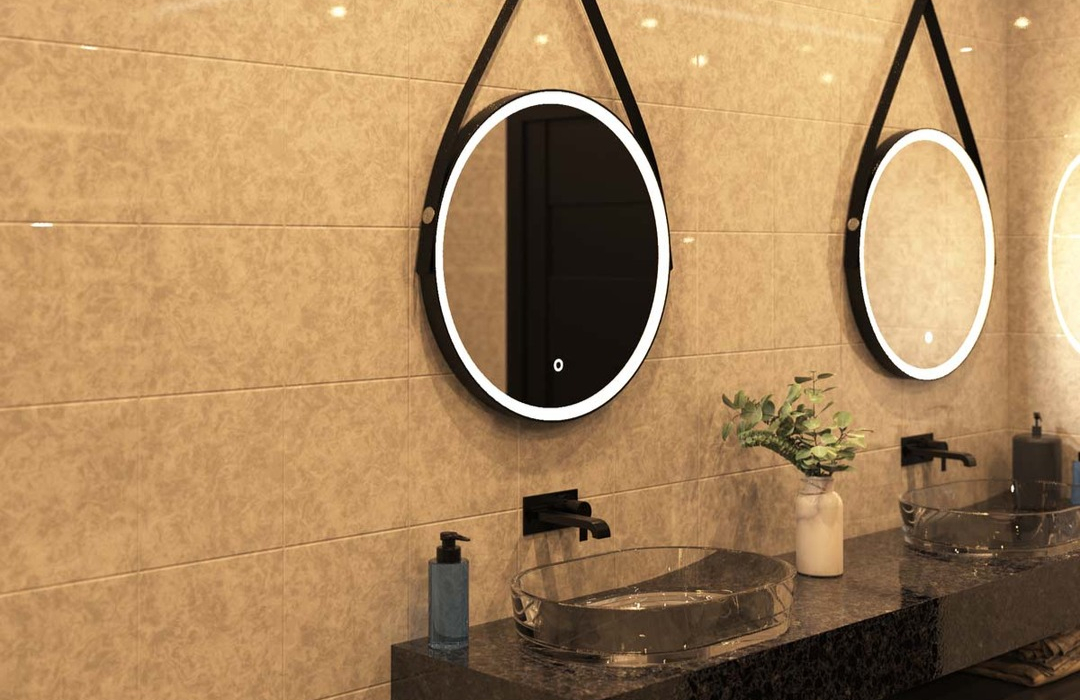
Let us begin with an uncomfortable truth:
A surprisingly large number of illuminated mirrors are sold like decoration first and electrical products second.
That is backwards.
Because the moment a mirror enters the bathroom, it is no longer just a nice reflective object with flattering light. It becomes part of a wet-zone, safety-sensitive, specification-heavy buying decision. In other words, the mirror may look beautiful on the moodboard, but if the LED mirror IP rating is wrong, the product is not “premium.” It is just expensive trouble.
And German buyers, thankfully, are usually too practical for that nonsense.
So this article is not just about an LED bathroom mirror. It is about a better buying system.
What this product program actually is
Teruier’s LED mirror offer should be understood as a bathroom-ready mirror program, not merely a trendy lighted mirror collection.
The real product is the combination of:
- the correct IP rating logic
- clean electrical integration
- useful lighting performance
- sensible anti-fog bathroom mirror specs
- buyer-friendly size planning
- channel fit for retail, project, and bathroom specialists
- clear production and OEM communication
That is the offer.
The mirror shape is only the visible part.
First: what an IP rating is, and why buyers should care
The International Electrotechnical Commission explains that the IP code under IEC 60529 is the system used to rate an enclosure’s resistance to the intrusion of solids and liquids. For LED mirrors, that second digit, the water-protection part, is the one buyers must not ignore.
VDE’s consumer guidance for bathrooms is very clear:
inside wet area rules, Area 0 requires IPX7; Area 1 lighting must have IPX4 and use safety extra-low voltage; Area 2 also allows lights with IPX4. VDE also notes that a 30 mA RCD is part of the special regulations for bathroom electrical installations.
That means one very important thing for buyers:
“Bathroom LED mirror” is not a real specification.
It is a marketing phrase.
IP rating is the real specification.
If a supplier tells you “suitable for bathroom” but cannot clearly state the rating, zone logic, voltage arrangement, and supporting test path, that is not reassuring. It is evasive with backlighting.
What smart buyers should ask beyond IP44
TÜV Rheinland makes the point even more sharply. In its expert discussion on smart bathrooms, it says DIN EN 60529 / ISO 20653 protection ratings such as IP44 play a key role in bathroom product testing, and that testing can also extend to high-voltage checks, EMC, wireless functions, and other digital-installation requirements.
This is where weaker suppliers usually reveal themselves.
They want to talk about:
- touch buttons
- Bluetooth
- fancy light effects
- perhaps a song and a dance
But serious buyers should also ask:
- What is the certified or declared LED mirror IP rating?
- Where is the driver located?
- What voltage architecture is used in the relevant bathroom zone?
- Is the demister pad on an independent switch?
- What EMC or electrical safety documentation exists for export markets?
- What happens to heat management in continuous use?
Because a mirror with twenty functions and vague compliance is not a better product.
It is simply a more complicated return.
Why this category is especially interesting now
The European design signal is moving in a useful direction. At Ambiente Trends 26+, Messe Frankfurt framed 2026 around “brave, light and solid,” with the “brave” direction explicitly describing unexpected collaborations where craftsmanship meets technology. Maison&Objet’s January 2026 theme, Past Reveals Future, responded to overconsumption and homogenisation with objects that feel more lived-in, meaningful, and rooted in craft and memory. Its In Materia curation also put wood, glass, fiber, earth and stone back at the center of material storytelling.
For buyers, that means the winning LED bathroom mirror is no longer just a cold tech object.
It should feel like technology with interior intelligence:
- softer shapes
- more credible materials
- calmer light
- better usability
- less gadget panic
This is exactly why the arched LED mirror format is doing real commercial work now. It carries the softness buyers want from current interiors, while still feeling architectural enough for bathrooms, powder rooms, hospitality vanity spaces, and premium apartment projects.
What a better Teruier program should include
A serious Teruier LED mirror OEM program should not begin with thirty random shapes. It should begin with a disciplined format ladder.
For example:
A bathroom LED mirror core program might start with:
- 600 x 800 mm
- 700 x 1000 mm
- 800 x 1200 mm
- 900 x 1800 mm for full-length or dressing applications
Then it should divide into clear commercial families:
1. Arched family
The arched LED mirror for premium-but-friendly bathroom retail, boutique hospitality, and apartment renovations.
2. Rectangular utility family
The volume seller for chain bathroom retail and mainstream home improvement channels.
3. Feature-driven family
Products with demister, dimming, tunable white, memory, or sensor upgrades for project and higher-ticket environments.
This is where buyers stop shopping “pretty mirror” and start buying category logic.
The specs that actually matter in daily use
A mirror is used with the face very close to it. This sounds obvious, but suppliers forget it constantly.
Berkeley’s Lighting 101 notes that color temperature affects how surfaces appear, that people tend to look best under lower color temperatures around 2700–3000K, and that CRI indicates how close a light source is to daylight, with 80+ considered good.
So for buyers, a sensible LED mirror discussion should include:
- CRI target
- color temperature range
- front light versus backlight behavior
- glare control
- anti-fog coverage area
- switch logic
- mirror thickness and edge treatment
- aluminum or metal frame finish
- installation method
- replacement and maintenance logic
A mirror that gives dramatic backglow but poor face lighting is excellent for Instagram and mildly insulting for shaving.
The old problem this solves
Buyers have suffered through the same old LED mirror pain for years:
- decent-looking samples, weak specs
- IP claims, no zone explanation
- anti-fog pad included, but badly positioned
- too many features, not enough test clarity
- styles that work online but not in store
- “Germany-ready” claims with no real understanding of German buyer caution
That last point matters.
The LED mirror Germany conversation is not won by enthusiasm. It is won by order, documentation, and specification discipline.
Which is honestly refreshing.
One illustrative Teruier selection-agent case
To keep this practical, here is an illustrative Teruier buyer-case scenario.
A German home retail buyer wanted to test illuminated mirrors without turning the category into a quality-control circus. The initial pool had 11 concepts across decorative and functional bathroom styles.
Teruier’s selection workflow reduced this to 4 sample candidates, then to 2 launch-ready heroes:
- one arched LED mirror for premium visual merchandising
- one rectangular LED bathroom mirror with anti-fog for volume potential
The screening criteria were not just style. They were:
- bathroom zone suitability
- IP declaration clarity
- demister usefulness
- light quality for daily grooming
- installation simplicity
- channel fit for chain-store display
Result of the sprint:
- 11 concepts → 4 samples → 2 launch SKUs
- feature discussion reduced from “everything included” to “what the channel will actually pay for”
- anti-fog moved from gimmick to spec conversation
- driver and switch placement were reviewed earlier, not after sample disappointment
- the buyer got a cleaner internal approval story: safer spec, better assortment logic, less decorative chaos
This is how a good supplier helps.
Not by making the mirror louder.
By making the buying decision easier.
Final judgment
If you are searching LED mirror IP rating, you are not really searching for lighting trivia.
You are searching for a supplier that understands this category is both electrical product and interior product at the same time.
That is where Teruier should win.
Not with “smart” mirror gimmicks first.
Not with ten pages of visual fluff.
But with a bathroom-ready system buyers can actually evaluate:
- proper IP logic
- credible OEM communication
- clear anti-fog specs
- good lighting performance
- channel-specific sizing
- sensible feature hierarchy
- documentation that does not arrive emotionally, but on time
Because the best LED mirror today is not the one with the most functions.
It is the one a buyer can approve with confidence, a contractor can install without drama, and a customer can use every morning without ever needing to think about the words “protection class.”
That is what good product work looks like.



