
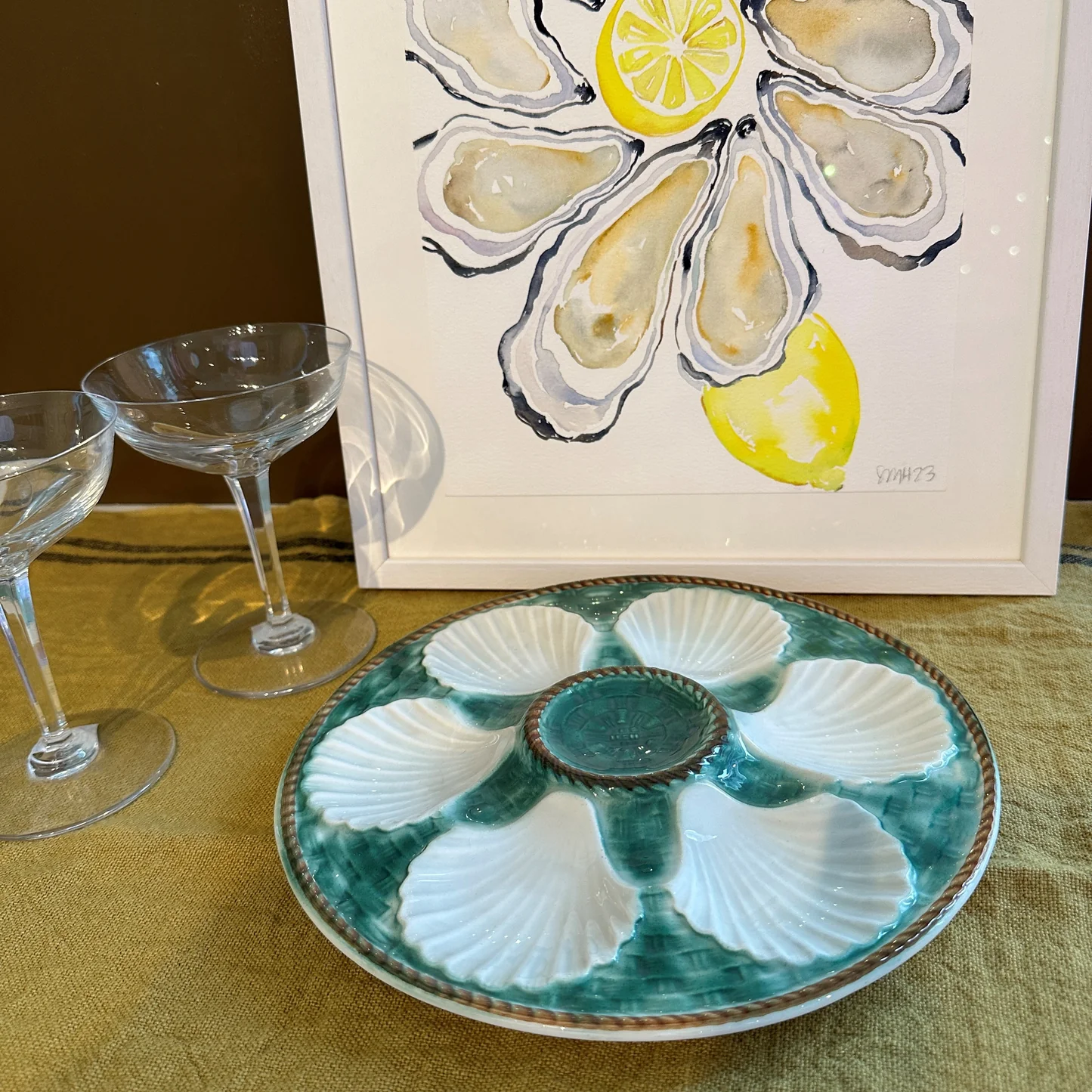
Let’s begin with a fact some buyers already know but do not always say out loud:
Most decorative tabletop is too polite to sell hard.
It is nice.
It is tasteful.
It is also forgettable.
That is exactly why oyster plate decor is interesting.
A good oyster plate does two things at once. It behaves like serveware, but it merchandises like décor. It gives a table personality, gives a shelf shape, and gives a buyer something far more useful than another generic ceramic round thing in “soft neutral.” It gives them a story.
And right now, story matters.
Why oyster plate decor makes sense now
The North American market is leaning toward more expressive, more sensory, more emotionally legible product. NY NOW’s Winter 2026 outlook highlighted bolder color, florals, and products that create emotional bonds through sensory engagement. Las Vegas Market Winter 2026 positioned itself as a major sourcing hub with 3,500+ product lines and reported strong new-buyer activity and strong order writing. That is exactly the kind of environment where a product like oyster plate décor works: memorable, tactile, giftable, and visually rich enough to stop the scroll or slow the aisle walk.
This is especially true when the piece carries a little majolica ceramic decor energy—gloss, relief, shape, and heritage flavor—but is edited for modern retail rather than buried in antique-shop cosplay.
In other words: nostalgic, yes. Dusty, no.
What this product actually is
A strong oyster plate decor program is not just a seafood-themed plate with too much confidence.
It is a hybrid product:
- decorative serveware
- collectible tabletop accent
- giftable entertaining piece
- coastal-but-not-cartoonish home accessory
- shelf styling object with strong shape language
That hybrid status is exactly why buyers like it.
In store, it can live in:
- tabletop and entertaining
- summer hosting
- coastal décor
- grandmillennial-adjacent collections
- holiday gifting
- curated decorative accents
Online, it can work in a very different way. It has strong photography value, reads instantly in thumbnails, and plays nicely with an Amazon assortment strategy where products need quick visual recognition and a reason to exist beyond “plate, but round.”
That is the trick: oyster plate décor is specific enough to feel intentional, but broad enough to sell across more than one merchandising lane.
What old versions got wrong
Let’s not romanticize the category. Old versions of this product often had very predictable problems:
- too literal
- too shiny in the wrong way
- weak compartment shape definition
- muddy glaze pooling
- gimmicky coastal styling
- poor pack-out for raised edges
- nice sample, unreliable reorder
That last one is the killer.
Because buyers do not lose money on charming prototypes.
They lose money on inconsistent production.
That is why this category lives or dies on details buyers should absolutely ask about:
- relief depth
- glaze tone control
- edge strength
- cavity symmetry
- underside finish
- carton logic
- reorder stability
The specs that actually matter
If I am looking at an oyster plate program, I want less marketing perfume and more usable information.
A serious supplier should be able to speak clearly about:
Material
Stoneware or ceramic body, food-safe finish where applicable, stable weight, and enough structural integrity that the rim and wells do not feel delicate for the sake of drama.
Relief and geometry
The shell wells need definition. If the sculpting is weak, the product loses its entire reason to exist.
Finish logic
This is where glaze consistency QC matters. Oyster plates often rely on layered whites, mineral greens, sea-glass blues, sandy neutrals, or antique-cream majolica effects. A little tonal variation can feel artisanal. Too much variation looks like three different factories were arguing.
Size architecture
A good program usually needs at least:
- one full serving/display size
- one smaller gifting or appetizer size
- possibly one flatter decorative version if the buyer wants broader décor placement
Transit logic
Raised edges, segmented wells, and glossy surfaces make this category fragile in very annoying ways. That is why ceramic packaging to reduce breakage is not optional here. Packaging is not just protection; it is part of whether the SKU deserves to exist at scale. Michigan State describes packaging as a full discipline, and academic work on e-commerce packaging continues to point to design, logistics, and overpackaging as real issues—not side chatter.
Why this beats the “safe” alternative
Because safe tabletop is crowded.
A flat white platter is easy.
A plain bowl is easy.
A vaguely modern accent tray is extremely easy.
None of those products give the buyer a reason to remember the line review.
Oyster plate decor does.
It wins because it can bridge:
- function and decoration
- heritage and novelty
- gift and self-purchase
- seasonal merchandising and year-round styling
That makes it a particularly useful hero piece in a broader ceramic story.
For example, a retailer can build around it with:
- one oyster plate hero SKU
- one fruit vase for playful contrast
- one harlequin vase or check-pattern object for pattern tension
- one neutral companion bowl or candleholder to calm the composition
That is not randomness. That is assortment design.
An illustrative Teruier selection-intelligence case
Here is the kind of buyer scenario this category was made for.
A U.S. chain home buyer wants a summer-to-early-holiday tabletop capsule that feels:
- giftable
- coastal without becoming souvenir-shop nonsense
- decorative enough to stand on its own
- specific enough to feel collectible
- scalable enough for both stores and online
The old sourcing approach would be:
“Find an oyster plate, make it glossy, hope the coastal crowd shows up.”
The smarter Teruier-style approach is:
- define whether the product is décor-first, serving-first, or gift-first
- choose one glaze direction that reads premium on camera and on shelf
- engineer cavity depth and rim thickness for both visual impact and durability
- build packaging around point-pressure risk
- decide whether the product leads a coastal story, a majolica story, or a broader entertaining story
- pair it with adjacent ceramics that help the buyer build a stronger basket
Illustrative outcome model:
A better assortment brief usually improves buyer confidence, speeds up sample decisions, and reduces weak-SKU drift because the hero product is being evaluated as part of a coherent retail story, not as a random “cute ceramic.” The real value is not just aesthetic lift. It is commercial clarity.
Who this product is for
This is for buyers who understand that a shelf needs one or two products with actual shape, not just ten products with acceptable silence.
More specifically:
- chain home décor buyers
- entertaining and tabletop buyers
- gift buyers
- coastal-lifestyle retailers
- curated marketplace sellers
- retailers building a sharper Amazon assortment strategy
That profile fits the current North American mood very well: more expressive, more layered, more tactile—but still highly demanding about QC, packaging, and reorder dependability.
Final word
A good oyster plate decor piece is not really about oysters.
It is about whether a buyer can find one object that gives them:
- instant visual differentiation
- strong styling value
- gifting potential
- collectible energy
- channel flexibility
- manageable breakage risk
- reorder confidence
That is why this category matters.
And that is why the right supplier should not just show you a plate.
They should show you the glaze logic, the packaging logic, the assortment logic, and the product’s reason for being.
Because in 2026, decorative tabletop has two choices:
Be memorable.
Or be markdown.



