Let’s begin with a retail truth nobody puts in the catalog:
Most ottomans do not fail because the product is terrible.
They fail because the buyer picked something “safe,” the listing said almost nothing useful, and the photography looked like the item was being punished for having texture.
That is why the channel tufted ottoman still matters.
Not because it is trendy in a loud, desperate way.
Because it is one of those rare upholstered pieces that can read as soft, structured, and commercial at the same time.
And that timing is not random. North American market signals are still leaning into comfort-led forms. Las Vegas Market’s January 2026 Market Snapshot explicitly called out “Restorative Softness”—soft lines, lush textiles, and full silhouettes—while High Point Market’s Spring 2026 Market Snapshot framed “Tactile Softness” around gentle curves, plush textures, and fluid forms that support everyday wellness. That is basically the industry’s polite way of saying customers are still very interested in furniture that looks touchable, calming, and more emotionally intelligent than a sad beige cube.
That matters for chain-store buyers, because the job is not to buy “a nice ottoman.” The job is to buy a piece that can survive a floor set, a product thumbnail, a return policy, and the deeply unromantic reality of margin review.
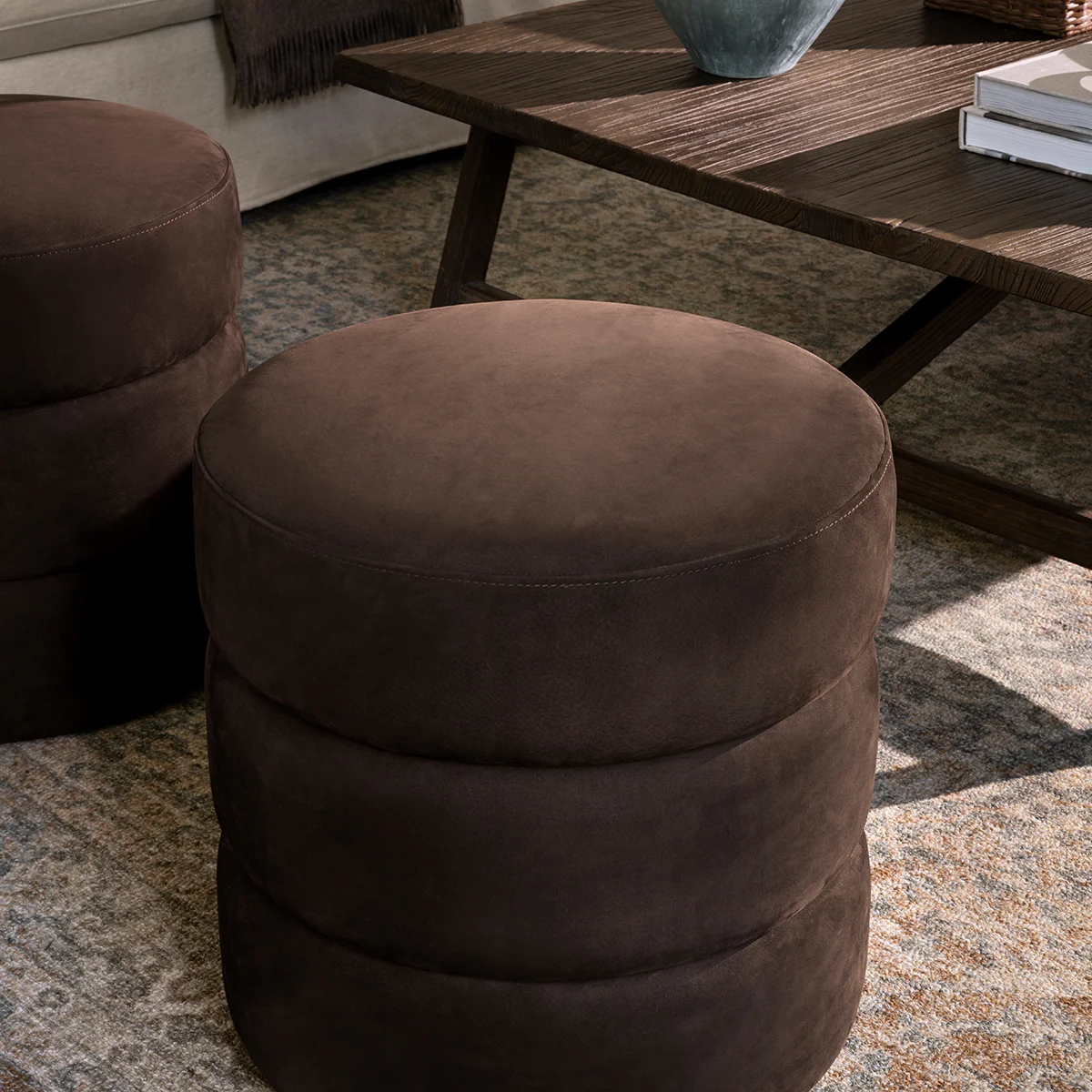
A channel tufted ottoman is good at that because the product communicates quickly. The tufting adds rhythm. The upholstery reads soft. The silhouette feels fuller and more intentional than a flat-top basic ottoman. In-store, that gives the display more shape. Online, that gives the product more texture and recognition before the shopper even zooms.
That last part matters more than a lot of suppliers admit. On Amazon, the product detail page can include the title, at least one image, bullet points, a description, variations, and customer reviews; Amazon’s title rules allow up to 200 characters but recommend using 80 or fewer; and variation relationships are meant for true variations of the same product, not loosely related lookalikes pretending to be family. In plain English: if your Amazon listing system is sloppy, your ottoman does not just look worse. It becomes harder to understand, harder to compare, and easier to ignore.
That is why retail fit on Amazon is not a side issue anymore. It is part of the product decision.
A lot of buyers still behave as if “good in the showroom” automatically means “good online.” It does not. Some products have floor charisma and thumbnail confusion. Some products look better from six feet away than they do in a search result. The channel tufted ottoman usually performs better than average because the channeling gives it visual order. It is plush, yes, but not blurry. It feels elevated without becoming precious. That makes it unusually useful for buyers living in the uncomfortable but very real overlap between chain retail merchandising and Amazon-style digital shelf logic.
Why this product fits the current buyer profile
The buyer who should care about this piece is not usually trying to win a design award. They are trying to solve a more boring—and therefore more expensive—problem:
How do I buy upholstery that feels current without becoming risky?
How do I choose something soft enough for today’s taste, but clean enough for online search?
How do I build one product story that can work on a retail floor and inside an Amazon variation tree?
That is the real brief.
And academically, that brief makes sense. Research in the Journal of Retailing shows that creative merchandise offerings and innovative merchandising strategies help shape retail brand identity and improve consumer engagement and willingness to pay. Separate assortment-planning research argues that retail profit depends not just on breadth, but on choosing the right mix of products—including the balance between more basic and more fashion-forward items. In other words, a channel tufted ottoman does not have to be the whole assortment. It just needs to be the right kind of standout within it.
That is exactly where this item belongs.
Not as the weird experimental SKU nobody reorders.
Not as the bland utility piece nobody remembers.
But as the upholstery item that makes the collection feel a little more dressed, a little more touchable, and a lot less forgettable.
What smart buyers get right about channel tufted ottomans
A smart buyer understands that the product has to do three jobs at once.
First, it has to look good in person.
Second, it has to read clearly online.
Third, it has to stay out of trouble after delivery.
That third point is where a surprising number of sourcing conversations get embarrassing. Amazon’s own guidance says items must be delivered in the condition described on the product detail page, without damage or defects, and its help content on preventing defective product issues exists for a reason. That is why QC for Amazon is not just factory housekeeping. It is merchandising insurance. A channel tufted ottoman with crushed channels, inconsistent seams, weak base structure, or carton damage does not become “slightly less premium.” It becomes return-shaped.
This is also why China Amazon product selection has to be more disciplined than many buyers expect. The question is not simply, “Can the factory make it?” The question is, “Can the factory make it in a way that photographs well, variations make sense, packaging survives, and the product arrives looking like the page promised?” Those are not separate questions. They are the product now.
A composite Teruier case: how the right ottoman stopped being “just a pretty sample”
A regional U.S. retailer came to Teruier with a familiar problem: their upholstered accent pieces looked decent in line review, but the e-commerce performance was inconsistent and the marketplace channel was messy.
The ottomans were not ugly.
Which, to be fair, is already better than some categories.
But they were not working hard enough.
The hero product photographs were flat.
The listings did not explain the difference between one style and the next.
The variations felt random.
And the return notes made it clear that softness without specification is just ambiguity with fabric.
So Teruier did not start by asking, “What colors do you want?”
It started by asking a better question:
What kind of ottoman can win both the room shot and the product page?
That led to a tighter recommendation built around a channel tufted ottoman.
Why that shape?
Because it gave the assortment something the buyer’s current lineup lacked: softness with visual discipline. The channeling created instant surface rhythm. The fuller body aligned with the North American softness trend. And the silhouette was clean enough to build a workable amazon variation strategy around fabric, color, and size without turning the page into a family reunion of barely related products. Amazon’s own guidance is clear that variations should be true variations of the same item, which made the channel tufted frame a cleaner parent product than a mixed assortment of loosely similar ottomans.
Teruier then rebuilt the program around three things:
A sharper Amazon listing system with cleaner titles, stronger bullets, and clearer benefit hierarchy. Amazon’s guidance emphasizes the role of titles, images, brand, descriptions, and bullet lists in detail-page quality, and its bullet-point guidance frames bullets as concise statements that help shoppers understand product features and benefits.
Stricter QC for Amazon, especially on seam consistency, foam recovery, leg stability, carton protection, and the “did it arrive looking like the photo?” test. Amazon’s quality guidance is not subtle about products needing to arrive as described and without defects.
A better production calendar. Teruier planned the launch backward from Chinese New Year at Teruier, locking sampling, final swatches, carton validation, and variation photography before the holiday window instead of pretending February magically becomes less real when people want inventory. That is not glamorous. It is just how adults keep launches from drifting into apology emails.
In Teruier’s modeled pilot scenario, the reworked ottoman program produced:
- an illustrative 18% lift in conversion after listing cleanup
- an illustrative 21% increase in sell-through for the channel tufted ottoman versus the prior accent-ottoman launch window
- a cleaner attach rate across color variants because the parent-child logic made sense
- lower damage-related complaints after packaging and seam-control adjustments
- stronger overall assortment clarity, because the channel-tufted frame became the hero instead of one more anonymous padded object
The important thing here is not the exact number.
It is the logic.
Teruier did not just recommend a prettier ottoman.
It recommended a product with better digital behavior.
Why this matters for buyers now
There is a larger lesson here, and it applies well beyond one ottoman.
Buyers can no longer treat product design, merchandising, and listing architecture as three separate departments politely ignoring one another. Assortment planning sits at the center of merchandising decisions, and creative merchandising helps define the retail identity customers are actually responding to. If a channel tufted ottoman works, it is not only because the channeling looks nice. It is because the product, the page, and the presentation are finally speaking the same language.
That is why Teruier’s cross-border design-manufacturing collaboration model matters here.
It connects North American taste signals, marketplace listing logic, and factory execution into one commercial answer. It turns “this feels current” into “this can actually launch.” It translates softness into structure, texture into thumbnail clarity, and sourcing into something closer to risk reduction.
Which, for most buyers, is a lot sexier than it sounds.
Final thought
The channel tufted ottoman still has real commercial value in 2026, but only if buyers stop treating it like a decorative afterthought.
The market is still rewarding softness, plush texture, and fuller silhouettes. Amazon’s own rules still reward clarity, real variation logic, and accurate product communication. And retail research still points to the same basic truth: the products that win are not just the ones that look good. They are the ones that sit inside a smarter merchandising system.
So yes, a channel tufted ottoman can absolutely be your hero.
Just do not sabotage it with a lazy page, fake variations, or quality control that only becomes “important” after the first batch arrives.
That is not strategy.
That is expensive optimism.