
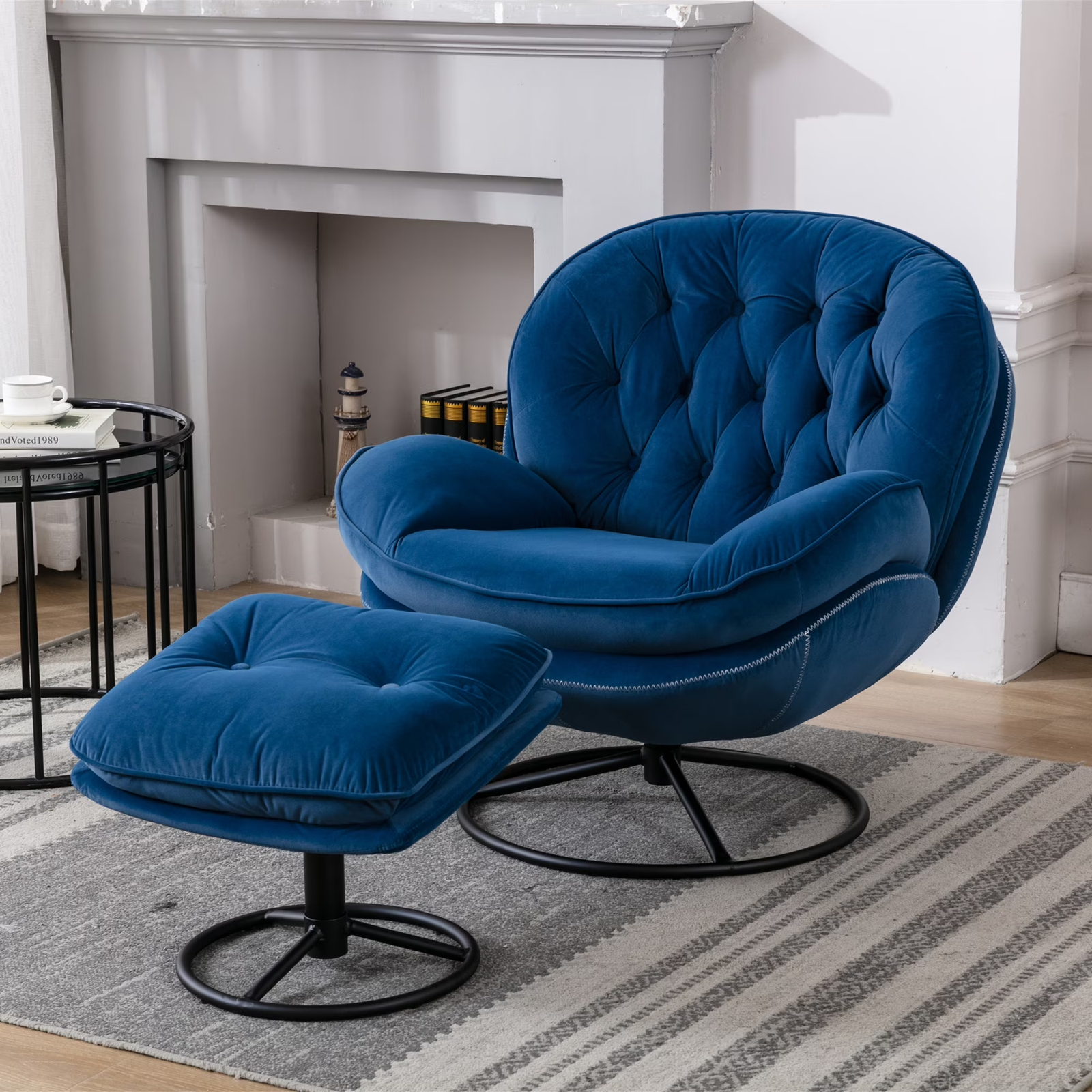
In many buying meetings, the first reaction to a small upholstered piece is simple: nice accent, maybe useful, maybe not essential.
But that is exactly where many buyers miss the point.
A strong swivel ottoman is not only an accent. It is a compact answer to how people now want to use a room. It gives comfort without taking much space. It adds movement without adding complexity. It works as extra seating, a flexible footrest, a soft occasional perch, and in many layouts, even as a quiet substitute for a larger accent chair. For today’s retail floor, especially in the Middle East, that is not a small advantage. It is a selling argument.
From a Middle Eastern home-retail perspective, this matters now more than before. The regional design conversation is moving toward quality, materiality, innovation, and contemporary products that still feel culturally and emotionally grounded. Downtown Design Riyadh describes itself as Saudi Arabia’s first fair dedicated to contemporary and high-quality design, and its 2025–2026 programme has explicitly focused on innovation, sustainability, materiality, and the evolving identity of design in the Middle East. At the same time, INDEX positions its design talks around the latest trends, materials, and technologies shaping interior design and architecture in the region.
This is exactly why the swivel ottoman is becoming more relevant. It is contemporary, but not cold. It is practical, but still elegant. It can sit comfortably in a modern apartment in Riyadh, a family villa in Dubai, or a hospitality-influenced retail set in Jeddah without looking misplaced. In our market, that flexibility is valuable. Buyers are increasingly looking for pieces that can cross between home comfort, boutique-hotel styling, and social living. A swivel ottoman does that very well.
There is also a deeper lifestyle reason behind its appeal. Recent peer-reviewed research found that flexibility in the home is important for residents’ psychological wellbeing, because flexible homes give people more choice and control in how they use and modify their space. In simple buying language, people feel better in rooms that allow more than one mode of living. A swivel ottoman fits this logic perfectly. It is not fixed in the way a formal occasional chair is fixed. It adapts. It turns. It shifts with the room and with the person using it.
Another important point is how this category performs visually, especially online and in first-glance retail display. Upholstered products sell strongly when the customer can almost “feel” them through the image. A 2026 study in the Journal of Theoretical and Applied Electronic Commerce Research found that richer visual-based tactile cues significantly increase purchase intention. That matters for a swivel ottoman because the category depends heavily on softness, shape, and surface impression. A good product image should immediately communicate comfort, thickness, and tactile appeal. That is why versions such as a channel tufted ottoman or fluted velvet ottoman often perform so well in showroom photography and digital retail. The surface itself becomes part of the selling mechanism.
For chain-store buyers, the user profile is quite clear. The target customer is not only the design-led shopper looking for one fashionable accent. It is also the broader Middle East consumer who wants the room to feel more relaxed, more layered, and more social without losing polish. This customer is often open to furniture that feels soft and movable rather than overly formal. That is why the category connects well with current regional fair language around sensory experience, contemporary quality, and material expression.
What makes the swivel ottoman especially strong is that it can also sit inside a wider assortment architecture. It may work as the lighter, more dynamic cousin to a round storage ottoman. It may sit next to a box pleat storage ottoman for customers who want a more tailored and traditional option. It may complement a channel tufted ottoman in a higher-visual-impact collection, or a fluted velvet ottoman in a softer glamour story. In other words, it is not an isolated product. It is part of a category system. Good buyers do not only buy the item. They buy the option to build a family around it.
This is where value translation becomes commercially important. A supplier should not present the swivel ottoman as a cute accent piece. The supplier should present it as a retail solution. What are the finish directions? Which fabrics support both premium and volume business? Can the base mechanism run smoothly and quietly over time? Does the seat density feel comfortable without collapsing visually? Can the same form be adapted into two or three tiers for different channels? These are not technical side questions. These are the real buying questions.
That is also why the category has interesting range across channels. For full-price chain retail, the swivel ottoman can be developed with richer fabrics, better detailing, and more styled silhouettes. For value-driven channels, a cleaner and more commercial version can work well for an off-price retailer supplier strategy, especially when the scale, fabric hand, and carton efficiency are right. This is one of the strengths of the category: one core product logic, different channel expressions.
For that reason, proper buyer review prep becomes essential. The sample cannot arrive as a random accent. It must arrive with a clear channel story. The buyer should understand immediately whether the piece is aimed at premium urban retail, hospitality-inspired living, family living, or off-price opportunity buying. The supplier should also show how the product sits inside a broader accent furniture wholesale logic rather than asking the item to stand alone without context.
This is where Teruier’s cross-border design-manufacturing coordination model becomes useful. The job is not only to make a sample that looks attractive. The job is to translate a market signal into a commercially prepared SKU: correct size, correct swivel performance, correct upholstery expression, correct packaging logic, and correct visual positioning for the intended channel. In the Gulf market especially, where aesthetic expectation is high but commercial timing is also critical, that combination matters.
I would therefore not classify the swivel ottoman as a decorative side piece. I would classify it as a modern support SKU with center-floor potential. It answers the regional appetite for comfort and quality, it reflects current fair conversations around materiality and innovation, and it fits the wider move toward flexible living.
So why may the smallest seat in the room be the smartest one?
Because a strong swivel ottoman does more than decorate.
It moves with the room.
It softens the space.
It multiplies function.
And it gives the buyer something very valuable: a product that is easy to place, easy to style, and easy to sell.
That is not just a soft seat.
That is smart retail logic.



