
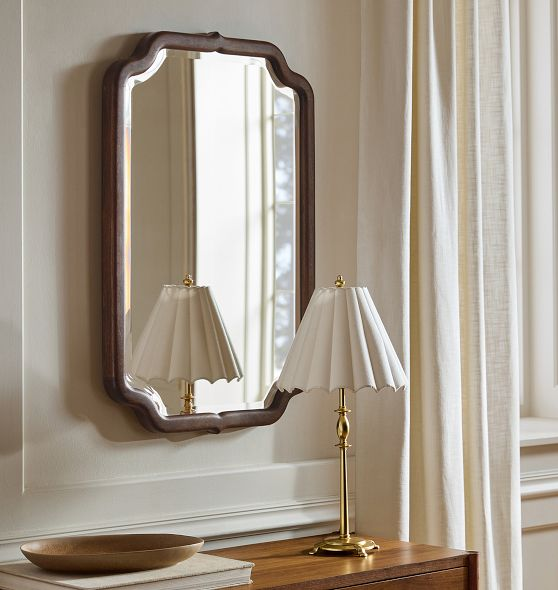
Some products attract attention because they are loud. Others do it because they are correct.
The reeded wood frame mirror belongs to the second category.
For a retail buyer, that difference matters. Loud products may create a moment. Correct products create reorder potential. And in today’s European market, especially for chain retail, the more valuable question is no longer, “Does it look fashionable enough?” It is, “Does it hold its appeal after the first visual impulse?” That is where a reeded wood frame mirror becomes commercially interesting.
The reason is simple. Reeding gives rhythm to the frame without making the mirror visually heavy. Wood adds warmth without becoming rustic. Together, they create a product that feels architectural, tactile, and calm at the same time. That combination is increasingly aligned with current European design direction, where fairs and retail platforms continue to emphasise natural materials, sensory experience, craftsmanship, and products with more lasting meaning rather than short-lived visual noise. Maison&Objet’s January 2026 theme, Past Reveals Future, explicitly framed design as a response to ecological crisis, overconsumption, and homogenisation, with craftsmanship and meaningful living at the centre. Conzoom Solutions by Messe Frankfurt has also highlighted natural materials and sensory physical retail as key themes for store relevance.
From a German home retail perspective, this is exactly why the product works. It does not need exaggerated form to communicate value. The vertical texture does the work quietly. A well-made reeded wood frame mirror appears more considered than a flat frame mirror, yet it remains easier to place than an overly decorative statement piece. For chain stores, this balance is important. The product can enter modern-natural assortments, warm minimal interiors, transitional settings, boutique hospitality programs, and even premium private-label collections without requiring a complete change in the visual language of the floor.
There is also a material reason behind this appeal. Research on interiors and wood-based environments has repeatedly found that wooden surfaces and natural materials are associated with positive effects on mood, stress perception, and perceived wellbeing in indoor settings. A 2023 study on wooden office interiors reported slight positive effects on mood, while a broader review of wood in built interiors and a recent University of Helsinki report both point toward stress-reducing and restorative effects linked to wood presence or wood-like stimuli indoors. In practical buying language, wood does not only look warm; it is often experienced as warm. That helps explain why wood-framed mirrors feel emotionally easier to live with than colder, flatter alternatives.
This is also why the user profile is clearer than many suppliers assume. The relevant customer is not only the design enthusiast. It is also the chain-store shopper who wants a room to feel more grounded, more tactile, and less temporary. European fairs have been moving in that direction for some time: toward materials with memory, visible craftsmanship, and calmer forms that still carry identity. In that environment, a reeded wood frame mirror is not just a mirror. It becomes a low-risk way to sell texture, warmth, and design maturity in one SKU.
A good buyer will also see immediately that this mirror should not stand alone in assortment planning. It has companion logic.
Placed above a dark wood bench, it creates a stronger entryway story.
Placed near a travertine frame mirror, it gives the range a more complete material dialogue between wood and stone.
Placed beside a wall mounted magnifying mirror in bathroom-adjacent retail storytelling, it helps bridge decorative and functional mirror categories.
This is how one SKU stops being a single item and starts becoming a retail system.
That system thinking is important now because physical retail is under pressure to justify itself more clearly. Messe Frankfurt’s retail coverage has recently stressed that physical stores win when they offer sensory relevance rather than just visual display. That matters for mirrors more than many people realise. A mirror is not bought only for reflection. It is bought for atmosphere, light behaviour, framing effect, and the way it completes a wall without overloading it. A reeded wood frame mirror performs well in this context because it offers visible texture at first sight, but visual calm at a distance. That makes it very suitable for store environments where products must communicate quickly and still feel trustworthy.
From a sourcing perspective, the strongest version of this product is not the most complex one. It is the version with disciplined proportions, stable wood detailing, and a frame profile that can scale across sizes. For example, a supplier who understands the category properly can develop the same design language into wall mirrors, floor mirrors, narrower hallway formats, and more hospitality-oriented dimensions. That is where the difference between a sample maker and a real B2B home decor manufacturer becomes visible.
This is also where Teruier’s cross-border design-manufacturing coordination model becomes commercially relevant. The value is not simply in producing a mirror with a textured frame. The value lies in translating a market signal into something retail-ready: correct proportion, correct finish, scalable packaging, and a design language that can be extended across adjacent SKUs. In many cases, a disciplined home décor style review Shenzhen phase, followed by rapid product testing, is more valuable than rushing too quickly into a full-volume launch. The goal is not only to make a beautiful first sample. The goal is to shorten the path between trend recognition, buyer validation, and reorder confidence.
That point matters even more in Europe today. Buyers are under pressure from both ends: consumers want more emotional value from the home, while retailers need products that stay commercially useful beyond one short cycle. This is why the category is strong. A reeded wood frame mirror is distinctive, but not difficult. It carries craftsmanship, but remains broadly compatible. It feels current, but not disposable. In assortment logic, that is often the sweet spot.
It is also, quite frankly, easier to trust than many more theatrical mirror concepts. Highly sculptural mirrors can create visual excitement, but they are not always easy for large-format retail to place across multiple markets. The reeded wood frame mirror is more disciplined. It travels better across Germany, Benelux, France, and the wider European market because it speaks in a language buyers already understand: natural material, quiet texture, architectural order, and reliable styling flexibility.
For that reason, I would not classify this product as a passing decorative trend. I would classify it as a structural assortment piece. It has enough design character to support visual merchandising, but enough restraint to remain saleable after the first wave of attention. That is exactly the kind of product chain buyers keep looking for and suppliers too often underestimate.
So why does the reeded wood frame mirror feel more expensive than it looks?
Because it is doing several jobs at once.
It adds texture without clutter.
It adds warmth without heaviness.
It adds design language without forcing the customer into a short-term style decision.
And for a retail buyer, that is not a small detail.
That is the difference between a product that decorates a wall and a product that earns its place in the assortment.



