
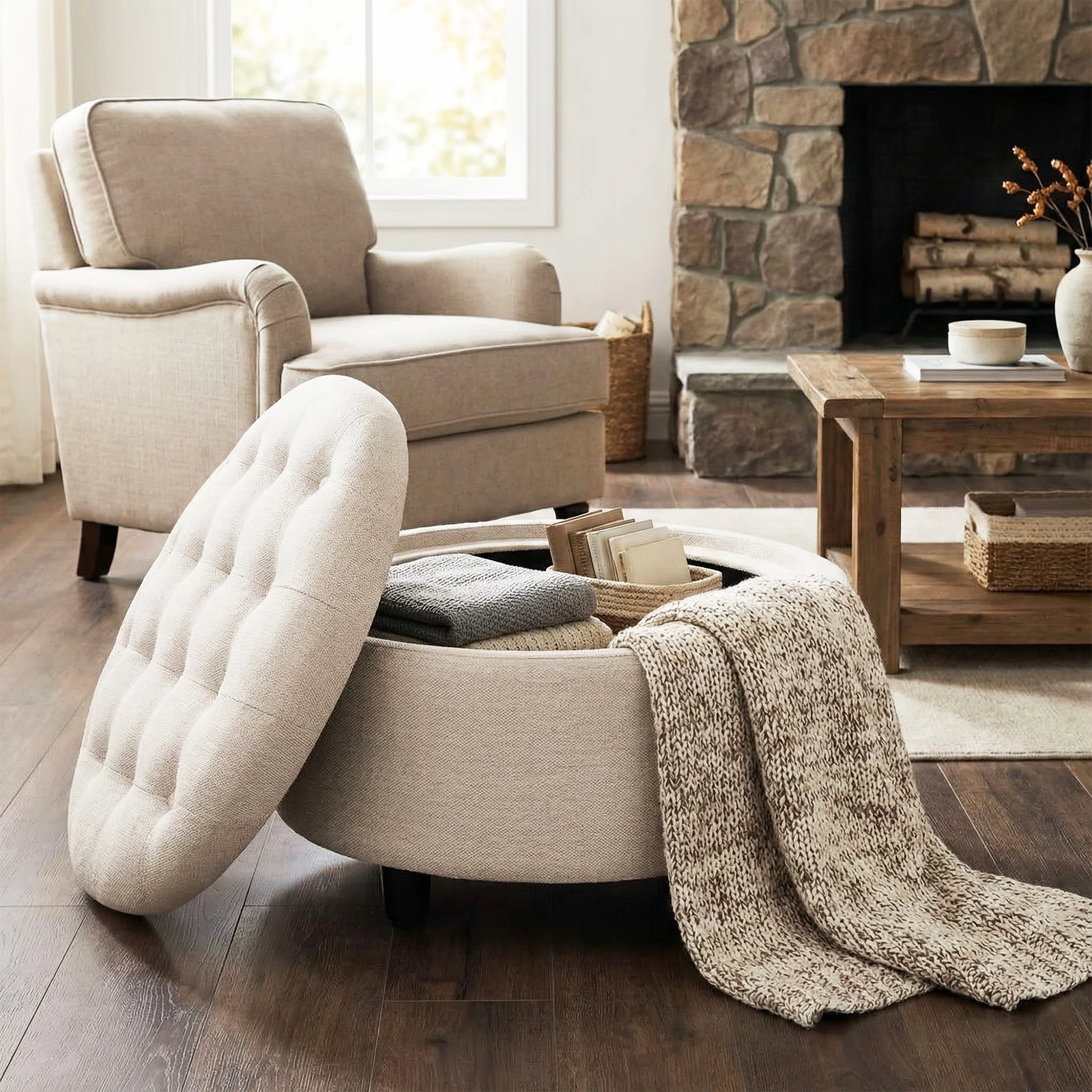
Why the Round Storage Ottoman Is the Soft Functional SKU Buyers Will Keep Reordering
Some products look good in a booth.
A few products look good in a booth and make sense on a retail floor six months later.
That is why I keep coming back to the round storage ottoman. On the surface, it is a simple category: a seat, a lid, a hidden compartment. But from a U.S. retail buyer’s perspective, it solves a much bigger problem. It brings softness to a room, removes visual hardness from a layout, and adds usable storage without asking the customer to sacrifice style. In a market that is clearly leaning toward soft forms, fuller silhouettes, and tactile comfort, that combination is commercially strong. Las Vegas Market’s official January 2026 Market Snapshot explicitly framed one key direction as “Restorative Softness,” built around “soft lines and forms, lush textiles and full silhouettes.”
The buyer behind this keyword is not shopping for a cute accent
The person searching round storage ottoman is usually not a casual shopper. More often, it is a furniture merchant, a soft-goods buyer, a chain-store category manager, or a sourcing lead looking for products that can work across roomsets, channels, and price tiers. That aligns closely with what the U.S. trade markets are signaling now. Atlanta Market’s January 2026 edition reported strong order writing, high buyer satisfaction, a 5% increase in stores attending, and a 15% increase in first-time buyers. Las Vegas Market describes itself as a cross-category sourcing destination drawing buyers from all 50 states and more than 80 countries. That tells me the current market is rewarding pieces that are both stylish and scalable.
That is exactly where the round storage ottoman gets interesting. It is easier to merchandise than a fragile hero accent, more flexible than a large case-good piece, and easier to justify than a product that only solves one task. It can sit in an entry, soften a bedroom corner, work as a bed end bench alternative, or anchor a small-space seating story next to a chair or sofa. That kind of placement flexibility is what serious buyers notice.
Why round form matters more than many buyers admit
The round silhouette is not a styling afterthought. It is part of why the category works.
A peer-reviewed study from researchers affiliated with the University of Pennsylvania found that people judged curvilinear interior spaces as more beautiful than rectilinear ones, and the authors reported that nonexperts were also more likely to indicate willingness to enter curvilinear spaces. That does not mean every round product is automatically a winner. But it does support a very practical buying insight: curved form can make interiors feel more inviting and visually resolved.
That is one reason a round storage ottoman often feels easier in a room than a sharper upholstered cube. It softens the floor plan. It can reduce the sense of interruption in tighter layouts. And when the broader market is already validating soft contour and more generous silhouettes, roundness stops being just a decorative choice and becomes a commercially useful one.
Storage is still one of the most underpriced emotional benefits in furniture
A lot of buyers still talk about storage as if it were a technical feature. Customers do not experience it that way.
They experience it as relief.
A design paper from the Norwegian University of Science and Technology argues that small homes require smart, space-saving furniture solutions to maintain wellbeing, and it notes that lack of space is one of the most common sources of dissatisfaction people cite about their homes. The paper also points out that furniture takes up a large share of floor space, which means multifunctional furniture has a direct impact on how livable a room feels.
That is why the round storage ottoman is stronger than it first appears. You are not only selling an upholstered accent. You are selling a place to hide the throw, the toys, the extra pillow cover, the magazines, the clutter that makes a room feel unfinished. In retail terms, that means the product carries both functional and emotional value. And that is often what separates a one-season novelty from a reorderable SKU. The wellbeing and small-space rationale is directly supported by the NTNU paper; the reorder conclusion is my merchandising inference based on how multifunctional categories typically perform.
What the ottoman selection intelligence would say
Our ottoman selection intelligence would make one point immediately:
Do not buy the round storage ottoman because it looks easy.
A weak version is very easy to make. A strong version is much harder.
The strong version gets five things right at once: the lid action feels smooth, the seat feels credible, the storage cavity is genuinely useful, the diameter feels balanced in the room, and the fabric story matches the retail channel. That is where adjacent categories matter. A buyer comparing a round storage ottoman with an upholstered storage bench should not only ask which one looks more premium. The better question is which one gives the room more flexibility. In tighter bedrooms or apartment layouts, the round version can outperform the bench because it feels lighter and easier to place. In larger bedroom stories, a bed end bench may still win on linear storage and visual grounding. This is exactly the kind of comparison that should sit inside a buyer’s own hot seller database review.
Why the fabric direction matters in 2026
The market is not just rewarding softness in shape. It is rewarding softness in touch.
Las Vegas Market’s 2026 snapshot language around lush textiles and full silhouettes gives buyers a clear permission structure for softer upholstery stories. That makes materials like performance boucle commercially useful because they deliver texture and softness while still speaking the language of everyday livability. A cozier teddy ottoman wholesale direction can also work, especially for fall or comfort-led assortments, but it usually needs tighter channel control because it can skew more seasonal or trend-sensitive.
From my point of view, performance boucle is the more scalable lane for a chain buyer. It fits the broader softness trend, but it also feels easier to normalize into a long-running assortment. A teddy-texture version can be a strong accent or seasonal layer, while a swivel ottoman extension may work for retailers trying to push the category into a more lounge-driven or youth-oriented story. Those last two points are buying inferences, but they follow directly from the market’s official softness direction and the commercial need for usable differentiation.
Where this SKU fits best in a retail program
I would not position the round storage ottoman as a throw-in accent.
I would position it as a soft functional anchor.
It is especially strong in small living rooms, bedrooms, apartments, entry-adjacent spaces, and family homes that need one more flexible seat without adding visual bulk. It also works as a useful bridge product in a mixed assortment. If a retailer already carries an upholstered storage bench, the round ottoman can give the same category a softer, more casual interpretation. If the store wants to freshen bedroom merchandising, it can sit beside or replace a more traditional bed end bench. And if the goal is to modernize without looking cold, the round form makes the whole assortment feel more approachable.
That placement logic also matches the broader U.S. market environment, where buyers are sourcing across categories and looking for products that can travel between style stories instead of living in only one rigid presentation. Atlanta Market’s January 2026 recap explicitly pointed to strong cross-category demand, and Las Vegas Market continues to position itself around cross-category commerce.
Why supplier choice matters more than the sample
This is the part buyers know, but sometimes still underestimate.
A nice sample is not the same thing as a good program.
The current U.S. trade-show environment is full of discovery, but discovery is only valuable when the supplier can support rollout, replenishment, and consistency. Atlanta Market’s 2026 results and Las Vegas Market’s positioning both reinforce how actively buyers are sourcing and comparing resources right now. In that environment, supplier discipline matters more, not less.
This is where Teruier’s value translation matters. A buyer does not only need a vendor who can copy a silhouette. The buyer needs a partner who can translate a market signal into a retail-correct SKU: the right diameter, the right seat firmness, the right storage depth, the right fabric recovery, the right carton, and the right finish story for the account. That is how a trend becomes a margin-protecting item instead of a risky sample.
Final buyer take
A lot of furniture categories still ask buyers to choose between softness and utility.
The round storage ottoman does not.
That is why I think it is one of the more commercially credible soft-goods SKUs for 2026. It aligns with the official market move toward softer forms and lush textiles. It benefits from research suggesting people respond positively to curvilinear spaces. It answers the ongoing small-space and storage pressures that make multifunctional furniture more relevant, not less. And for a chain-store buyer, that is the sweet spot: current enough to feel fresh, practical enough to justify floor space, and broad enough to reorder.
That is not a minor SKU.
That is the kind of SKU buyers build programs around.



