
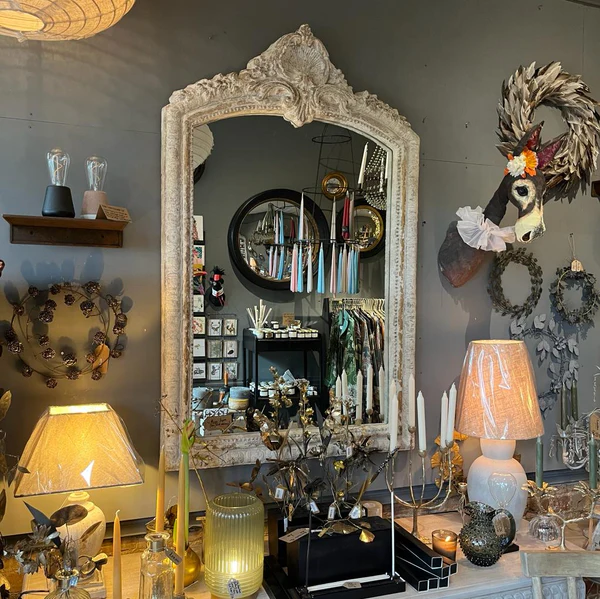
Why the Antiqued Mirror Is No Longer “Old World” — But One of the Smartest Margin Pieces in 2026
There is a mistake many buyers still make with mirrors.
They sort them into two easy boxes. One is modern: clean, bright, minimal. The other is traditional: decorative, nostalgic, safe. In that old classification, the antiqued mirror is often pushed into the second box and forgotten there.
That is now commercially lazy.
In 2026, the antiqued mirror is not returning because the market wants to live in the past. It is returning because the market is tired of surfaces that feel flat, anonymous, and too polished to be believable. Buyers are now looking for products that bring atmosphere, memory, softness, and visual depth without becoming theatrical. That change is visible in the strongest fair signals in Europe. Maison&Objet January 2026 centered its edition on “Past Reveals Future,” explicitly framing the conversation around heritage, craft, and reinvention. Ambiente Trends 26+ used the official style worlds “brave, light and solid,” asking how colours, shapes, and materials can build a livable future rather than a merely fashionable one.
For a German retail buyer, this matters because it changes the job of the mirror. A mirror is no longer only a reflective object. It is now a mood carrier. It can warm a hard wall, soften an architectural line, and make a room feel more layered before the customer even notices the furniture. That is exactly why the antiqued mirror has become more relevant inside current mirror trends 2026: it delivers reflection, but not the cold kind. It gives character without asking the customer to buy a fully antique interior. That places it in a very efficient middle ground between trend and permanence. This broader shift toward lived-in, storied interiors is also visible in 2026 design coverage from major publications, which highlight more layered, less sterile homes.
Why aged reflection feels more current than perfect reflection
An antiqued mirror works because it is slightly imperfect in the right way.
Perfect reflection can be useful, but it can also be visually hard. It shows everything and softens nothing. In contrast, an antiqued surface introduces atmosphere. It catches light, but with restraint. It reflects space, but with texture. This makes it especially powerful in rooms that need warmth, depth, or a more collected emotional tone.
This is not only a styling opinion. Research in environmental aesthetics and architectural perception has repeatedly shown that people tend to respond more positively to curvilinear and visually softer interior environments than to sharper, more rectilinear ones. Recent studies found that curved spaces increase positive affect and are often judged more beautiful, while broader work on spatial perception shows that the visual character of interiors strongly shapes how people evaluate a room. That matters here because the best antiqued mirror programs are rarely only about finish; they are usually paired with softer outlines, warmer metals, and less rigid presentation.
That is why the category should not be treated as a “vintage look” only. It is better understood as a softening tool for contemporary interiors.
Where the antiqued mirror fits in a 2026 assortment
The strongest buyers will not merchandise the antiqued mirror as a museum piece. They will merchandise it as an answer to a very modern problem: how to make homes feel warmer, more dimensional, and less generic.
That gives the category several strong commercial positions.
It can sit in a premium hallway story, where the mirror needs to create first impression and depth.
It can sit in a layered living-room wall program, where wall mirror ideas must do more than simply fill blank space.
It can sit in a hospitality-inspired bathroom concept, where a curved bathroom mirror in an antiqued or softly distressed finish makes the room feel less clinical.
And it can sit in a design-led décor capsule beside an organic wall mirror, where asymmetry, fluidity, and warm reflection speak to a more emotional customer.
In other words, the antiqued mirror is not one SKU. It is a family of profitable possibilities.
Shape matters just as much as finish
This is where many factories get the category wrong.
They think “antiqued” is enough. It is not.
A good antiqued finish on the wrong shape still feels dated. But the right shape can move the finish into the present tense. This is why outline selection matters so much in 2026.
An organic wall mirror gives the finish more looseness and modernity. It tells the customer that age and fluidity can live together.
A curved bathroom mirror brings hospitality calm. It reduces the visual severity that bathrooms often have and lets the aged finish feel refined rather than decorative.
A brass wall mirror frame—especially when the brass is muted, aged, or less glossy—can bridge classical memory and current material taste. Several 2026 design publications have noted the movement away from overly pristine metallics toward finishes that feel more soulful, muted, or capable of developing patina over time.
That point is commercially important. The best antiqued mirror today does not sell because it looks “old.” It sells because it looks settled.
What the real buyer profile looks like
The audience for this article is not a casual home improver.
It is more likely a category buyer, assortment manager, visual merchandising lead, sourcing director, or hospitality-furnishing buyer inside a chain store, project business, or design-led retail group. This person is not asking, “Is this mirror pretty?” That question is too small.
The real questions are these:
Will this mirror make a store vignette look more expensive?
Will it work in both retail and hospitality-inspired storytelling?
Will it still feel current after the next fair season?
Will it cross-sell with consoles, cabinets, lighting, and wall décor?
Will the supplier execute the finish consistently at scale?
That is also why the latest European fair direction matters so much. Ambiente’s Interior Looks and hospitality-focused programming explicitly connect interior brands with buyers from retail, architecture, hotels, restaurants, and contract sectors. This tells us something important: buyers are no longer buying by room only. They are buying by atmosphere, use case, and visual language across sectors.
An antiqued mirror fits that new logic very well, because it can move from residential to boutique hospitality to curated retail without losing meaning.
Why QC checkpoints matter more in this category than in a plain mirror
Here the conversation becomes serious.
A plain mirror can sometimes survive mediocre execution. An antiqued mirror usually cannot. The finish itself is the product story, so inconsistency becomes immediately visible. If the distressing is uneven in the wrong way, the mirror looks cheap. If the edge treatment is careless, the “aged” effect looks accidental. If the metal tone and glass treatment do not belong together, the whole piece feels false.
That is why real QC checkpoints are not a footnote in this category. They are the difference between an elevated SKU and a failed one.
A supplier must control:
the consistency of the antiqued effect,
the balance between reflection and haze,
the colour match between frame and glass mood,
the cleanliness of edge finishing,
the hanging and backing stability,
and the packaging protection that keeps the surface visually intact on arrival.
This is where value translation becomes more than a slogan. A European buyer does not purchase “antique effect.” The buyer purchases a controlled emotional result. Someone has to translate design intent into repeatable execution.
That is where Teruier can position itself more sharply: not as a factory that happens to make mirrors, but as a team that understands how a trend signal becomes a retail-ready mirror program.
The smarter way to merchandise the category
Many retailers still isolate the mirror.
Better retailers build a scene.
An antiqued mirror performs best when it is shown with materials that support its logic: textured wood, quieter upholstery, aged brass or bronze details, softer ceramics, and lighting with visual warmth. This is also why it belongs in broader wall mirror ideas content rather than product-only selling. Customers need to see what the mirror does to a room, not only what the mirror looks like by itself.
For chain-store buyers, this is useful because the mirror can become a linking SKU between furniture, lighting, accessories, and entryway décor. It is therefore not only a margin piece. It is a narrative piece.
And narrative is exactly where the 2026 market is moving: toward interiors that feel collected, storied, and emotionally legible rather than blank and over-edited.
Final thought
A standard mirror gives clarity.
An antiqued mirror gives clarity plus memory.
That is why it deserves more respect from serious buyers in 2026. It is not an old-fashioned decorative extra. It is a highly useful commercial object: warmer than a plain mirror, more flexible than a purely ornate one, and better aligned with where European interiors are clearly moving.
For the right buyer, that is not nostalgia.
That is assortment intelligence.



