Stop Filling Corners: Why the Oversized Leaning Mirror Is Becoming the Smartest Statement SKU on the Floor
The mistake many buyers still make is simple: they treat the mirror as a finishing touch. Something to hang late, after the real assortment has already been decided.
That is old thinking.
An oversized leaning mirror is not a filler product. It is a spatial tool. It gives height without construction, light without renovation, and statement value without asking the customer to buy an entire room set. In a difficult retail climate, that matters. Because the best SKU is not always the loudest one. Often, it is the one that makes the whole shop floor look more expensive than it really is.
In Europe, that logic is becoming stronger, not weaker. At Maison&Objet Paris 2026, the programme leaned into “Past Reveals Future,” framing the market around lived-in meaning, heritage, and innovation. At Ambiente 2026, the official trend language was “brave, light and solid,” with a strong focus on how shapes, materials, and atmosphere can define how people want to live now. Across both fairs, the signal was clear: interiors are becoming more emotional, more tactile, and more architectural.
That is exactly why the oversized leaning mirror deserves serious attention from a German retail buyer. It sits at the intersection of several active market directions at once: reflective surfaces, softer geometry, visible materiality, and room-defining scale. It can speak to residential consumers, but it also borrows authority from hotel lobby design trends, where first impression, depth, and visual calm have become commercially powerful design tools. Recent industry coverage still treats the hotel lobby as a make-or-break moment, often using rounded shapes, vertical drama, and strong focal pieces to create emotional arrival.
Why the format works so well now
There is also a design-psychology reason behind this shift. Academic research on architectural perception found that spaces with higher ceilings and more openness were more likely to be judged as beautiful. Another recent study found that curved rooms increased positive affect, reduced negative affect, and even improved creative output compared with rectangular rooms. A mirror is not a ceiling, of course, and one should not pretend otherwise. But for a buyer, the inference is commercially useful: products that visually suggest height, openness, softness, and flow are working with, not against, how people already respond to space.
This is why a large floor mirror is outperforming many smaller decorative pieces. A small mirror may complete a wall. An oversized leaning mirror can redefine a corner, expand a narrow passage, soften a heavy cabinet programme, or turn an ordinary vignette into a destination moment.
For the customer, that feels aspirational.
For the retailer, it feels efficient.
The oversized leaning mirror is not just a mirror
From a merchandising point of view, this format does three jobs at once.
First, it acts as function. Customers still want a full-body mirror in bedrooms, dressing areas, and entry zones.
Second, it acts as architecture. In compact apartments or urban homes, it creates perceived air and scale.
Third, it acts as décor. It is part of the visual language of the room, not only a reflective object.
That is why the product should not be sold as a technical mirror alone. It should be sold as mirror wall decor with floor presence. That is the difference.
A buyer who understands this will not place it in the same conversation as a commodity rectangle. The correct comparison is closer to an accent chair, a sculptural lamp, or a console that controls sightline and mood.
What shape is commercially strongest?
This is where many collections become confused.
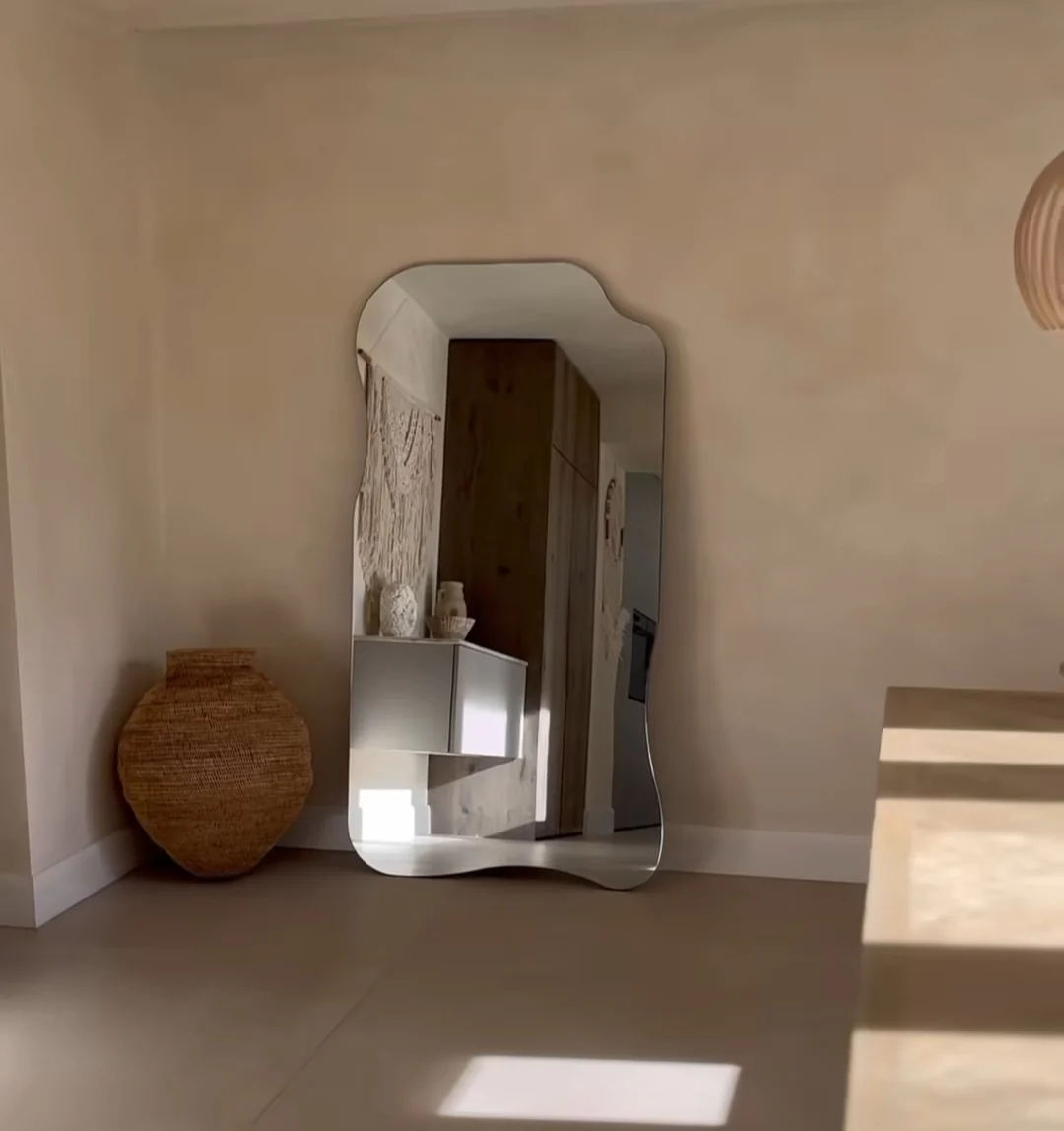
A puddle mirror is editorial and fresh. It has softness, asymmetry, and social-media energy. But for broad retail programmes, it often works best as a fashion-forward accent, not as the backbone of the assortment.
The arched mirror, by contrast, is more stable commercially. It carries softness, but also discipline. It references architecture. It suits classic interiors, hospitality projects, and contemporary homes at the same time. If you are building a range that must work across Germany, Austria, Benelux, and parts of Central Europe, the arched silhouette is often the safer volume play.
Then there is the frame story. A slim metal wall mirror language communicates clarity and modernity. A bronze framed mirror adds warmth, patina, and a slightly more premium emotional register. In 2026, that warmth is especially relevant because reflective finishes are returning, but they are being balanced by darker, richer, more grounded materials rather than cold minimalism.
So the real answer is not one shape only. It is a tiered assortment:
-
one disciplined best-seller in arched form
-
one clean rectangular oversized leaning mirror in black or dark bronze
-
one softer fashion piece for editorial lift, possibly influenced by the puddle mirror language
That is not trend chasing. That is commercial layering.
Where this mirror wins on the shop floor
The strongest placement is usually not the bedroom department.
It is the transition zones.
Think entrance displays. Think hallway edits. Think compact urban living stories. Think “small square metres, big visual effect.” That is where customers immediately understand the value. In fact, some of the best entryway mirror ideas today are not complicated at all: one generous leaning mirror, one bench or narrow console, one lamp, one tray, one object. Finished.
For chain retail, that simplicity is gold. It shortens the decision. It gives the customer a clear picture. It also helps the mirror work as a linking product between furniture, lighting, and décor.
And if you are selling into hospitality or mixed-use projects, the argument becomes even stronger. Recent European fair programming has explicitly addressed not only retailers and interior designers, but also hoteliers, restaurateurs, hospitality interiors, and contract buyers. That means the aesthetic overlap between residential and hospitality is no longer a side story. It is part of the buying logic itself.
What buyers should demand from suppliers
A beautiful mirror is easy.
A repeatable commercial mirror is harder.
For an oversized leaning mirror to work in a serious retail programme, the supplier must solve more than appearance:
The proportion must feel elegant, not merely big.
The frame must be thin enough to look current, but stable enough for transport.
The rear construction must support both leaning and optional wall fixing.
The packaging must be engineered for damage reduction, not only carton cost.
The style must photograph well in e-commerce, but also stand correctly in real stores.
This is where too many factories still fail. They supply mirror products. They do not supply mirror programmes.
At Teruier, the better path is not to begin with “What mirror can we produce?” but with “What room problem can this mirror solve for the buyer?” That is where the cross-border design-manufacturing collaboration model becomes meaningful. Trend language from Europe must be translated into a SKU that can survive freight, margin targets, replenishment pressure, and multi-market styling needs. In other words: design is only half the work. The rest is value translation.
What the user profile really looks like
The reader of this article is not a hobby decorator.
It is more likely a category buyer, assortment planner, visual merchandising lead, or private-label sourcing manager inside a home chain, design-led retailer, marketplace brand, or hospitality furnishing team. This person has already seen enough products. What they need is not more noise. They need confidence.
They want to know:
Will this piece raise perceived value?
Will it work in both online and physical retail?
Will it fit present European taste without becoming tired in six months?
Will it support add-on sales in benches, lighting, wall décor, and entry furniture?
Will it arrive intact?
That is also why the current European fair mood matters. The market is not asking for empty novelty. It is asking for objects with emotional clarity, craftsmanship, material honesty, and a reason to exist. Maison&Objet’s emphasis on heritage plus innovation, and Ambiente’s emphasis on brave, light, and solid, both point in the same direction. Buyers want products that feel grounded, but not dull; expressive, but not chaotic.
The right oversized leaning mirror fits that brief almost perfectly.
The commercial conclusion
A good mirror reflects the room.
A great oversized leaning mirror upgrades the room before the customer even sees themselves in it.
That is why this category is stronger than it looks. It is not only about reflection. It is about atmosphere, perceived square metre value, styling efficiency, and cross-category margin.
For the retailer, it is one of the rare products that can feel architectural, emotional, and practical at the same time.
And in 2026, that combination is not a niche advantage. It is exactly what the better buyers are looking for.