
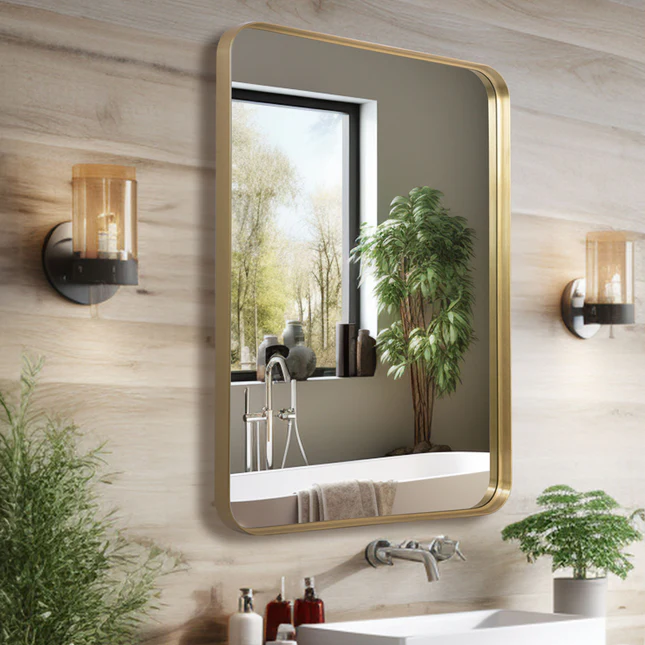
I don’t buy mirrors just because a planogram tells me I need another reflective SKU.
I buy them because a great mirror can do three jobs at once: make a room feel larger, make a wall feel intentional, and make a customer stop long enough to imagine the piece in their own home. That is the real conversation behind decorative mirrors wholesale. It is not just about glass, frame, and carton size. It is about visual pull, retail emotion, and whether a mirror earns its space on the floor.
And right now, the mirrors that earn that space are changing.
The old mirror formula is losing power
For years, too much wholesale mirror sourcing was built around safe repetition: standard rectangles, generic metallic finishes, and assortments that looked useful on paper but forgettable in-store. That model still fills a wall, but it does not always create desire.
What I am seeing now as a U.S. retail buyer is different. A mirror has to work harder. It has to sit inside a full lifestyle story. It has to photograph well for e-commerce. It has to hold margin without looking overworked. And ideally, it has to function as both utility and art.
That is why mirror wall decor is becoming more strategic than basic. A mirror is no longer just an accessory. In the best assortments, it becomes the visual hinge of the room.
Why decorative mirrors wholesale feels more important now
Recent U.S. market direction supports this shift. Spring 2025 High Point Market framed themes such as “Nod to Nature” and “Repose,” while Winter 2026 Las Vegas Market highlighted “Restorative Softness,” defined by soft lines, fuller silhouettes, and comfort-led form. Home Accents Today, citing Houzz’s U.S. design outlook, also noted that rounded forms and oblong mirrors were showing up strongly at recent trade shows, with organic modern remaining a key influence. At the same time, Las Vegas Market’s Winter 2026 edition drew buyers from all 50 states and more than 80 countries, and organizers reported strong order writing, notable growth in new buyers, and high exhibitor satisfaction.
That matters because buyers are not just browsing trend stories anymore. They are writing business around them.
The buyer behind this keyword is easy to recognize
If you are searching decorative mirrors wholesale, you are probably not looking for “more mirrors.” You are looking for fewer mistakes.
You may be a category buyer for a home chain, a merchandising manager balancing price architecture, or a sourcing lead trying to make one mirror program stretch across multiple store formats. You want something trend-right, but not so trendy that it dies after one season. You want something design-led, but still practical enough to reorder. You want something that looks premium on a wall, but does not destroy margin in freight, packaging, or damage claims.
That is the hidden buyer psychology behind this keyword.
And that is exactly why the newer Organic Mirrors story is working.
Why Organic Mirrors are winning attention
Curved and biomorphic forms are not just a style fad. There is a real design logic behind why they work. Research in neuroaesthetics and environmental design has found that people generally rate curved forms as more pleasant than angular ones, and biomorphic interior environments can be more memorable than rectilinear ones. In retail terms, that means an organic wall mirror is not only softer to look at; it is often easier to notice, easier to remember, and easier to build a room story around.
That is a serious advantage for a buyer.
Because once a customer remembers the shape, the mirror has already done more work than a generic commodity piece ever could.
Not all bulk mirrors are created equal
This is where many suppliers still miss the point.
They think bulk mirrors means scale alone. But scale without story is just inventory. A chain buyer does not need a container of random frames. A chain buyer needs a clean collection logic:
one hero organic shape,
one easier volume shape,
one warmer finish story,
one wall grouping option,
and one entry price that keeps the whole assortment commercially balanced.
That is what turns wholesale into retail performance.
A good wall mirror supplier understands this. They do not simply offer sizes. They offer role clarity. Which mirror is the statement piece? Which one is the repeatable volume driver? Which one belongs in modern organic? Which one belongs in transitional? Which one should anchor an entry wall, and which one belongs above a console in a tighter store footprint?
That is not product dumping. That is merchandising intelligence.
Decorative mirrors wholesale should behave like a collection, not a catalog
The strongest programs I see are not built around isolated SKUs. They are built around a visual family.
For example, one assortment can start with an organic wall mirror in a soft asymmetrical silhouette, extend into smaller mirror wall decor pieces for grouped installations, and then finish with a more classical accent using a darker or antiqued tone for stores that want a richer mood. Even a speculum mirror reference can play a role here, not as a museum piece, but as a vocabulary cue for buyers who want something with old-world depth, atmospheric reflection, or a more collected look rather than a clean contemporary shine.
That is how you widen the sell-in conversation without losing cohesion.
And cohesion matters, because today’s buyer is often merchandising mirrors beside lighting, ceramics, accent furniture, and seasonal décor. The mirror that wins is the one that can cross categories gracefully.
The academic side supports the retail side
Retail research has increasingly treated visual merchandising and store atmospherics as deeply connected. In plain English, products do not sell in isolation; they sell as part of an environment. When your mirror assortment improves the atmosphere of a vignette, it improves more than appearance. It improves the selling context.
That is one reason mirrors punch above their weight in retail. They are not large furniture-ticket items, but they can shift perceived openness, brightness, and polish inside a selling space. Design education sources also continue to emphasize the role of reflective surfaces in distributing light and increasing visual impact in interiors.
For a store buyer, that is not theory. That is margin support.
What I now expect from a serious mirror partner
As a buyer, I no longer want a vendor who only ships product. I want a partner who helps translate a trend into something commercially durable.
That means a supplier who understands why rounded forms are working in the U.S. market right now. A supplier who can develop a coherent set of decorative mirrors wholesale options instead of a pile of disconnected frames. A supplier who can talk about finish, silhouette, carton protection, scale, and display logic in the same conversation.
This is where Teruier’s value is easy to understand.
The advantage is not just manufacturing. The advantage is value translation: taking what buyers are seeing in U.S. markets, then turning that direction into reorder-ready SKUs, clearer assortment architecture, and a more usable sourcing conversation. In other words, not just “here is a mirror,” but “here is how this mirror earns space, earns attention, and earns reorders.”
That is the difference between a factory relationship and a category-building relationship.
The real question behind decorative mirrors wholesale
So when I look at a new mirror supplier, I am not asking the old question anymore.
I am not asking, “Who has the cheapest mirror?”
I am asking:
Who understands the current American taste for softer forms and natural visual language?
Who can turn one strong shape into a family of sellable options?
Who can help me buy with confidence, not just with caution?
Who can give me mirrors that feel designed, not merely sourced?
Because that is what decorative mirrors wholesale really means now.
It means buying reflection, yes.
But more importantly, it means buying retail momentum.
And the suppliers who understand that will not just sell more mirrors. They will help their buyers build better walls, stronger stories, and more profitable stores.



