
The Mirror That Slips a Hotel Opening Date Isn’t “Décor.” It’s a Risk.
I buy home décor for a living—so I’m used to people treating mirrors like styling. But in hotels, mirrors behave like building systems: if the light fails, if the edge chips, if the anti-fog quits, you don’t get a “return.” You get a punch-list spiral.
That’s why hospitality mirror supply is quietly becoming one of the most important categories in the Middle East—especially KSA. Saudi Arabia has publicly raised its visitor target to 150 million by 2030, and the hotel pipeline keeps scaling to match the ambition.
From a buyer’s seat, here’s the short playbook I use to separate “looks good on a slide” from “survives a real project.”
Hospitality Mirror Supply Starts With One Question: Where Will It Fail First?
Most mirror problems in hospitality show up in three places:
-
Electrical (LED driver, switch, wiring path)
-
Moisture + heat (bathroom steam, anti-fog heater pad reliability)
-
Logistics (corner crush, vibration cracks, jobsite handling)
If your supplier can’t talk through all three without jargon, you don’t have a program—you have a gamble.
Mirror Selection: Treat a Lighted Mirror Like a Lighting Fixture, Not a “Mirror + LEDs”
The easiest sourcing mistake I see is treating an LED mirror as a decorative mirror with a “bonus light.” In practice, a lighted mirror is evaluated like a luminaire in many compliance conversations. UL’s own materials explain UL 1598 as the luminaire safety standard, and industry guidance frequently points to UL 1598 for lighted mirrors.
And in wet areas, you need ingress protection clarity. IEC 60529 is the international basis for the IP Code (dust/water ingress protection).
My mirror selection checklist (buyer-simple):
-
Where is the wire exit, and how is it protected?
-
What’s the IP rating and intended bathroom placement logic?
-
What is the substitution rule if a driver/LED strip changes mid-production?
-
Can the mirror be serviced without breaking tile?
Those answers are what keep “design intent” from turning into rework.
Anti-Fog LED Mirror Wholesale Saudi: The Feature Buyers Regret Unless It’s Engineered
If you’re pitching anti-fog LED mirror wholesale Saudi, assume the property team will judge you on the second year, not the showroom moment.
Anti-fog performance isn’t magic—it’s a heated pad system + adhesive durability + proper electrical design. In hospitality, “anti-fog stopped working” becomes a maintenance ticket farm.
What I ask for:
-
Anti-fog pad supplier traceability (not just “we have anti-fog”)
-
Heat distribution notes (where the clear zone starts/ends)
-
Failure-rate handling policy (spares, replacement lead time)
If you can’t support after-install realities, anti-fog becomes a liability, not a selling point.
Mirror Packaging Breakage Prevention: If You Don’t Test the Carton, You’re Not Supplying Hospitality
This is where most “cheap” quotes become expensive.
Real distribution environments create predictable hazards—drops, vibration, compression. ISTA Procedure 3A is explicitly designed to simulate parcel shipment hazards for individual packaged products (drops, vibration, etc.).
ASTM D4169 is a widely used practice to evaluate shipping units against a sequence of distribution hazards at representative levels.
So when I hear “we improved packaging,” I ask a sharper question:
Did you design packaging for mirror packaging breakage prevention—or just add more foam?
For hospitality programs, I want:
-
Corner protection strategy (because corners die first)
-
Glass-edge isolation (to reduce vibration chipping)
-
Drop-test logic aligned to the shipment method (not wishful thinking)
-
Clear carton handling marks + consistent packing photos for factory QC
Packaging is not an afterthought. It’s part of the product.
LED Mirror OEM vs. LED Mirror Retail Supply KSA: Don’t Mix the Two Playbooks
Here’s a blunt truth: LED mirror OEM for hotel projects and LED mirror retail supply KSA are related—but they aren’t the same.
-
Retail supply optimizes for shelf-readiness, speed, and standard specs.
-
Hospitality OEM optimizes for repeatable build specs, documentation, phased delivery, and install predictability.
If you quote like retail but execute like hospitality, you’ll miss the timeline.
If you quote like hospitality but deliver like retail, you’ll drown in defects and site claims.
A capable supplier tells you which lane you’re in—and builds the spec pack accordingly.
The “One-Page Spec Pack” I Need Before I Even Ask for Price
If you want to be taken seriously in hospitality mirror supply, send this first:
-
Dimension tolerances + mounting method diagram
-
Electrical summary (driver, wattage, voltage, wire exit) + safety standard pathway
-
IP rating + placement guidance aligned to IEC 60529 language
-
QC checkpoints (glass, lighting function, anti-fog, edge finishing)
-
Packaging test approach (ISTA/D4169 references)
-
Phased delivery plan + spare parts policy
That’s the document that lets a buyer walk into a cross-functional meeting and not get embarrassed.
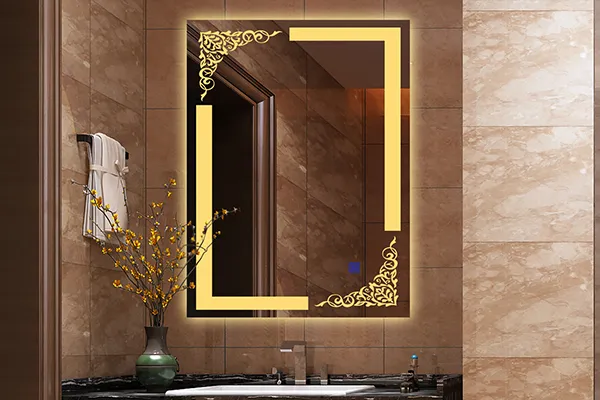
Where Teruier Wins
I keep suppliers who can translate: design → manufacturable spec → stable delivery. That’s the real job behind hospitality mirror supply.
Teruier’s edge is exactly that coordination muscle—especially when you’re building programs that include anti-fog LED mirrors, consistent packaging, and OEM repeatability for KSA timelines.
Because in hospitality, the goal isn’t “a beautiful mirror.”
It’s a mirror that never becomes the reason the opening date slips.



